
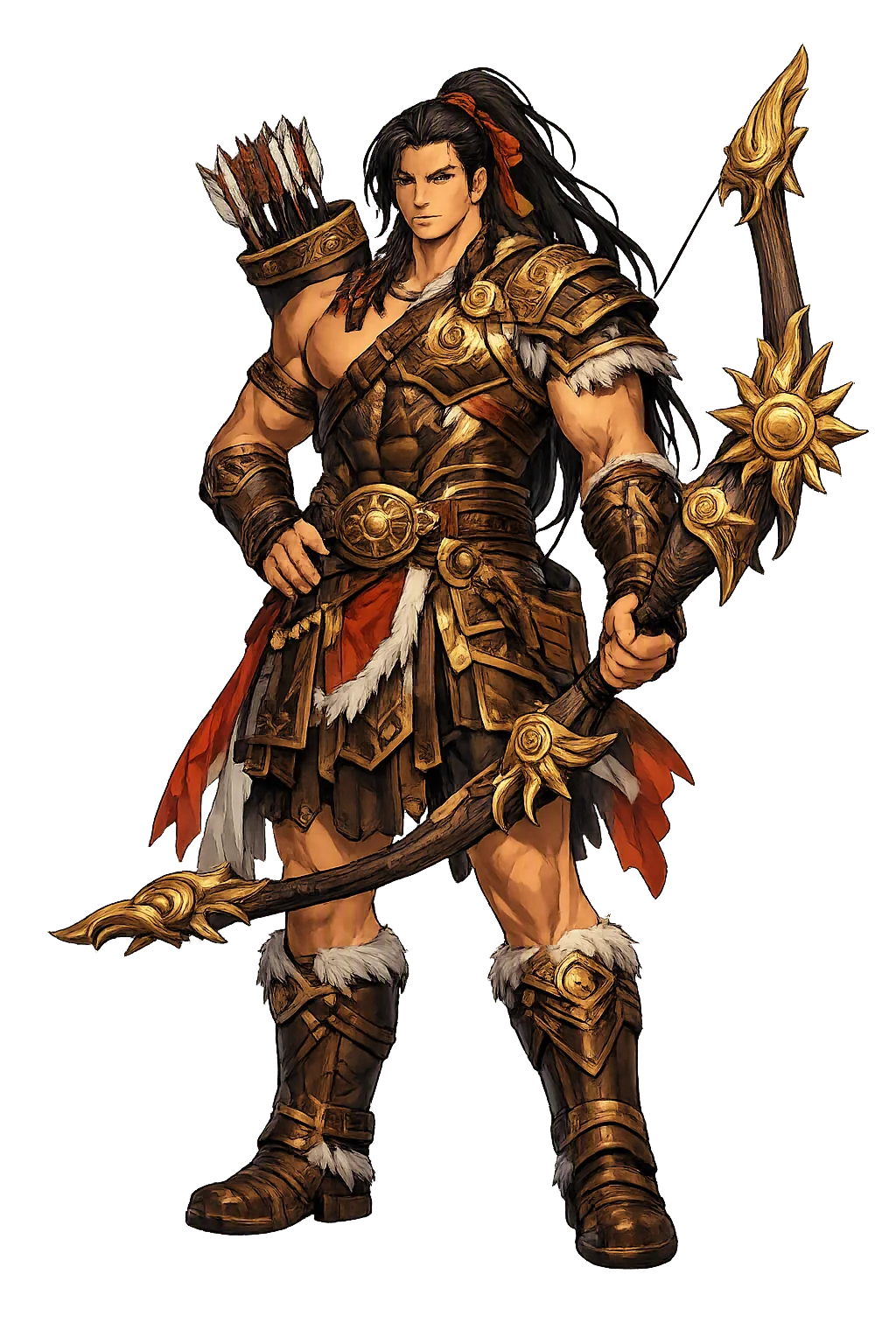
Hòuyì: the stories first, then the spelling
The marks in Hòuyì make the most sense standing next to the myths they have to carry. So the myths come first.
The Stories That Carry the Name
The Shooting of the Nine Suns. In the reign of Emperor Yáo, the ten suns — three-legged crows roosting in the Fusang tree, sons of Dìjùn and the sun-mother Xīhé — abandoned their orderly rotation and rose together. The earth burned: rivers dried, crops withered, and the people starved. Yáo called on Hòuyì, the divine archer, who climbed to the heights and loosed his arrows.
The Clearing of the Monsters. The drought had loosed terrors on the world, and the Huáinánzǐ lists the archer's second labor: he slew Yàyǔ, the man-eating beast of the wilds; Záochǐ in the waters of Chouhua; Jiǔyīng, the nine-headed monster of the Xiong river; the great wind-bird Dàfēng in the marshes of Qingqiu; the giant serpent Xiūshé at Lake Dongting; and the monstrous boar Fēngxī in the mulberry groves of Sanglin. Only when the last beast fell could the people plow in peace.
The Elixir and the Flight of Cháng'é. For his service, Xīwángmǔ, Queen Mother of the West, granted Hòuyì the elixir of immortality. He brought it home — and there the story turns. His wife Cháng'é took the elixir and rose to the moon, leaving the archer mortal and alone on the earth he had saved.
And Here Is What the Spelling Preserves
Against those stories, the attestation: 后羿, in the attestation Shān Hǎi Jīng (Classic of Mountains and Seas) and Huáinánzǐ give us. The name means "The divine archer who shot down nine suns".
The restoration keeps 2 features the ASCII form houyi cannot show:
- o → ò — Stress on o: where the voice peaks.
- i → ì — Stress on i: where the voice peaks.
A storyteller pronouncing the name would restore every one of them by instinct. The file only writes down what the voice already knows.
At a Glance
- Restored name: Hòuyì
- ASCII form: houyi
- Meaning: "The divine archer who shot down nine suns"
- Domain of influence: Archery, Suns, Heroism
- Pantheon: Chinese
- Classification: Tier 1
- Original script: 后羿
- Series: The Restoration Files, No. 115 of 287
The Name Travels
Hòuyì's myth traveled with Chinese civilization itself. In Japan the story of the archer and the ten suns was known through Chinese texts and pictorial art, where it informed depictions of solar catastrophe alongside native Amaterasu lore; Korea received the cycle through the same classical canon, and its own founding archer figure Jumong — whose very name is glossed as 'skilled archer' — shows how deeply the archer-hero type resonated on the peninsula.
The Address It Earned
The temple of Hòuyì stands at /sites/houyi/ — lore, scholars, patterns — because a name carrying this much story deserves more than a parking page. The restoration preserves more than the ASCII form can express — stress, length, or a letter the Latin keyboard lost — which places it, mechanically, in Tier-1.
The Sources Are Open
The myths above are retold from the temple's record; the primary voices are in the Sacred Texts: Tao Te Ching. Nothing in this file outranks them.
The File Continues
Read the founding dispatch for the name's full story, the Resonance File for the archetype at work — or the whole archive in one sitting.
Continue the series — previous file: Ḥr (read it here) · next file: Ḥꜥpy (read it here).
The Restoration Files are written from the same canonical record as the temples themselves: the lexicon, the lore catalog, the pattern atlas, and the cited scholarly sources. If a file ever disagrees with its temple, the temple is right — tell us, and the file will be corrected.