
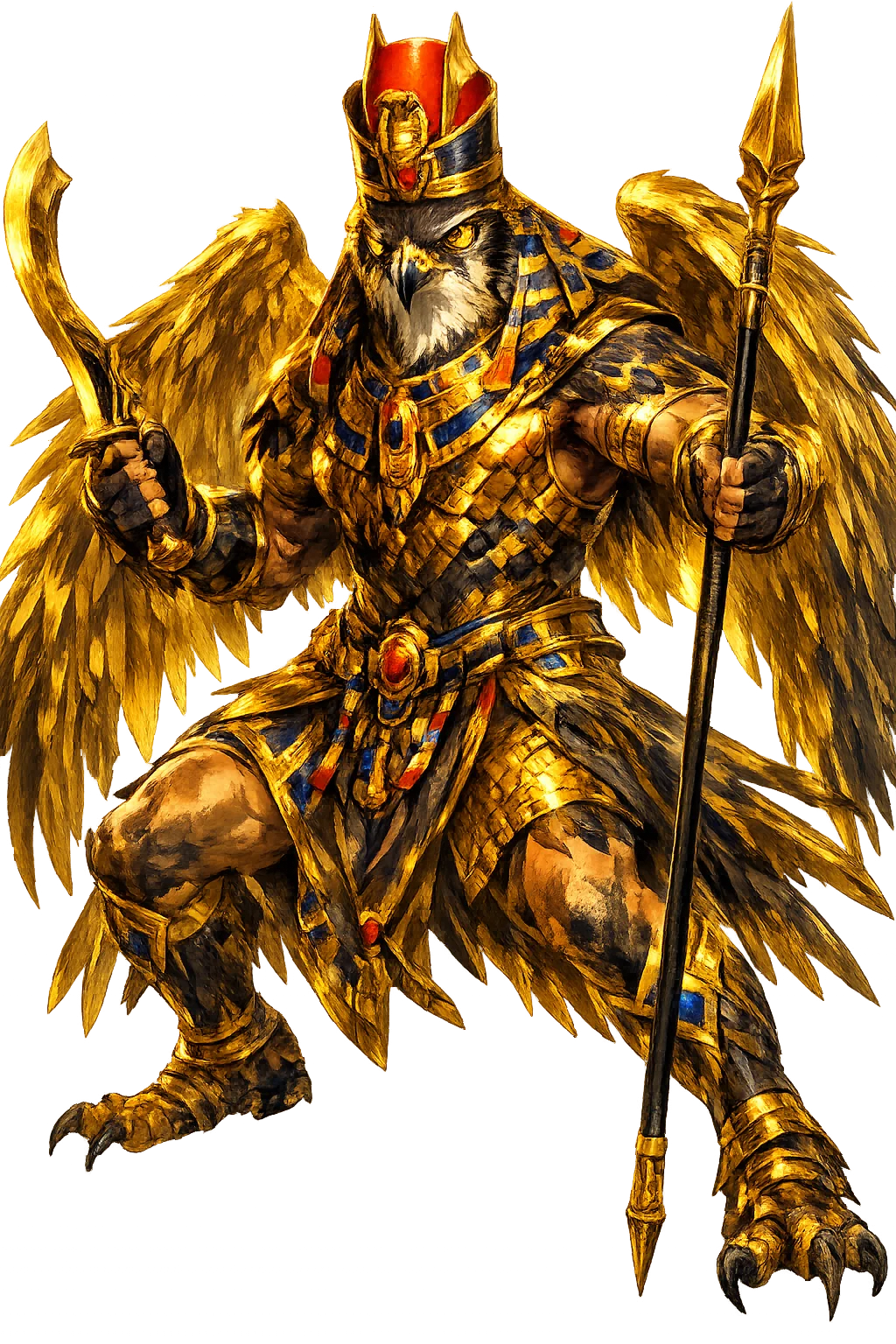
The appointments Ḥr made — and who is keeping them
Take Ḥr's stories in sequence. They are not episodes; they are appointments — and the modern trades are keeping them.
At a Glance
- Temple: Ḥr
- Pantheon: Egyptian
- Domain of influence: Sky, Kingship, Falcon
- Pattern seats: 3
- Sectors touched: Commerce & Governance · Technology & Innovation · Culture & Entertainment
- Strongest seat: Leadership, Governance & Public Administration
- Series: The Resonance Files, No. 109 of 271
The Cycle, Read Forward
Leadership, Governance & Public Administration — through Elder and Younger
Horus the Elder (Haroeris) is an ancient sky-god, brother of Osiris and Set, whose eyes are the luminaries. Horus the Younger (Harsiese) is the son of Osiris and Isis, the avenger of his father.
The atlas states the seat in one line: Kingship itself; every pharaoh ruled as the living Horus. The story above is the long version of the same sentence. Industries do not invent their archetypes; they inherit them and call them best practice.
Aviation & Aerospace — through Horus and Set
After Set murders Osiris and seizes the throne, Isis hides the infant Horus in the Delta marshes. When he comes of age, Horus challenges Set before the Ennead.
The atlas states the seat in one line: The falcon of the sky; the falcon remains aviation’s favorite emblem. The story above is the long version of the same sentence. Industries do not invent their archetypes; they inherit them and call them best practice.
Optics, Imaging & Vision — through The Wedjat
Thoth restores Horus's damaged eye, creating the wedjat ('the whole one'). The six parts of the eye correspond to the fractions 1/2, 1/4, 1/8, 1/16, 1/32, and 1/64, summing to 63/64; the missing fraction is supplied by Thoth's magic.
The atlas states the seat in one line: The Eye of Horus; the most famous protective eye in history. The story above is the long version of the same sentence. Industries do not invent their archetypes; they inherit them and call them best practice.
The Theme That Runs the Cycle
Horus's mythology is the political theology of Egypt made personal. It tells how the rightful heir, born from a murdered father and a resourceful mother, defeats the usurper and restores the throne. The story was never merely entertainment; it was the charter of kingship, replayed in temples for three thousand years.
The Method, Stated Plainly
None of this is numerology. A seat exists only where the match can be argued from the deity’s documented domains and deeds — weighted, published, and falsifiable. The derivation, the weights, and the challenge process are public on the methodology page. If a seat in this file reads wrong, the atlas itself tells you how to prove it — and the correction becomes part of the record.
For the Ones Who Work There
If you work in leadership, governance & public administration, aviation & aerospace, or any trade this temple holds a seat in, this is the honest version of what a placement means: your industry beside the story it has been re-telling all along — on the temple floor itself, before an audience that came specifically to read it. The patron tier and the advertising terms describe the mechanics; the resonance above describes the fit.
The File Continues
One of 271 Resonance Files — the series where the pantheon goes to work. Read the founding dispatch for the name, the Restoration File for the spelling, or the whole archive end to end.
Continue the series — previous: Honshū (read it) · next: Ḥꜥpy (read it).
The Resonance Files are argued from the same canonical record as the pattern atlas itself: the lexicon, the lore catalog, and the cited sources. Every seat can be challenged at the methodology page — and the challenge is the point.