The Authentic Orthography
Sky, Kingship, Falcon · The Distant One (Egyptian ḥr)
Unicode restoration and ASCII comparison
𓅃
The name in its original Egyptian form. Ḥr (𓅃) is attested in the source tradition — “The Distant One (Egyptian ḥr)”. Its emphatic consonants carry the full phonetic and orthographic weight of the source tradition.
horus
Reduced to plain horus, the name loses everything that made it specific: emphatic consonants. What remains is an ASCII string that machines can parse but that no longer speaks with its original voice.
Ḥr
The Unicode restoration recovers what ASCII flattened. Ḥr restores emphatic consonants, returning the name to its original written dignity. The domain encodes to Punycode, but the browser displays the truth.
Ḥr.com → xn--r-xnm.com
The non-ASCII characters in Ḥr are encoded while the ASCII remains visible. To the DNS, it is Punycode. To humanity, it is Ḥr.
How Ḥr travels from ancient script to the modern URL
Egyptian Ḥr; the original vocalisation is unknown. The name probably means “the distant/far one", perhaps referring to the soaring falcon.
Sky, Kingship, Falcon
The Unicode restoration Ḥr uses Egyptological characters registrable in .com; hieroglyphs are outside the .com IDN table.
How Ḥr was spoken
Sky · Kingship · Falcon
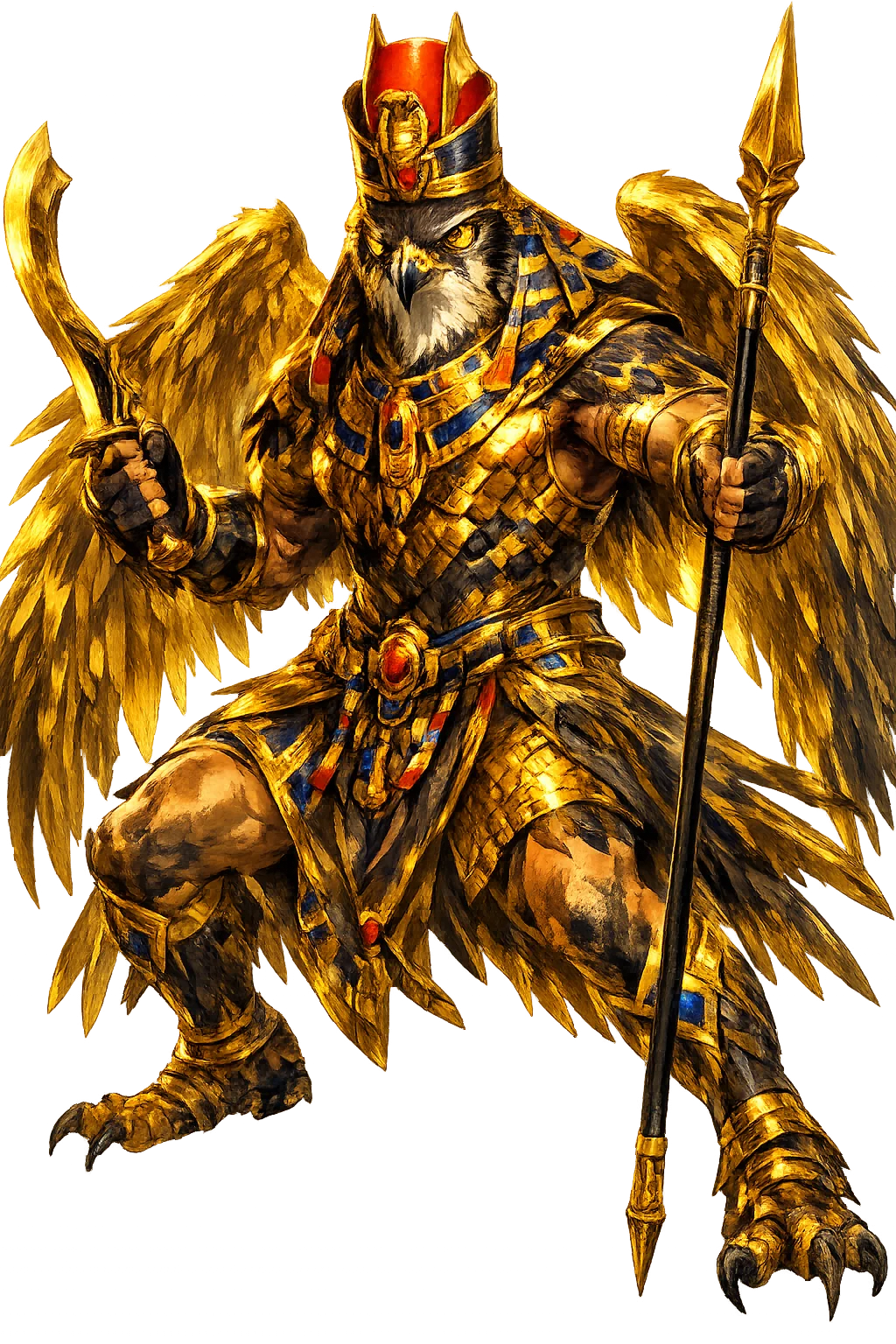
Ḥr is the falcon of the sky, whose eyes are the sun and the moon, whose wings outspread are the heavens, and whose incarnation on earth is the living pharaoh. He is not one god but a constellation of related gods — Horus the Elder, the primordial sky; Horus the Younger, son of Osiris and Isis; and Re-Horakhty, the solar synthesis. Through all his forms he stands for one thing: legitimate authority defending cosmic order against chaos.
Horus soars across the heavens; his right eye is the sun, his left the moon, and his body the luminous air.
Every pharaoh is the 'Living Horus'; the Horus-name is the first and oldest of the five royal names.
The lanner or peregrine falcon — swift, far-seeing, and deadly — is Horus's living embodiment.
The restored eye of Horus is Egypt's supreme symbol of protection, wholeness, and royal health.
Stories of Ḥr
Horus's mythology is the political theology of Egypt made personal. It tells how the rightful heir, born from a murdered father and a resourceful mother, defeats the usurper and restores the throne. The story was never merely entertainment; it was the charter of kingship, replayed in temples for three thousand years.
Horus the Elder (Haroeris) is an ancient sky-god, brother of Osiris and Set, whose eyes are the luminaries. Horus the Younger (Harsiese) is the son of Osiris and Isis, the avenger of his father. Over time these figures merged, so that the Horus of Edfu is simultaneously the primordial falcon and the royal heir. The Egyptians themselves were not always precise about the distinction; what mattered was the constellation of meanings gathered under the name.
After Set murders Osiris and seizes the throne, Isis hides the infant Horus in the Delta marshes. When he comes of age, Horus challenges Set before the Ennead. Their contest lasts eighty years, filling the satirical Contendings of Horus and Set with trials, tricks, and humiliations. Set tears out Horus's left eye; Horus castrates Set. Finally the tribunal rules for Horus, establishing that legitimate succession triumphs over brute force.
Thoth restores Horus's damaged eye, creating the wedjat ('the whole one'). The six parts of the eye correspond to the fractions 1/2, 1/4, 1/8, 1/16, 1/32, and 1/64, summing to 63/64; the missing fraction is supplied by Thoth's magic. The eye thus becomes a symbol of wholeness recovered, and its image is worn on amulets by the living and painted on mummies for the dead.
From the earliest dynasties, the pharaoh was the living Horus. Upon death he became Osiris; his successor became the new Horus. This cycle bound every reign to the original mythic victory and made the king responsible for maintaining ma'at against the chaos that Set represents. The festival at Edfu annually re-enacted Horus's triumph, renewing the cosmos by re-enacting its founding.
Horus is the god of the long view. The falcon sees what the ground-dweller cannot; the king must see beyond his own reign. To call on Horus is to remember that authority is not merely power but rightfulness — the triumph of ma'at over isfet, of inheritance over usurpation, of the whole over the torn.
Enter Extended Lore