
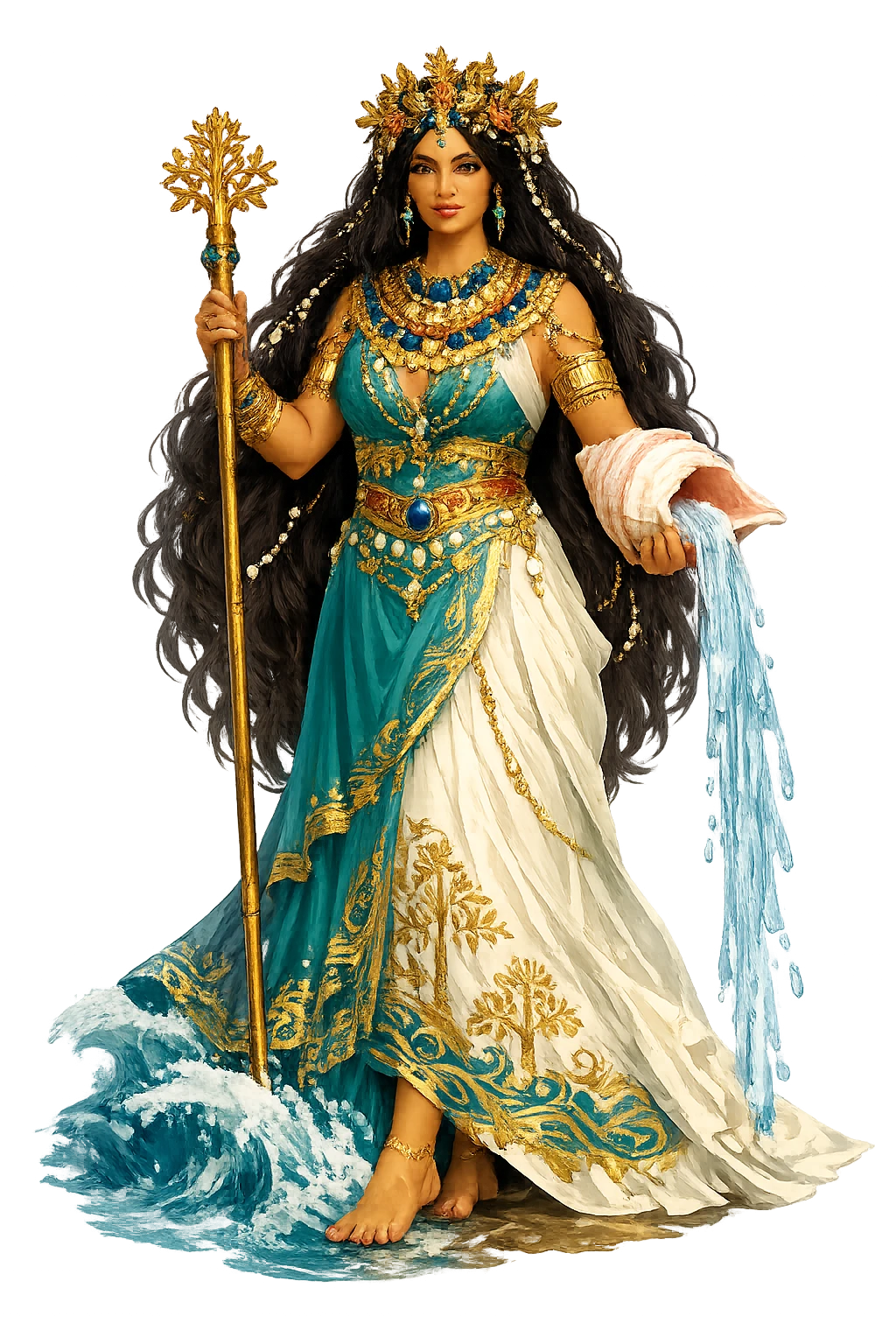
ʾAṯiratu: the stories first, then the spelling
The marks in ʾAṯiratu make the most sense standing next to the myths they have to carry. So the myths come first.
The Stories That Carry the Name
A Palace for Baʿlu. In KTU 1. 4 the storm-god Baʿlu has defeated Yammu but has no house — and no standing — among the gods. The queen mother acts.
The Seventy Sons and the Succession. The tablets call her qnyt ʾilm, 'Creatress of the Gods', and the pantheon itself 'the seventy sons of ʾAṯiratu'. When Baʿlu lies dead in the realm of Môtu, it is to her that ʾIlu turns: let one of your sons be made king. She names ʿAṯtaru the Radiant, who climbs Baʿlu's throne on Mount Ṣāpānu — and cannot fill it: his feet do not reach the footstool, his head does not reach the top, and he steps down.
The Vow of King Keret. In KTU 1. 14–1. 16 the childless King Keret marches on Udum to win the bride Ḫurriyu, and on the road he stops at the shrine of 'ʾAṯiratu of the Tyrians and the goddess of the Sidonians'.
And Here Is What the Spelling Preserves
At a Glance
- Restored name: ʾAṯiratu
- ASCII form: athiratu
- Meaning: "‘Lady of the Sea’ — the Ugaritic mother of the gods (rbt ʾaṯrt ym), consort of ʾIlu and intercessor for Baʿlu, KTU"
- Domain of influence: Lady of the Sea, Mother of the Gods
- Pantheon: Canaanite
- Classification: Tier 1
- Original script: 𐎀𐎘𐎗𐎚
- Series: The Restoration Files, No. 43 of 271
The Name Travels
West Semitic speakers carried her under shifted sounds. In Phoenician the interdental ṯ becomes š, and she is ʾAšeratu — the form the Septuagint's translators carry into Greek as ἄλση, 'groves', and Ἀσήρα.
The Address It Earned
The temple of ʾAṯiratu stands at /sites/athiratu/ — lore, scholars, patterns — because a name carrying this much story deserves more than a parking page. The restoration preserves more than the ASCII form can express — stress, length, or a letter the Latin keyboard lost — which places it, mechanically, in Tier-1.
The Sources Are Open
The myths above are retold from the temple's record; the primary voices are in the Sacred Texts: Enūma Eliš. Nothing in this file outranks them.
The File Continues
Read the founding dispatch for the name's full story, the Resonance File for the archetype at work — or the whole archive in one sitting.
Continue the series — previous file: Athēnai (read it here) · next file: Atlantís (read it here).
The Restoration Files are written from the same canonical record as the temples themselves: the lexicon, the lore catalog, the pattern atlas, and the cited scholarly sources. If a file ever disagrees with its temple, the temple is right — tell us, and the file will be corrected.