
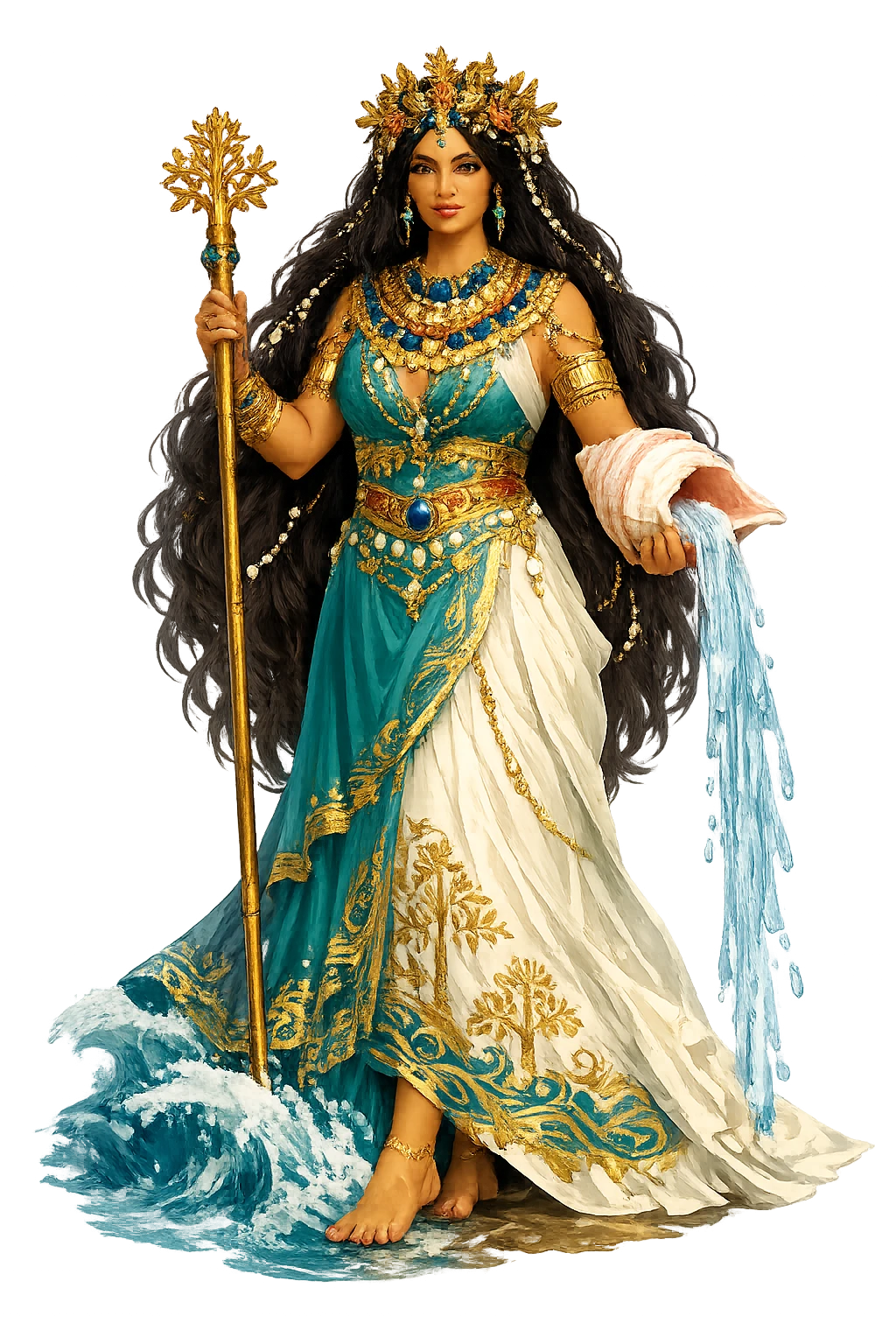
How ʾAṯiratu kept her interdental
In 2026, names are treated as data points. ʾAṯiratu is a reminder that they are also fossils — that a single letter can carry three thousand years of sound change, palace politics, and polemic. The Ugaritic mother of the gods wrote her name with an interdental consonant that English still owns and that Phoenician and Hebrew traded away; the web simply made keeping it actionable. What follows is the full scholarly picture, followed by the engineering compromise that lets a restored spelling live at a real address.
At a Glance
- Restored name: ʾAṯiratu
- ASCII form: athiratu
- Meaning: "Lady of the Sea" — the Ugaritic mother of the gods (rbt ʾaṯrt ym)
- Domain of influence: Lady of the Sea, Mother of the Gods
- Pantheon: Canaanite
- Classification: Tier 1
- Original script: 𐎀𐎘𐎗𐎚 (Ugaritic)
- Live domain: aṯiratu.com
Overview
ʾAṯiratu (athiratu) — Lady of the Sea, Mother of the Gods · the Ugaritic mother of the gods (rbt ʾaṯrt ym) — belongs to the Canaanite tradition, where she is catalogued under the domain "Lady of the Sea, Mother of the Gods".
She is the consort of the high god ʾIlu, the Creatress of the Gods (qnyt ʾilm) whose seventy sons fill the divine council, and the court's one reliable intercessor: when Baʿlu needs a palace, it is ʾAṯiratu who rides to ʾIlu's tent and wins the decree (KTU 1.4 III–V).
PuniCodex restores the name as ʾAṯiratu and serves its temple at aṯiratu.com. The restoration preserves at least one distinctive feature — a diacritic or a distinctive letter — that the ASCII form loses, which places the name in Tier 1. The plain ASCII form athiratu survives as a modern convenience imposed by the early domain-name system; the restoration, not the fallback, is the form the project defends as philologically complete.
The Name
The name is attested in Ugaritic as 𐎀𐎘𐎗𐎚 — four signs of alphabetic cuneiform, read a-ṯ-r-t and vocalized ʾAṯiratu with the nominative case-ending. Her full court style runs rbt ʾaṯrt ym, "the Great Lady who walks on the Sea".
The ASCII form athiratu survives only because the early domain-name system could not carry diacritics; it is a technological compromise, not an ancient spelling. Worse, the scholarly Latin convention "Athirat" inserts an h to hint at a letter no Ugaritic sign writes. The restoration ʾAṯiratu recovers the name's two distinctive features directly in the address bar: the glottal onset ʾ (ʾalep) and the underdotted ṯ, the voiceless interdental /θ/ of English "thin".
The project holds the domain aṯiratu.com (xn--airatu-w17b.com) as the canonical home of this name.
The Original Script
The name is written in Ugaritic as 𐎀𐎘𐎗𐎚. Ugaritic is an alphabetic cuneiform of thirty signs, impressed in clay at Ras Shamra between roughly 1400 and 1190 BCE and written left-to-right — unusual for a Semitic script. Its three ʾalep signs carry vowels, so the first sign of her name already fixes the a.
Pronunciation
The reconstructed pronunciation of the name is /ʔaθ.i.ˈraː.tu/ — Ugaritic Reconstruction.
For the modern speaker, the closest approximation is: ah-thi-RAH-too — the th is the soft interdental of "thin", with the stress on the long third syllable.
Kindred and historical forms of the name:
- Ugaritic — 𐎀𐎘𐎗𐎚 (ʾaṯrt)
- Phoenician — 𐤀𐤔𐤓𐤕 (ʾšrt, Ašeratu)
- Hebrew — אֲשֵׁרָה (ʾĂšērāh)
- Owned form — ʾAṯiratu
The second consonant is the whole story. Ugaritic ṯ is /θ/, the sound English keeps in "thin". Across Phoenician and Hebrew the interdental shifted to the sibilant š, so the same goddess is Ašeratu at Tyre and ʾĂšērāh in the Bible; only Arabic (ث) and Ugaritic keep the older sound.
Mythology
ʾAṯiratu rarely fights; she decides. Her scenes in the tablets show the queen mother at work — approached by the younger gods, saddling her donkey, speaking in the high god's tent, and settling what thunder cannot.
A Palace for Baʿlu (The Baal Cycle)
In KTU 1.4 the storm-god Baʿlu has defeated Yammu but has no house — and no standing — among the gods. The queen mother acts. She has her servant Qōdēšu-wa-ʾAmruru saddle her donkey, rides to the source of the two rivers, to ʾIlu's tent. ʾIlu sees her coming and is glad; the banquet is spread, the request is made, and the decree is given: let a house be built for Baʿlu like the gods'. Without her embassy the storm-god stays homeless.
The Seventy Sons and the Succession (The Baal Cycle)
The tablets call her qnyt ʾilm, "Creatress of the Gods", and the pantheon itself "the seventy sons of ʾAṯiratu". When Baʿlu lies dead in the realm of Môtu, it is to her that ʾIlu turns: let one of your sons be made king. She names ʿAṯtaru the Radiant, who climbs Baʿlu's throne on Mount Ṣāpānu — and cannot fill it: his feet do not reach the footstool, and he steps down. Even the succession is hers to attempt.
The Vow of King Keret (The Keret Epic)
In KTU 1.14–1.16 the childless King Keret marches on Udum to win the bride Ḥurriyu, and on the road he vows at the shrine of "ʾAṯiratu of the Tyrians and the goddess of the Sidonians": if he brings the woman home, he will pay her measure in silver and gold. He wins the bride — and forgets the vow. Sickness follows, and the epic's third tablet turns on the queen mother's unpaid debt. Kings swear to her; she collects.
She Who Treads the Sea (The Lady)
Her great title rbt ʾaṯrt ym is read "the Great Lady who walks on the Sea" — and by some scholars, "she who treads on the sea-dragon". Her servant is called dgy ʾaṯrt, "fisherman of ʾAṯiratu", and rows her messages across the deep; and in the Keret Epic the royal heir is promised to "suck the milk of ʾAṯiratu, the breasts of the Virgin ʿAnatu" — the queen mother's milk legitimates a king of Ugarit.
Symbols & Iconography
The iconography associated with ʾAṯiratu concentrates in a small set of recurring attributes:
- The sea — ym, the waters she treads and rules; the title rbt ʾaṯrt ym made permanent
- The spindle — the queen mother's domestic sovereignty, women's work raised to cosmic office
- The saddled donkey — the beast her servant harnesses for the ride to ʾIlu's tent (KTU 1.4 iv)
No cult statue of ʾAṯiratu is known from Ugarit; her clearest ancient portrait is textual — the donkey, the servant holding the reins, the mother riding out to change a god's mind.
Epithets & Cult Titles
Her titles are all offices of the queen mother.
- qnyt ʾilm — "Creatress of the Gods"; the divine council is her brood.
- rbt ʾaṯrt ym — "the Great Lady who walks on the Sea"; her most famous style.
- qnyt ʾilm — "lamp of the gods"; the sanctuary-light of the divine household.
- ʾaṯrt ṣrm — "ʾAṯiratu of the Tyrians"; her coastal cult-title in the Keret Epic.
The Ugaritic Tablets
Her archive is the alphabetic corpus of Ras Shamra: the palace narrative (KTU 1.4 III–V), the banquet of "the seventy sons of ʾAṯiratu" (KTU 1.4 VI), the succession scene of KTU 1.6 I, and Keret's vow at her Tyrian shrine (KTU 1.14–1.16).
Archaeology & Evidence
No temple of ʾAṯiratu has been securely identified at Ugarit — the queen mother seems to have shared the acropolis cult of Baʿlu and ʾIlu. Her worship is stamped across the wider Iron Age Levant instead: the tree-and-lion iconography of the tenth-century Taanach cult stand, the hundreds of Judean pillar figurines, and above all the painted pithoi of Kuntillet ʿAjrud (c. 800 BCE) and the Khirbet el-Qom tomb inscription, with their blessings "by Yahweh … and his Asherah".
Realm & Domain
ʾAṯiratu is the great mother of the Ugaritic pantheon: consort of the high god ʾIlu, and the one deity who can walk into his tent and change his mind.
Creatress of the Gods
The whole divine council are "the seventy sons of ʾAṯiratu" — and she names their kings.
Lady of the Sea
rbt ʾaṯrt ym: she treads the Mediterranean that carried Ugarit's wealth, and her own servant is the divine fisherman.
The Intercessor
When Baʿlu needs a palace, it is ʾAṯiratu who rides to ʾIlu's tent and wins the decree.
Lamp of the Gods
qnyt ʾilm: the creatress of the gods — the mother whose presence illumines the court.
Across Cultures
West Semitic speakers carried her under shifted sounds. In Phoenician the interdental ṯ becomes š, and she is ʾAšeratu — the form Philo of Byblos hands to Greek readers as Ἀσερά. Hittite tablets know her as Ašertu, consort of Elkunirša, and Egyptian religion of the empire age venerates a figure many scholars identify with her as Qudšu, "Holiness".
Within the corpus, her closest kinships are the Canaanite household itself: [[baal|Baʿlu]], [[el|ʾIlu]], [[anat|ʿAnatu]], [[shapash|Šāpšu]], [[asherah|ꜥAsherah]], and [[aseratu|ʾAšeratu]].
In the Hebrew Bible
The Bible knows her as ʾĂšērāh — some forty occurrences, nearly all hostile. Deuteronomy forbids planting "an asherah, any tree" beside the altar (16:21); Gideon cuts down his father's asherah (Judges 6); Elijah's contest counts "the four hundred prophets of Asherah who eat at Jezebel's table" (1 Kings 18:19); and Josiah drags her image out of the temple to burn it at the Kidron (2 Kings 23:4–7). Whether the biblical ʾăšērîm are the goddess or her wooden cult-object is the standing question of the scholarship.
Cultural Legacy
Her afterlife is an argument the Bible could not win. The Deuteronomists reduced her to a planted pole, yet the prophets' rage testifies to a devotion that ran from Jezebel's table to the village oven. Twentieth-century archaeology turned polemic into attestation at Kuntillet ʿAjrud and Khirbet el-Qom; modern scholarship — Day, Hadley, Wiggins — rebuilt the queen mother from those shards; and feminist theology has reclaimed her as the divine feminine edited out of the Western canon.
The Scholarly Record
The account of ʾAṯiratu given in this edition rests on the witnesses and reference works listed below.
- Coogan & Smith, Stories from Ancient Canaan, 2nd ed., 2012.
- Day, Yahweh and the Gods and Goddesses of Canaan, 2000.
- Wyatt, Religious Texts from Ugarit, 2nd ed., 2002.
- Hadley, The Cult of Asherah in Ancient Israel and Judah, 2000.
- Wiggins, A Reassessment of Asherah, 1993.
- Smith, The Ugaritic Baal Cycle, 1994–2009.
A Meditation
ʾAṯiratu is the theology of the quiet word. The storm-god wins the battles; she wins the audience. Her power is the intercessor's power — the mother who rides to the high god's tent and comes home with the decree in her hand. She asks the question every house answers daily: when the thunder fails, whose voice does the king still trust?
The Unicode Restoration
ʾAṯiratu is classified as Tier 1: the restoration preserves at least one distinctive feature — a diacritic or a distinctive letter — that the ASCII form loses. Here the feature is doubled: the glottal letter ʾ and the underdotted ṯ, an interdental consonant that two millennia of sound change erased from the name's later forms. The ASCII fallback athiratu still resolves everywhere, but it is the restored form that carries the name's full information. That is the whole thesis of this temple: the marks are the message.
Character by Character
The journey from athiratu to ʾAṯiratu, one character at a time:
- a → ʾA — Glottal onset (ʾalep)
- t → ṯ — Underdotted t: /θ/
- h → — — The h of the Latin convention, unwritten in Ugaritic
- i → i — Same
- r → r — Same
- a → a — Same
- t → t — Same
- u → u — Same
The Domain Name
The restored name is live as a working domain: aṯiratu.com resolves today and routes to this temple — carried by the DNS in punycode form as xn--airatu-w17b.com, an ASCII-compatible encoding that lets a non-ASCII name travel the global network. The visitor sees ʾAṯiratu; the machines see the encoding.
The Canaanite Pantheon
ʾAṯiratu is one of 14 entries the PuniCodex lexicon catalogues under the Canaanite pantheon. The Pantheon page gathers the tradition's major figures in one place, and the Lexicon lets you filter all 927 restorations by tradition, tier, or script.
Frequently Asked Questions
What does ʾAṯiratu mean? The traditional gloss is "Lady of the Sea" — the Ugaritic mother of the gods, rbt ʾaṯrt ym.
Which tradition does ʾAṯiratu belong to? ʾAṯiratu is catalogued in the Canaanite pantheon of the PuniCodex lexicon.
Why is ʾAṯiratu classified as Tier 1? Because the restoration preserves at least one distinctive feature the ASCII form loses — here the glottal ʾ and the interdental ṯ.
Is ʾAṯiratu a working domain? Yes — aṯiratu.com resolves today and routes to this temple.
What is the punycode for aṯiratu.com? The DNS encoding is xn--airatu-w17b.com; browsers perform the translation automatically.
Typing ʾAṯiratu
You do not need a special keyboard to use this restoration. The PuniCodex Type Tool converts the ASCII form athiratu into ʾAṯiratu as you type. Copy the restored form, paste it into the address bar, and the DNS does the rest.
Sister Temples
The queen mother's household keeps its own temples in the corpus: ꜥAsherah, her Hebrew Bible form; ʾAšeratu, her Phoenician form; Baʿlu, the storm-god she championed; and ʾIlu, the high god whose tent she rides to. The temple itself lives at /sites/athiratu/.
Why This Restoration Matters
In 2026 the stakes are practical. Search indexes, language models, and localization pipelines all inherit whatever spelling the web normalizes — which means every Unicode domain is also a training signal. ʾAṯiratu teaches the machinery that the interdental still exists and that the restored spelling points to a real place. The infrastructure decides which names the future sees; this restoration makes sure it sees the whole name — ṯ and all.
Explore Further
This post is one doorway into the temple. The home page carries the full character breakdown and the ambient canvas; the lore page tells the myths in long form; the Scholarly Edition preserves the sources, pronunciation data, and revision history; and the patron wall supports the restoration directly. For the wider map, browse the Lexicon, explore the Pantheon, or return to the PuniCodex blog.
Related Names
Sources
The full scholarly apparatus — every citation, revision, and review — lives in the Scholarly Edition. Key references for this post:
- KTU 1.4 III–V (the palace intercession); KTU 1.6 I (the succession).
- KTU 1.14–1.16 (the Keret Epic: the vow and the suckling oracle).
- Coogan & Smith, Stories from Ancient Canaan.
- Day, Yahweh and the Gods and Goddesses of Canaan.
- Wyatt, Religious Texts from Ugarit.
- Lexicon authorities for this entry: KTU, Coogan, Day.