
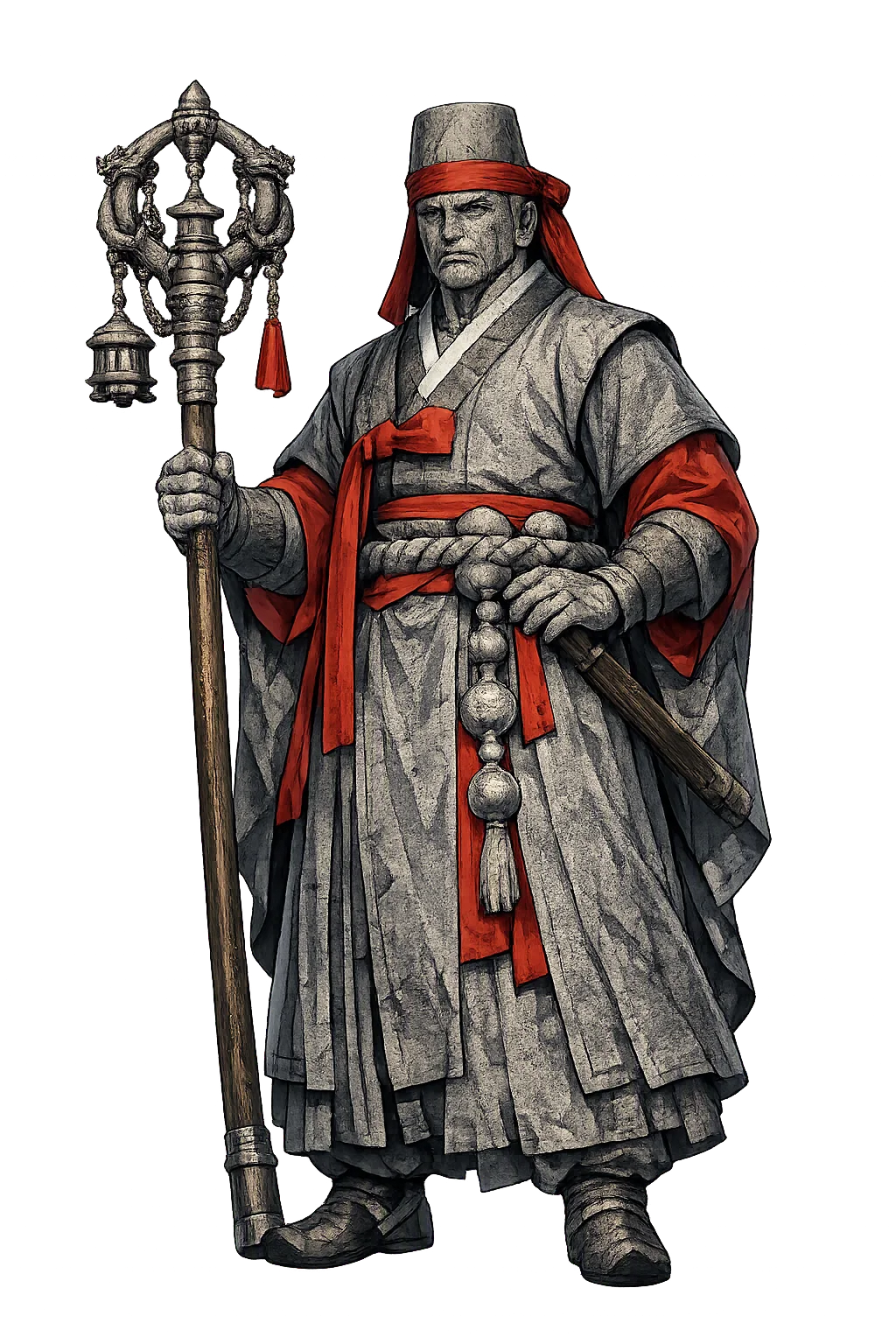
Why Seonangshin belongs in your address bar
Every address bar is a choice. When you type Seonangshin, you are not typing a novelty; you are restoring a name that the early DNS, built for English typewriters, could not carry. The plain ASCII form seonangshin is a leftover of that constraint, not the name itself. This post is the long version of the restoration: where the name comes from, how the Hangul + Hanja tradition wrote it, how it is pronounced, what the myths and the material record preserve, and why its Unicode form now lives as a working domain. The claim throughout is simple — the original spelling is not decoration. It is the name.
At a Glance
- Restored name: Seonangshin
- ASCII form: seonangshin
- Meaning: "Village spirit"
- Domain of influence: Village Guardian, Boundary
- Pantheon: Korean
- Classification: Tier 2
- Original script: 서낭신 (城隍神) (Hangul + Hanja)
Overview
Seonangshin (seonangshin) — Village Guardian, Boundary · Village spirit — belongs to the Korean tradition, where it is catalogued under the domain "Village Guardian, Boundary". The name means "Village spirit".
Seonangshin is the village guardian spirit who protects settlements, boundaries, and travellers from harm in Korean tradition. The name means "Village spirit" and belongs to the domain "Village Guardian, Boundary." Seonangshin is the spirit who guards the village boundary, usually honoured at a shrine near the entrance to the settlement. The deity is believed to protect the community from epidemics, disasters, war, and wandering malevolent forces.
PuniCodex restores the name as Seonangshin and serves its temple at its temple. The restoration needs no distinctive letters or diacritics its ASCII form would lose, which places the name in Tier 2. The plain ASCII form seonangshin survives as a modern convenience imposed by the early domain-name system; the restoration, not the fallback, is the form the project defends as philologically complete.
The Name
The name is attested in Hangul + Hanja as 서낭신 (城隍神). Etymologically it means "Village spirit".
The ASCII form seonangshin survives only because the early domain-name system could not carry diacritics; it is a technological compromise, not an ancient spelling. The Unicode restoration Seonangshin recovers the full diacritic detail of the scholarly transliteration directly in the address bar. The restoration needs no distinctive letters or diacritics its ASCII form would lose, which places the name in Tier 2.
The letter-by-letter transformation runs:
- s → S — Same, capitalized
- e → e — Same
- o → o — Same
- n → n — Same
- a → a — Same
- n → n — Same
- g → g — Same
- s → s — Same
- h → h — Same
- i → i — Same
- n → n — Same
The Original Script
The name is preserved in Hangul + Hanja as 서낭신 (城隍神) — Korean alphabet + Chinese characters, attested Modern Korean, in Korea. The script is written left-to-right.
The scholarly transliteration is Seonangsin (Revised Romanization), giving the normalized reading /sʌ.naŋ.ɕin/.
The rendering proceeds step by step:
- Hangul 서낭신 with Hanja 城隍神 — the village guardian
Korean names may be written in Hangul, the indigenous Korean alphabet, and sometimes in Hanja, the Sino-Korean character set. For Seonangshin, the Hangul form is 서낭신 and the Hanja form is 城隍神. Hangul ‘서낭신’ and Hanja ‘城隍神’ (Seonghwangsin in Sino-Korean reading); the figure is also called Dongbaek Seonang or Dodangsin in regional cults. The ASCII form seonangshin is a technological compromise; the capitalised restoration Seonangshin is the scholarly citation form.
Pronunciation
The reconstructed pronunciation of the name is /sʌ.naŋ.ʃin/ — Korean Reconstruction.
Phoneme by phoneme:
- sʌ — The first syllable of Seonangshin, carrying primary stress in the romanised form.
- naŋ — The middle syllable or element, pronounced with level pitch in Korean.
- ʃin — The final syllable, often closing in a nasal or simple vowel in the Korean reading.
For the modern speaker, the closest approximation is: 'suh-NAHNG-sheen' — The first vowel is a mid back unrounded vowel; the second syllable contains a velar nasal. The name is the Korean reading of the Sino-Korean term for a city-moat guardian deity.
Kindred and historical forms of the name:
- Hangul — 서낭신 — the Korean script form.
- Hanja — 城隍神 — the Sino-Korean character form.
The first vowel is a mid back unrounded vowel; the second syllable contains a velar nasal. The name is the Korean reading of the Sino-Korean term for a city-moat guardian deity.
Mythology
The mythology of Seonangshin is preserved in Korean oral tradition, shamanic ritual texts, and classical sources such as the Samguk Yusa. The narratives are not merely stories; they encode social values, ritual obligations, and relationships between humans, nature, and the sacred. Some details vary by region and by shamanic lineage.
The Shrine at the Village Gate (Village cult)
Every traditional village had a seonangdang, a small shrine at the boundary where the village met the wilderness. Offerings of rice wine, cloth, and prayers were made there to keep disease and disaster outside the community.
Guardian of the Threshold (Boundary myth)
Seonangshin was imagined as a warrior or official who patrolled the margins of settlement. People passing through the boundary bowed or left a small offering to ensure safe travel and to avoid offending the guardian.
The Dongje Festival (Communal rite)
Village communal rites (dongje) gathered the entire community at the seonangdang. The rite renewed the covenant between the village and its guardian, strengthening social solidarity and collective protection.
Symbols & Iconography
The iconography associated with Seonangshin concentrates in a small set of recurring attributes, each a compressed statement about the name:
- Seonangdang shrine — The physical boundary shrine where the village meets the wild.
- Geumjul sacred rope — A straw rope that marks sacred space and wards off pollution.
- Jangseung and sotdae — Guardian posts and bird-topped poles that announce the protected boundary.
- Village tree — A great tree believed to be the residence or companion of the guardian spirit.
Archaeology & Evidence
No monument, inscription, or artifact in the current PuniCodex corpus is yet assigned to Seonangshin with certainty. That absence should be read honestly: for a Korean name of this type the material record is expected to be thin, and the primary evidence remains the textual testimony gathered in the Scholarly Sources section.
Were such evidence to surface, it would take recognizable forms: votive or dedicatory inscriptions naming 서낭신 (城隍神), sanctuary or cult remains tied to village guardian and iconography matching its traditional attributes (seonangdang shrine and geumjul sacred rope). Each candidate would be weighed against the reconstructed form of the name before entering the scholarly record.
Realm & Domain
Seonangshin is the village guardian spirit who protects settlements, boundaries, and travellers from harm in Korean tradition. The name means "Village spirit" and belongs to the domain "Village Guardian, Boundary." Seonangshin is the spirit who guards the village boundary, usually honoured at a shrine near the entrance to the settlement. The deity is believed to protect the community from epidemics, disasters, war, and wandering malevolent forces.
Village Guardian
Seonangshin defends the settlement and its people from harm.
Boundary Shrine
The seonangdang marks the threshold between civilised space and the wild.
War and Protection
The spirit is invoked against invasion, epidemic, and disaster.
Community Rites
Annual dongje festivals renew the bond between village and guardian.
Across Cultures
Seonangshin sits at the intersection of indigenous Korean village guardian cults and the Sino-Korean city-god tradition. Confucian reformers promoted official worship of local tutelary deities, while shamanic practice preserved the older spirit cults at village boundaries. The figure also overlaps with military hero cults: generals who defended a region were sometimes posthumously honoured as seonangshin. Today the seonangdang survives as a heritage site, and the rites are sometimes revived as community festivals rather than as explicit religious worship.
Kindred figures in the PuniCodex cross-tradition index include Andvari, Kérberos, Fáfnir, Garmr, Goshin, and Médousa, each linked through guardian / protector.
Cultural Legacy
Seonangshin remains visible in Korean cultural landscapes: village guardian trees, stone cairns, jangseung posts, and restored seonangdang shrines appear in heritage villages such as Hahoe and Yangdong. The figure also informs Korean ideas of community, boundary, and collective responsibility. In a digital age, Seonangshin is sometimes invoked metaphorically to discuss online community safety and the guardianship of shared spaces.
The Scholarly Record
The account of Seonangshin given in this edition rests on the witnesses and reference works listed below. Lexica and etymological dictionaries secure the form and meaning of the name; the literary and religious texts supply the narrative evidence.
- Academy of Korean Studies, Cultural Landscapes of Korea (2013).
- National Folk Museum of Korea, Encyclopedia of Korean Folk Beliefs (2015).
- Grayson, James H., Korea: A Religious and Cultural History (Routledge, 2002).
A Meditation
Seonangshin invites reflection on the relationship between name, place, and identity. The restoration of the capitalised scholarly form is a small act of recognition: it marks the name as a proper noun of continuing significance in Korean culture and resists the flattening effect of ASCII-only domain names.
The Unicode Restoration
Seonangshin is classified as Tier 2: the restoration needs no distinctive letters or diacritics its ASCII form would lose. The ASCII fallback seonangshin still resolves everywhere, but it is the restored form that carries the name's full information. That is the whole thesis of this temple: the marks are the message.
Character by Character
The journey from seonangshin to Seonangshin, one character at a time:
- s → S — Same, capitalized
- e → e — Same
- o → o — Same
- n → n — Same
- a → a — Same
- n → n — Same
- g → g — Same
- s → s — Same
- h → h — Same
- i → i — Same
- n → n — Same
The Korean Pantheon
Seonangshin is one of 12 entries the PuniCodex lexicon catalogues under the Korean pantheon. The Pantheon page gathers the tradition's major figures in one place, and the Lexicon lets you filter all 980 restorations by tradition, tier, or script — the fastest way to see where this name sits among its kin.
Frequently Asked Questions
What does Seonangshin mean? The traditional gloss is "Village spirit."
Which tradition does Seonangshin belong to? Seonangshin is catalogued in the Korean pantheon of the PuniCodex lexicon.
Why is Seonangshin classified as Tier 2? Because the restoration needs no distinctive letters or diacritics its ASCII form would lose — and the marks in the restored spelling preserve exactly that evidence.
Can I use Seonangshin in a normal browser? Yes. The DNS resolves the punycode form automatically, and the type tool on this site converts seonangshin to Seonangshin for copying and pasting.
Where does the scholarly information come from? The entry is built from lexica, inscriptional evidence, and reviewed scholarly sources listed in the Scholarly Edition. Every claim is traceable to a canonical source.
Typing Seonangshin
You do not need a special keyboard to use this restoration. The PuniCodex Type Tool converts the ASCII form seonangshin into Seonangshin as you type, and the browser extension offers the same conversion inside any text field. Copy the restored form, paste it into the address bar, and the DNS does the rest.
Sister Temples
Other temples in the Korean pantheon include Yongwang, Hwanin, and Sosin — each with its own restoration story, its own scholarly record, and its own place in the lexicon.
Why This Restoration Matters
Restoring Seonangshin is part of a larger effort to make the web multilingual by default. The PuniCodex project does not ask users to learn a new alphabet; it asks the infrastructure to respect the alphabets that already exist. Every section of this post — the script, the sound, the myths, the evidence — converges on the same point: the marks in Seonangshin are information, and information deserves an address of its own. A single Unicode domain is a small proof, but it is a proof that scales: every name restored makes the next one easier, and every visit to the temple is a vote for the restored form.
Explore Further
This post is one doorway into the temple. The home page carries the full character breakdown and the ambient canvas; the lore page tells the myths in long form; the Scholarly Edition preserves the sources, pronunciation data, and revision history; and the patron wall supports the restoration directly. For the wider map, browse the Lexicon, explore the Pantheon, or return to the PuniCodex blog.
A Closer Look at the Marks
A restored name is a small map. In the case of Seonangshin, the map does not lead through diacritics or special letters, because the source tradition wrote the name in Hangul + Hanja rather than in the Latin alphabet. The ASCII form seonangshin and the restored form share the same letters; the restoration is a decision about which conventional spelling should serve as the public reference.
That decision is not cosmetic. The original script attestation carries semantic and phonetic information that no romanization can fully reproduce. By fixing one conventional spelling as the canonical domain form, the project prevents the drift that happens when a name is romanized differently in every article, map, and database. The breakdown still lists each character — s, e, o, n, a, n, g, s, h, i, n — so visitors can see exactly what is being carried forward and what is not. What looks like "no change" is, in fact, a deliberate choice to keep the name stable, searchable, and addressable.
Seonangshin in Its Tradition
Seonangshin does not stand alone. It belongs to the Korean tradition, where it is counted among 12 names in the PuniCodex lexicon. Its sphere — Village Guardian, Boundary — places it beside other figures who govern similar aspects of experience. The restored spelling is therefore not only a philological decision; it is a way of keeping the name in the company of its kin. When the address bar shows Seonangshin, it marks the boundary between a generic search term and a named entry in a living catalog of myth. That catalog is the point of the project. Every restored name is a vote for specificity: the web should know the difference between a figure and a keyword, between a tradition and a trend. Seonangshin is one such vote.
What You Will Find in the Temple
The temple page for Seonangshin is more than a landing page. The home tab presents the character breakdown, the pronunciation guide, and the live domain status in a single view. The lore tab gathers the myths and narratives that give the name its depth. The Scholarly Edition tab publishes the sources, variant forms, and review history that justify the restoration. Industry patterns show where the name appears in modern commerce and culture, while the gallery and creatives tabs collect visual and sponsor material. The patron wall lets visitors support the restoration directly. Each tab is generated from the same canonical sources, so the domain, the blog, the scholars page, and the search index all agree. The result is a single source of truth about a name, delivered through several doors.
The Restoration on the Live Web
A domain name is a kind of publication. When Seonangshin resolves, it proves that the restored spelling is not a theoretical exercise; it is a working address on the public internet. Search engines can index it, language models can encounter it, and anyone who copies it from a manuscript can paste it into a browser. That practical reality changes the status of the restoration. Before Unicode domains, a scholar could write the name correctly in an article while the public web flattened it to seonangshin. Now the public web can carry the correct form end to end. The punycode translation happens silently, so the infrastructure remains compatible while the visible name keeps its marks. That compromise — human-readable restoration, machine-readable encoding — is the foundation of every PuniCodex temple.
Restoration Notes
Restoring a name is not a single decision; it is a sequence of smaller decisions, each backed by a different kind of evidence. For Seonangshin, the chain begins with the attested form in Hangul + Hanja, continues through the standard scholarly romanizations, and ends with the DNS-compatible Unicode spelling used by this temple. The meaning "Village spirit" anchors the name in its semantic field; without that anchor, the marks would float free of the figure they name. The restored form Seonangshin and the ASCII form seonangshin share the same Latin letters; the restoration here is a conventional capitalization rather than a recovery of lost diacritics or special characters. Those adjustments are not arbitrary styling. They follow the tier rule that places Seonangshin in Tier 2: the restoration needs no distinctive letters or diacritics its ASCII form would lose. The rule is mechanical, not editorial, which means the same standard applies to every entry in the lexicon. A visitor who disagrees with the classification can at least see exactly which evidence produced it, because every step is recorded in the Scholarly Edition. That transparency is the difference between a restoration project and a branding exercise. The name is being put back, not invented.
Related Names
Sources
The full scholarly apparatus — every citation, revision, and review — lives in the Scholarly Edition. Key references for this post:
- Academy of Korean Studies, Cultural Landscapes of Korea (2013).
- National Folk Museum of Korea, Encyclopedia of Korean Folk Beliefs (2015).
- Grayson, James H., Korea: A Religious and Cultural History (Routledge, 2002).
- Standard Korean orthography.
- Lexicon authorities for this entry: Korean folklore, Shamanic texts.