
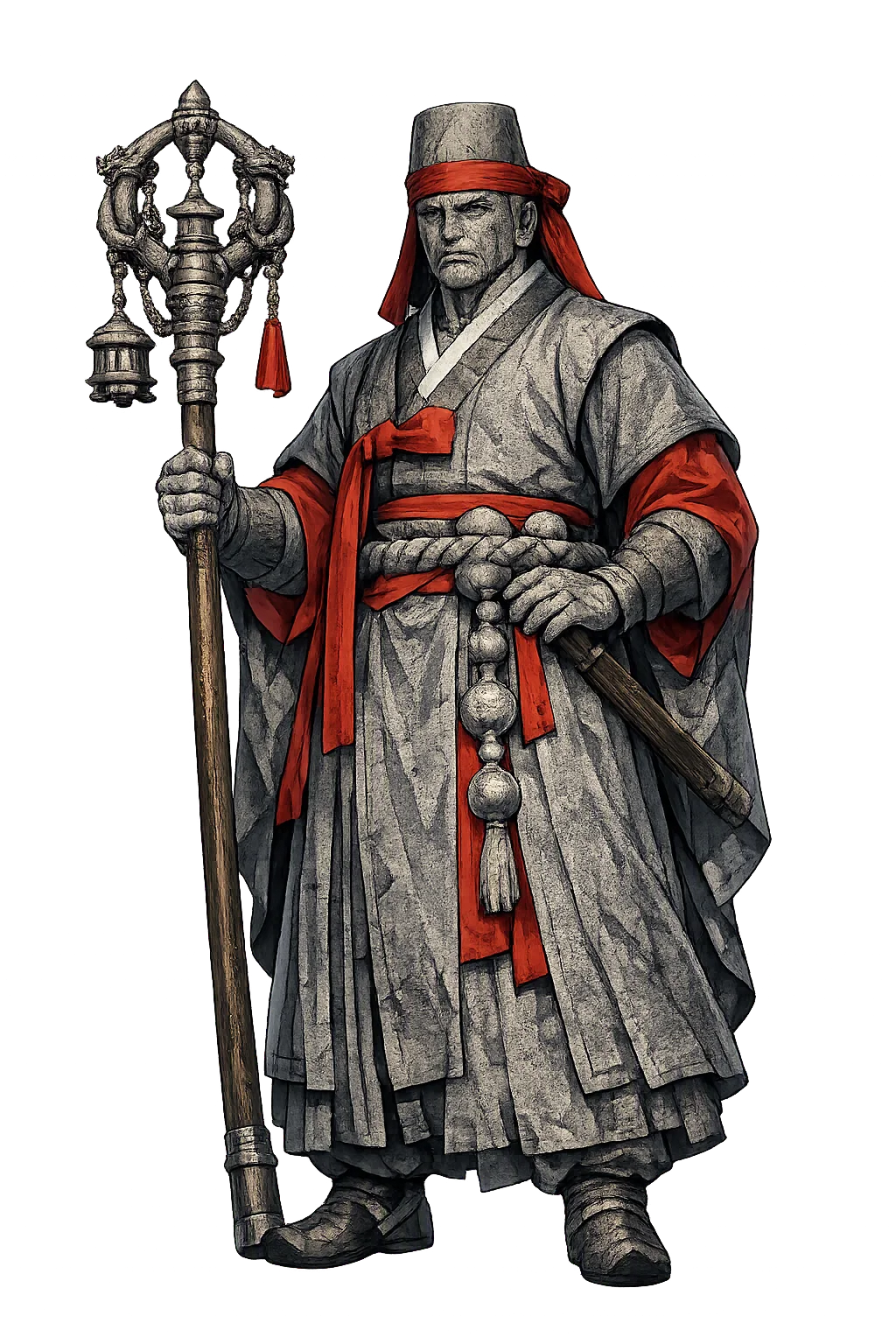
Seonangshin and the industries that were always telling its story
The myths did not retire. They moved offices. This is the file on where Seonangshin works now.
Seonangshin has no epic cycle; her mythology is the living archive of Korean village religion — boundary shrines, communal rites, and origin legends recorded in classical miscellanies such as the Samguk Yusa and the nineteenth-century Dongguk Sesigi, then catalogued by twentieth-century folklore surveys. The narratives vary by region and by shamanic lineage, and the record says so.
The pattern atlas — which maps every flagship temple to the industries its archetype demonstrably resonates with, each match argued and open to challenge — seats this temple in 3 industries. This file reads those seats the way they were earned: through the myths.
At a Glance
- Temple: Seonangshin
- Pantheon: Korean
- Domain of influence: Village Guardian, Boundary
- Pattern seats: 3
- Sectors touched: Society & Spirit · Culture & Entertainment
- Strongest seat: Education, Research & Knowledge
- Series: The Resonance Files, No. 433 of 548
The Myth at Work
The Shrine at the Village Gate. Every traditional Korean village kept a seonangdang, a small open shrine set where the settlement's paths met the fields — the precise point where cultivated space gave way to mountain and wild. The nineteenth-century miscellany Dongguk Sesigi (1849) describes the offerings made there: rice wine poured out, lengths of cloth hung, the season's first fruits presented, and prayers spoken to keep epidemic and disaster outside the settlement. — that is not just a story. It is a business model, four thousand years early.
Guardian of the Threshold. Korean village religion builds its boundary in visible grammar: the geumjul, a twisted straw rope hung with paper strips and dried gourds, declares sacred space; the jangseung, grinning wooden posts carved in the likeness of generals, stand sentinel at the paths; the sotdae, tall poles topped with carved birds, lift the village's wishes skyward. Seonangshin was imagined moving among these markers as a patrolling official or armed warrior, inspecting the fence between the human world and the wilderness. — that is not just a story. It is a business model, four thousand years early.
The Seats
Each of these is argued in the atlas with a weight and a why-line. What the atlas cannot fit in one line is the whole myth — so here is each seat with its story restored.
Education, Research & Knowledge
Schools, universities, and research institutions. (Sector: Society & Spirit)
Primary seat: Seonangshin embodies village guardian, boundary — the core of education. Swap the costume and the sentence is indistinguishable from the myth. That is what a resonance seat means.
Mythic Name Restoration
Scholarly Unicode restorations of mythic names for modern identity. (Sector: Culture & Entertainment)
Resonant seat: Seonangshin shares symbolic territory with mythic restoration. Swap the costume and the sentence is indistinguishable from the myth. That is what a resonance seat means.
Writing, Publishing & Media
Books, journalism, and content platforms. (Sector: Culture & Entertainment)
Resonant seat: Seonangshin shares symbolic territory with publishing media. — the atlas stops there, out of discipline. The myth keeps going: the function Seonangshin performs in the stories is precisely the function this industry sells.
The Long Employment
Seonangshin remains visible in the Korean cultural landscape: guardian trees, stone cairns, jangseung posts, and restored seonangdang shrines stand in heritage villages such as Hahoe and Yangdong, inscribed together as a UNESCO World Heritage cultural landscape in 2010, and on Jeju the island's stone seonangdang cairns are protected as folk heritage. Urban Korea keeps the learned cousin of the cult alive in seonghwang shrines, and the dongje survives wherever a village still gathers — as rite, as festival, or as tourist calendar. The age changed. The work did not.
The Method, Stated Plainly
None of this is numerology. A seat exists only where the match can be argued from the deity’s documented domains and deeds — weighted, published, and falsifiable. The derivation, the weights, and the challenge process are public on the methodology page. If a seat in this file reads wrong, the atlas itself tells you how to prove it — and the correction becomes part of the record.
For the Ones Who Work There
If you work in education, research & knowledge, mythic name restoration, or any trade this temple holds a seat in, this is the honest version of what a placement means: your industry beside the story it has been re-telling all along — on the temple floor itself, before an audience that came specifically to read it. The patron tier and the advertising terms describe the mechanics; the resonance above describes the fit.
The File Continues
One of 548 Resonance Files — the series where the pantheon goes to work. Read the founding dispatch for the name, the Restoration File for the spelling, or the whole archive end to end.
Continue the series — previous: Selēnē (read it) · next: Sšꜣt (read it).
The Resonance Files are argued from the same canonical record as the pattern atlas itself: the lexicon, the lore catalog, and the cited sources. Every seat can be challenged at the methodology page — and the challenge is the point.