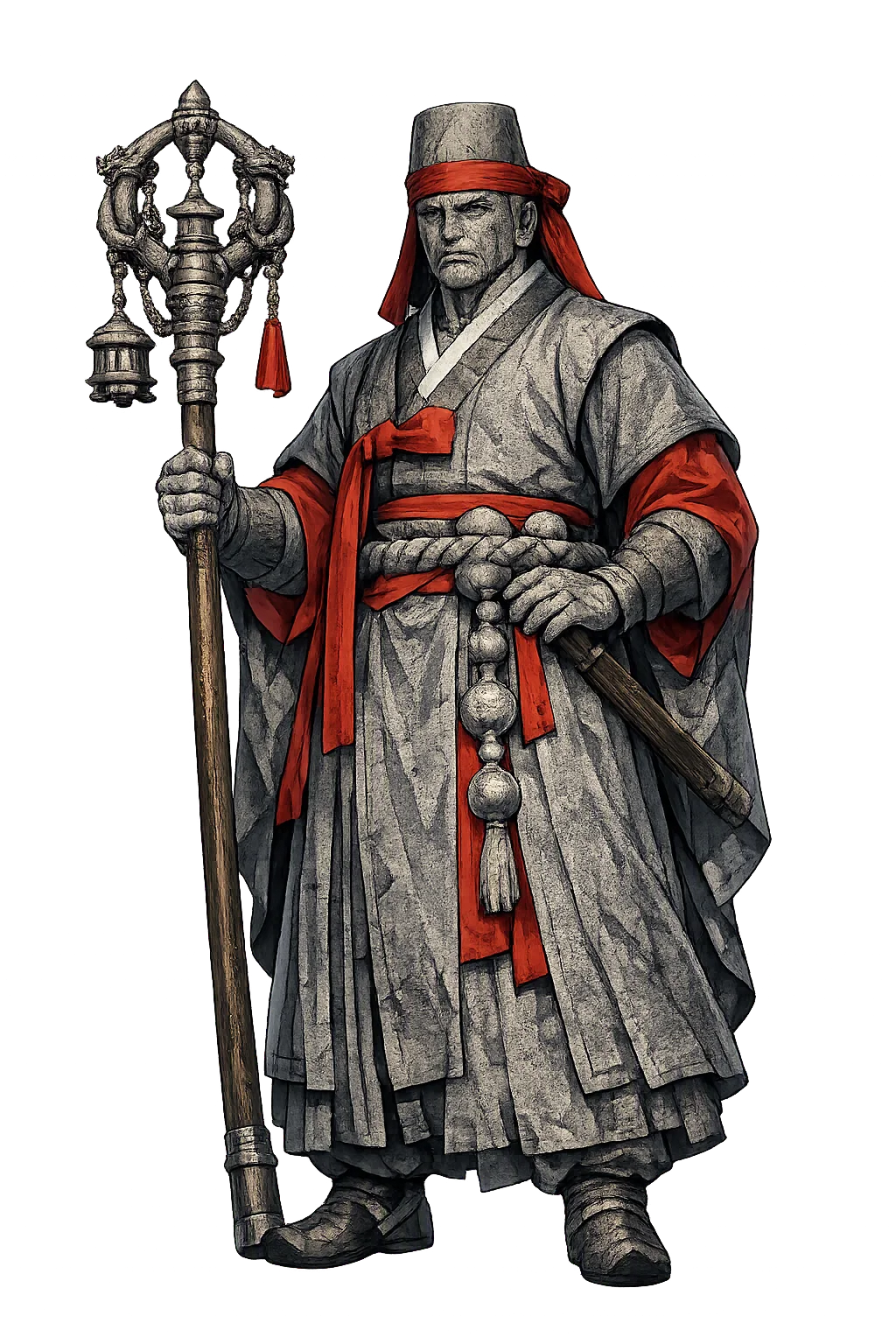
Stories of Seonangshin
Seonangshin has no epic cycle; her mythology is the living archive of Korean village religion — boundary shrines, communal rites, and origin legends recorded in classical miscellanies such as the Samguk Yusa and the nineteenth-century Dongguk Sesigi, then catalogued by twentieth-century folklore surveys. The narratives vary by region and by shamanic lineage, and the record says so.
Every traditional Korean village kept a seonangdang, a small open shrine set where the settlement's paths met the fields — the precise point where cultivated space gave way to mountain and wild. The nineteenth-century miscellany Dongguk Sesigi (1849) describes the offerings made there: rice wine poured out, lengths of cloth hung, the season's first fruits presented, and prayers spoken to keep epidemic and disaster outside the settlement. The shrine was usually nothing grand — a ring of stones, a low platform, sometimes a great guardian tree under which the spirit was thought to rest — but its placement was theology: the village existed because someone stood watch at its edge. The offerings were not thanks so much as a retainer's wages: the community fed its sentinel so the sentinel would keep the boundary sealed. The myth's meaning is spatial — a people defines itself by what it places at its border.
Korean village religion builds its boundary in visible grammar: the geumjul, a twisted straw rope hung with paper strips and dried gourds, declares sacred space; the jangseung, grinning wooden posts carved in the likeness of generals, stand sentinel at the paths; the sotdae, tall poles topped with carved birds, lift the village's wishes skyward. Seonangshin was imagined moving among these markers as a patrolling official or armed warrior, inspecting the fence between the human world and the wilderness. Travellers passing the shrine dismounted, bowed, or left a pinch of food; to pass carelessly was to risk misfortune on the road, for the guardian noted disrespect as readily as reverence. Twentieth-century folklore surveys recorded the custom still alive in remote villages, and the road-customs around surviving seonangdang preserve it as etiquette. The threshold is the myth itself: safety is a negotiated privilege, renewed at every crossing, and the boundary stone is the signature on the treaty.
Korean folklore preserves a recurring origin legend for its village guardians: the seonangshin is the spirit of a young woman — often a maiden who died unmarried — who took up the guardianship of the settlement that failed her in life. The motif is catalogued in the National Folk Museum of Korea's Encyclopedia of Korean Folk Beliefs (2015) and across the regional legend collections, and it belongs to the wider family of Korean shrine legends in which the wronged dead become protective powers when honoured and dangerous ones when neglected. Versions attach the guardian to a particular tree, stone, or spring; some name her; many were collected from shamans whose village rituals address her by title rather than by name. The sources disagree on details by region — Jeju, the mainland south, and the central provinces each keep their own telling — but the structural claim is stable: the guardian was once one of the community's own, and her watch is the settlement's debt made visible. The legend reads marginality transformed into sovereignty: the figure with least power in life becomes the power that rules the boundary.
Once a year — most often in the first lunar month — the village gathered at the seonangdang for the dongje, the communal rite that renewed the covenant between settlement and guardian. A ritual specialist, and in many regions a shaman, led the prayers; offerings of food, wine, and in earlier centuries a pig were presented; and the rite closed with shared food and drink, the boundary between household and community briefly dissolved. The point was as social as it was sacred: the dongje synchronized the village calendar, settled obligations, and reasserted that protection was a collective undertaking, not a private charm. The great surviving example is Hahoe village's byeolsingut kut, a masked shamanic rite still performed for the settlement's tutelary powers and honoured by UNESCO; the National Folk Museum's surveys record dozens of humbler dongje across the peninsula. Where a seonangdang has been restored as heritage, the rite often returns as festival — the same gathering under a new description. The rite performs the community's oldest claim: together, watched over, we persist.
boundary spirit who protects settlements and travellers
Seonangshin is the village guardian spirit who protects settlements, boundaries, and travellers from harm in Korean tradition. The name means "Village spirit" and belongs to the domain "Village Guardian, Boundary." Seonangshin is the spirit who guards the village boundary, usually honoured at a shrine near the entrance to the settlement. The deity is believed to protect the community from epidemics, disasters, war, and wandering malevolent forces.
Seonangshin defends the settlement and its people from harm.
The seonangdang marks the threshold between civilised space and the wild.
The spirit is invoked against invasion, epidemic, and disaster.
Annual dongje festivals renew the bond between village and guardian.
From the original script to the living URL
서낭신 (城隍神)
The name in its original Korean form. Seonangshin (서낭신 (城隍神)) is attested in the source tradition — “Village spirit”. Its original diacritics and script distinctions carry the full phonetic and orthographic weight of the source tradition.
seonangshin
The plain seonangshin form is identical to the Unicode restoration. Because this name is already written in Latin letters, no diacritics, stress, or script information were lost — only capitalization differs.
Seonangshin
The Unicode restoration does not need to recover lost marks for Seonangshin. Its value is canonical spelling and consistent cataloguing, not the reconstruction of erased orthography. The domain is readable as-is to both DNS and humanity.
Seonangshin.com
This restoration is written entirely in ASCII letters — no Punycode encoding stands between Seonangshin and the DNS. The domain reads identically to machines and to human eyes.
Owned, ideal, and ASCII forms of Seonangshin
Seonangshin
Restores 서낭신 (城隍神). The full Unicode restoration. seonangshin.com is not in the PuniCodex collection — it is watched for release; if it drops, this temple upgrades to an owned flagship.
How Seonangshin was spoken
How Seonangshin travels from ancient script to the modern URL
The lore you have read is the living myth. Extended Lore opens the scholarly vault beneath it: the cult and its material remains, a history of the image, the name after antiquity, a meditation on what the name still means, and the full scholarly apparatus — etymology, orthography, sources.
Enter Extended Lore