
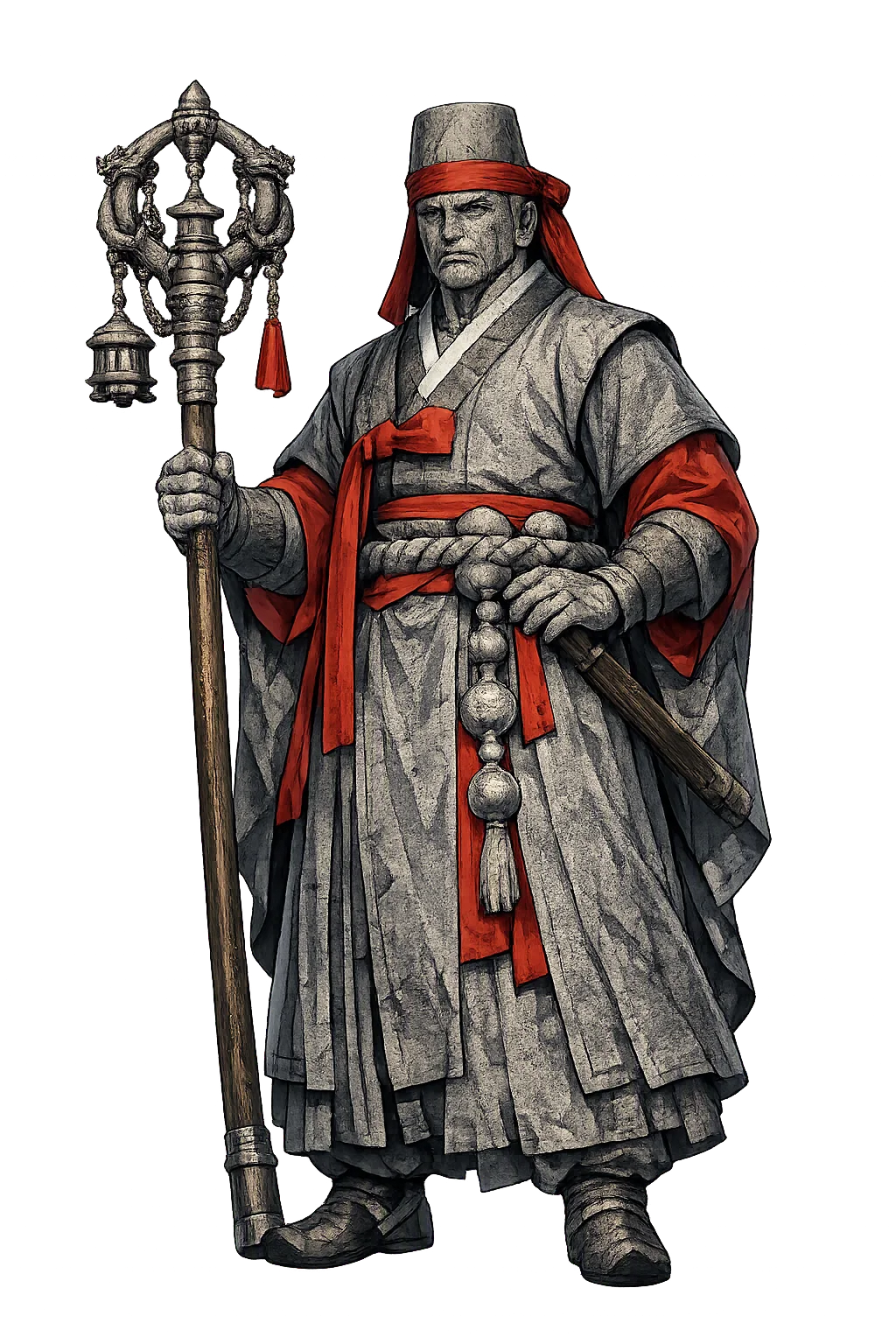
Why Seonangshin is spelled that way — and what it costs to get it right
There is a version of this name the early internet had to settle for: seonangshin. This is the file on how Seonangshin replaced it.
Seonangshin has no epic cycle; her mythology is the living archive of Korean village religion — boundary shrines, communal rites, and origin legends recorded in classical miscellanies such as the Samguk Yusa and the nineteenth-century Dongguk Sesigi, then catalogued by twentieth-century folklore surveys. The narratives vary by region and by shamanic lineage, and the record says so.
At a Glance
- Restored name: Seonangshin
- ASCII form: seonangshin
- Meaning: "Village spirit"
- Domain of influence: Village Guardian, Boundary
- Pantheon: Korean
- Classification: Tier 2
- Original script: 서낭신 (城隍神)
- Series: The Restoration Files, No. 433 of 548
The Name Before the Marks
Spoken, the name runs `/sʌ.naŋ.ʃin/` — 'suh-NAHNG-sheen' — The first vowel is a mid back unrounded vowel; the second syllable contains a velar nasal. The name is the Korean reading of the Sino-Korean term for a city-moat guardian deity.
The Temple That Stands Now
The restored name is not a plaque; it is an address. The temple of Seonangshin lives at /seonangshin/, with its mythology in the lore halls, its peer-reviewed record in the Scholarly Edition, and its place in the pattern atlas on the patterns floor.
The restoration keeps one feature the ASCII form drops. One is enough to matter, and the label says so plainly: Tier-2.
Where the Name Stood First
Seonangshin's material witnesses are standing, not buried. The UNESCO-listed clan villages Hahoe (Andong) and Yangdong (Gyeongju) preserve their guardian shrines, village trees, and ritual topography intact; Jeju's stone seonangdang — low cairns of stacked volcanic rock with a single sacred pole — survive by the hundreds across the island and are documented in provincial folk-heritage registers. The National Folk Museum of Korea's regional surveys record seonangdang structures, jangseung pairs, and sotdae poles from every province, many photographed before the mid-twentieth century upheavals. Documentary witnesses complement the fabric: the Dongguk Sesigi (1849) describes the rites, and Joseon administrative records list licensed seonghwang shrines. No excavation is required; the cult's archaeology is the vernacular landscape itself. The temple on the web is the newest of these addresses — the first one that fits in a pocket.
The Archetype at Work
The pattern atlas seats this temple in 3 industries, each match argued and weighted: Education, Research & Knowledge (primary seat: Seonangshin embodies village guardian, boundary — the core of education.); Mythic Name Restoration (resonant seat: Seonangshin shares symbolic territory with mythic restoration.); Writing, Publishing & Media (resonant seat: Seonangshin shares symbolic territory with publishing media.). The Resonance File reads those seats through the myths themselves.
The File Continues
The temple's founding dispatch tells the name's story; its Resonance File reads the myths into the industries; the blog index holds the whole archive.
Continue the series — previous file: Selēnē (read it here) · next file: Sšꜣt (read it here).
The Restoration Files are written from the same canonical record as the temples themselves: the lexicon, the lore catalog, the pattern atlas, and the cited scholarly sources. If a file ever disagrees with its temple, the temple is right — tell us, and the file will be corrected.