
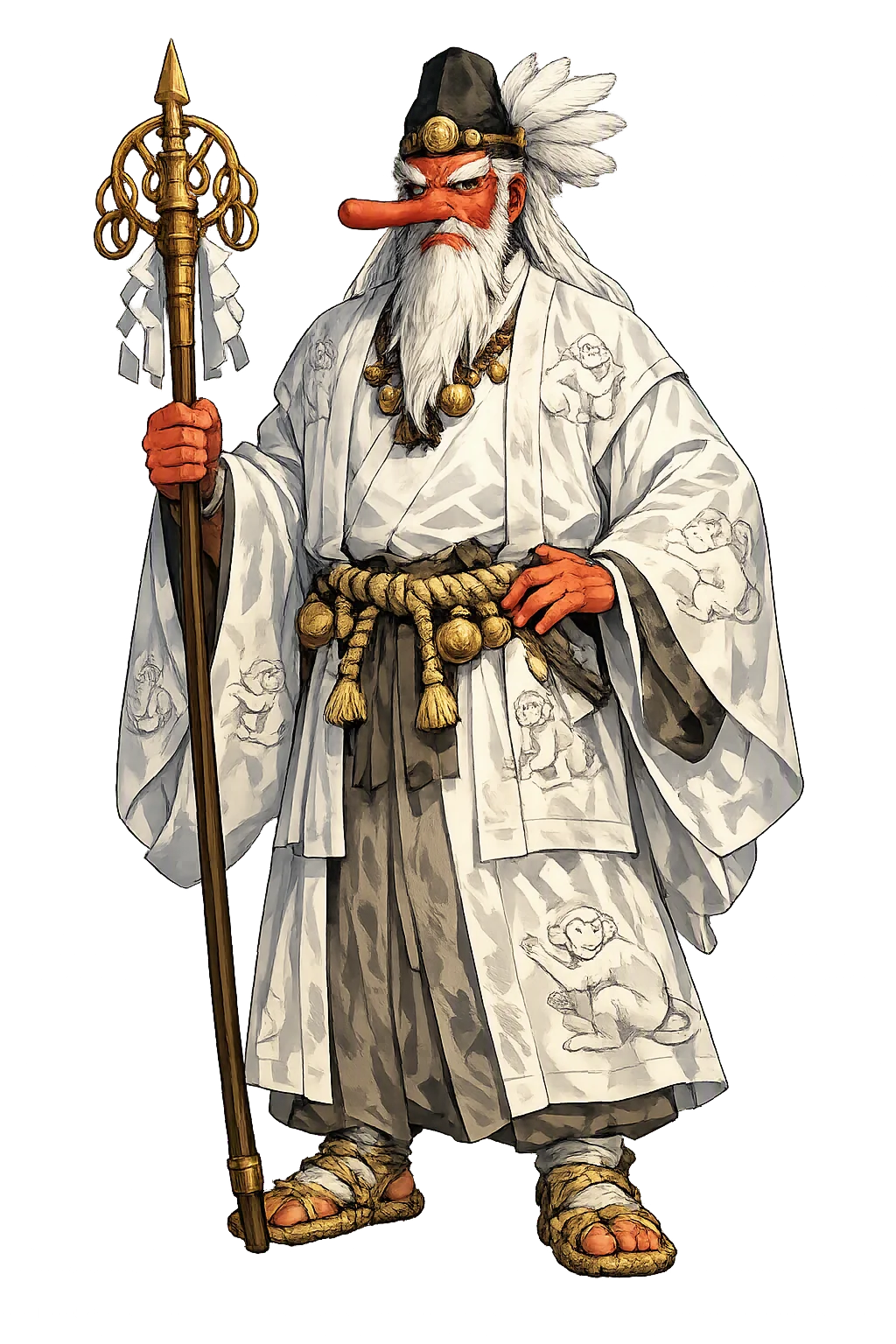
Recording Sarutahiko
Long before it became a digital address, this name travelled through scripts. Sarutahiko begins in Japanese characters, passes through scholarly transliteration, and arrives in a Latin form that needs no special encoding. Each stage preserves some information and requires some judgment. This post follows that journey: the original evidence, the reconstructed pronunciation, the mythological record, the material remains, and the reviewed spelling used by the temple.
At a Glance
- Canonical name: Sarutahiko
- ASCII form: sarutahiko
- Meaning: "Monkey-field prince"
- Domain of influence: Crossroads, Guidance
- Pantheon: Japanese
- Restoration: ASCII-equivalent form
- Original script: 猿田彦 (Japanese characters)
Overview
Sarutahiko (sarutahiko) — Crossroads, Guidance · Monkey-field prince — belongs to the Japanese tradition, where it is catalogued under the domain "Crossroads, Guidance". The name means "Monkey-field prince".
Sarutahiko is the kami who stands at the boundary between heaven and earth. When Ninigi descended from Takamagahara, Sarutahiko blocked the way until Ame-no-Uzume persuaded him to become the guide. With his long nose, glaring eyes, and red face, he became the model for the taikomochi and tenjin figures of Japanese folk performance and the patron of those who stand at thresholds.
PuniCodex records the canonical scholarly spelling Sarutahiko and serves its temple at its temple. The displayed form is ASCII-equivalent — a description computed from the displayed form itself. The plain ASCII form sarutahiko contains the same letters: no recovered diacritics or special encoding is claimed. The work here is consistent citation, capitalization, provenance, and cultural context.
The Name
The name is attested in Japanese characters as 猿田彦. Etymologically it means "Monkey-field prince".
The canonical spelling Sarutahiko matches the conventional scholarly romanization. The plain ASCII form sarutahiko contains the same letters, so no lost diacritics or encoding transition is claimed. The editorial work is to fix one reviewed reference spelling, preserve capitalization and provenance, and keep the original evidence visible. The displayed form is ASCII-equivalent — a description computed from the displayed form itself.
The letter-by-letter transformation runs:
- s → S — Same, capitalized
- a → a — Same
- r → r — Same
- u → u — Same
- t → t — Same
- a → a — Same
- h → h — Same
- i → i — Same
- k → k — Same
- o → o — Same
The Original Script
The name is written in Japanese characters as 猿田彦. That attested script remains the primary evidence for the conventional romanization Sarutahiko. The canonical Latin spelling does not pretend to recover marks it never contained: it fixes one reviewed reference form while leaving the original script visible for comparison.
The Kojiki writes 猿田彦 — 猿 'monkey' + 田 'field' + 彦 'lord, male honorific' — for the earth-born kami who blocks the crossroads at Ninigi's descent and ends as the husband of Ame-no-Uzume. Whether 猿 points to a monkey-deity, to a tabooed 'bestial' outsider, or is merely phonetic has been argued since the chronicles were read as philology; no consensus exists. The writing offers a folk etymology that may be no etymology at all — the name itself is older than any of its characters' proposed readings.
Pronunciation
The reconstructed pronunciation of the name is /sa.ɾɯ.ta.hi.ko/ — Modern Standard Japanese (Hepburn).
Phoneme by phoneme:
- Sa- — Voiceless alveolar fricative [s] plus open central [a]
- -ru- — Alveolar tap [ɾ] plus close back unrounded [ɯ]
- -ta- — Voiceless alveolar stop [t] plus open central [a]; from 田 'field'
- -hiko — Voiceless glottal [h], close front [i], voiceless velar [k], open-mid [o]; from 彦 'prince/lad'
For the modern speaker, the closest approximation is: 'SAH-roo-tah-hee-koh' — the 'r' is a light tap, and all vowels are short.
Kindred and historical forms of the name:
- Japanese — 猿田彦 (Sarutahiko) — saru 'monkey' + ta 'field' + hiko 'prince'; the saruta element is etymologically obscure (Ashkenazi, Handbook of Japanese Mythology).
- Wife — Ame-no-Uzume-no-mikoto, the dancing goddess; the Kojiki makes her the ancestress of the Sarume.
- Descendants — The Sarume (猿女, 'monkey-women') clan of female ritual dancers, from whom the kagura tradition descends (Kojiki).
Sarutahiko keeps its restoration plain: plain Hepburn. He is the kami who guided Ninigi's descent and who stands at boundaries.
Mythology
Sarutahiko's mythology is compact but complete in its own way: the earth-born kami who blocks the heavenly descent and becomes its guide; the husband of the dancing goddess; a drowned god whose spirit is still named at Ise. Around these Kojiki and Nihon Shoki episodes, folk religion built a vast afterlife of crossroads, masks, and martial arts.
The Blockade at the Floating Bridge (Kojiki / Nihon Shoki)
When Ninigi no Mikoto, grandson of Amaterasu, prepared to descend from Takamagahara to rule the Central Land of Reed-Plains, an awesome figure stood at the eight-fold crossroads at the earthward end of the Floating Bridge of Heaven. The Kojiki describes Sarutahiko with a long nose, a red and shining face, eyes like eight-span mirrors, and a beard that hung down; the Nihon Shoki variant measures him more exactly — a nose of seven hand-spans, a height over seven feet, eyes red like mirrors — and says the heavenly envoys sent to negotiate all stood back in fear. Only Ame-no-Uzume, goddess of dawn, mirth, and dance, stepped forward. She spoke to him boldly and well, and the gatekeeper was won: he asked who was coming and offered himself as guide. No force moved him and no god outranked him; what opened the road was speech. The myth's meaning is a charter of legitimacy: heaven's claim to the land passes through an earthly gatekeeper's consent — rule is negotiated at the threshold, not imposed from the sky.
The Marriage That Founded a Line (Kojiki)
After the descent was accomplished, Ame-no-Uzume married Sarutahiko, and the Kojiki draws the genealogical consequence: Uzume is the ancestress of the Sarume — the “monkey-women” — the order of female ritual dancers of the Yamato court, whose sacred performances are the root from which kagura, and in part the comic spirit of Noh, descend. The marriage folds the unruly leader of the earthly kami into the celestial order without domesticating him: he remains the red-faced giant, she remains the dancer who out-talked him, and together they become the founding couple of Japanese sacred performance. Structurally the pairing is exact — the goddess who moves between worlds weds the god who guards the crossing — and politically it is shrewd: the oldest indigenous power of the archipelago is not defeated by Ninigi's line but married into it. The myth remembers that Japan's ritual arts were born at a boundary, from a negotiation.
The Drowning at Azaka (Kojiki)
Even gatekeepers die. The Kojiki records that Sarutahiko went to Ise, to the Isuzu River at Azaka, where a giant clam closed upon his hand while he fished; he fell into the water and drowned. The tradition speaks the event in three divine names given to his spirit as he sank: Sokodokumitama, “Bottom-Reach-Spirit,” as he went to the riverbed; Tsubutatsumitama, “Rising-Bubble Spirit,” as his breath broke the surface; and Awasakumitama, “Bubble-Bursting Spirit,” as the bubbles burst and were gone. Anthropologist Emiko Ohnuki-Tierney reads the episode through the monkey symbolism latent in his name — the macaque with one hand trapped in a shell is a stock figure of Japanese folktale. The undertone of the myth is initiatory: the god of boundaries meets his own limit at the water's edge, and in the telling of his death the river at Ise gains a guardian presence that outlasts the god's body.
The Great Kami of the Crossroads (Folk religion)
Only seven kami bear the title Ōkami, “Great Kami,” and Sarutahiko is almost alone among them in being an earthly (kunitsukami) rather than a heavenly deity — Inari is the other. Medieval Shugendō adopted him as a protector of mountain ascetics; later folk religion made him patron of roads, travelers, comedians, and performers — his grotesque mask leads the Menkake Gyōretsu, the masked procession still held at Kamakura's Tsurugaoka Hachimangū, and Ueshiba Morihei, founder of Aikido, made Sarutahiko's stance between heaven and earth the model of aiki, standing “one with the universe.” His cult geography is anchored by Tsubaki Grand Shrine in Mie — first among some two thousand branch shrines — and Sarutahiko Jinja beside the Isuzu River at Ise, near the place of his drowning. The pattern across the centuries is consistent: whoever stands at a threshold — pilgrim, dancer, martial artist — stands where Sarutahiko stood first.
Symbols & Iconography
The iconography associated with Sarutahiko concentrates in a small set of recurring attributes, each a compressed statement about the name:
- Long nose — His most distinctive feature, symbolizing spiritual perception
- Red face — The color of power and boundary-crossing deities
- Jeweled spear — The weapon he brandished when blocking Ninigi's path
- Crossroads — The thresholds he guards
Archaeology & Evidence
Sarutahiko's cult geography is unusually legible. Tsubaki Grand Shrine at Suzuka in Mie Prefecture, set at the foot of Mount Nyūdō, is the head shrine of his cult, first among some two thousand branch shrines; Sarutahiko Jinja stands by the Isuzu River at Ise, beside the river of his drowning, and Ōasahiko Shrine in Tokushima is another ancient seat. Images of the god — the red shining face, hanging beard, long nose — survive in shrine statuary, festival regalia, and the masks of the Menkake Gyōretsu procession still performed at Kamakura's Tsurugaoka Hachimangū, a medieval rite whose masks are preserved as temple treasures. No inscription from the archaic period names him; his earliest witnesses are the Kojiki (712) and Nihon Shoki (720) manuscripts themselves.
Realm & Domain
Sarutahiko is the kami who stands at the boundary between heaven and earth. When Ninigi descended from Takamagahara, Sarutahiko blocked the way until Ame-no-Uzume persuaded him to become the guide. With his long nose, glaring eyes, and red face, he became the model for the taikomochi and tenjin figures of Japanese folk performance and the patron of those who stand at thresholds.
Guide of Ninigi
He led Ninigi's descent from heaven to earth.
Crossroads Guardian
He protects boundaries, paths, and transitions.
Husband of Uzume
Ame-no-Uzume married him after negotiating the heavenly descent.
Folk Performer
His appearance influenced comedic and ceremonial performers.
Across Cultures
Sarutahiko is an earthly kami who becomes an ally of the heavenly order. His long nose and red face connect him to other boundary figures in Japanese folk religion, and his marriage to Ame-no-Uzume unites two of the most dynamic kami in the pantheon. He is also venerated in Shugendō as a guide for mountain ascetics.
Kindred figures in the PuniCodex cross-tradition index include Andvari (guardian / protector), Kérberos (guardian / protector), Ẹṣù (messenger / travel / commerce), Fáfnir (guardian / protector), Garmr (guardian / protector), and Gná (messenger / travel / commerce).
Cultural Legacy
Sarutahiko is worshipped at Tsubaki Grand Shrine and other shrines associated with guidance and performance. His image influences Japanese masks, festival costumes, and the design of tenjin figures. He remains the kami you call upon when standing at a threshold.
The Scholarly Record
The account of Sarutahiko given in this edition rests on the witnesses and reference works listed below. Lexica and etymological dictionaries secure the form and meaning of the name; the literary and religious texts supply the narrative evidence.
- Kojiki (Ninigi's descent; the marriage to Uzume; the drowning at Azaka).
- Nihon Shoki, descent of Ninigi (variant account).
- Philippi, Donald L., Kojiki (University of Tokyo Press, 1968).
- Aston, W. G., Nihongi (Japan Society, 1896).
- Ohnuki-Tierney, Emiko, The Monkey as Mirror (Princeton, 1987).
- Bocking, Brian, A Popular Dictionary of Shinto (1996).
A Meditation
Sarutahiko stands at the edge of two worlds. He is not an enemy of heaven but its necessary guide: the one who knows the way down. His marriage to Uzume reminds us that the most stubborn boundaries can be crossed with courage, humor, and respect.
The Canonical Spelling
Sarutahiko is the canonical spelling used by this temple. The plain ASCII form sarutahiko contains the same letters, so there are no lost diacritics to recover and no special encoding transition to explain. What the temple preserves is the reviewed reference form: capitalization, conventional romanization, original evidence, and a stable place to inspect them. The value here is not added decoration; it is fidelity to the attested record.
Character by Character
The canonical form Sarutahiko and the plain ASCII form sarutahiko share the same letters. The character list therefore documents continuity rather than recovery: every character is carried forward deliberately, with capitalization serving as the proper-noun convention. No additional mark is inserted merely to make the restoration appear more elaborate.
The Japanese Pantheon
Sarutahiko is one of 45 entries the PuniCodex lexicon catalogues under the Japanese pantheon. The Pantheon page gathers the tradition's major figures in one place, and the Lexicon lets you filter all 983 restorations by tradition or script — the fastest way to see where this name sits among its kin.
Frequently Asked Questions
What does Sarutahiko mean? The traditional gloss is "Monkey-field prince."
Which tradition does Sarutahiko belong to? Sarutahiko is catalogued in the Japanese pantheon of the PuniCodex lexicon.
Does this name need recovered diacritics? No. Sarutahiko is already an ASCII-form canonical spelling. The scholarly work is to preserve the attested convention and its evidence, not to add marks.
Can I use Sarutahiko in a normal browser? Yes. The spelling works directly in an ordinary browser, and the type tool can confirm and copy the canonical form.
Where does the scholarly information come from? The entry is built from lexica, inscriptional evidence, and reviewed scholarly sources listed in the Scholarly Edition.
Typing Sarutahiko
You do not need a special keyboard to use this name. Sarutahiko already uses ordinary Latin letters. The PuniCodex Type Tool lets you confirm the canonical spelling and copy it cleanly, while the original-script notes in the temple show the evidence behind the romanization.
Sister Temples
Other temples in the Japanese pantheon include Izanagi, Izanami, and Jizō — each with its own restoration story, its own scholarly record, and its own place in the lexicon.
Why This Record Matters
Every stage from Japanese characters to the canonical Latin spelling was an act of care: the scribe who first recorded the name, the lexicographer who glossed it, the editor who fixed the convention, and the scholar who documented the reconstruction. The temple is the latest stage, not the last word. Its principle remains simple: a name deserves to be written in the form its evidence supports. Sarutahiko is that principle made accessible.
Explore Further
This post is one doorway into the temple. The home page carries the full character breakdown and the ambient canvas; the lore page tells the myths in long form; the Scholarly Edition preserves the sources, pronunciation data, and revision history; and the patron wall supports the restoration directly. For the wider map, browse the Lexicon, explore the Pantheon, or return to the PuniCodex blog.
A Closer Look at the Spelling
A canonical name is a small map. In the case of Sarutahiko, the route does not lead through diacritics or special letters, because the conventional scholarly spelling already uses the Latin alphabet. The original evidence — 猿田彦 in Japanese characters — carries semantic and phonetic information that no romanization can fully reproduce.
By fixing one reviewed spelling as the public reference, the project prevents the drift that occurs when a name is romanized differently in every article, map, and database. The character list shows exactly what is carried forward. "No change" here means a deliberate choice to keep the name stable, searchable, and faithful to the record.
Sarutahiko in Its Tradition
Sarutahiko does not stand alone. It belongs to the Japanese tradition, where it is counted among 45 names in the PuniCodex lexicon. Its sphere — Crossroads, Guidance — places it beside other figures who govern similar aspects of experience. The canonical spelling keeps the name in the company of its kin and gives researchers one stable reference across the temples, the APIs, and the scholarly record.
What You Will Find in the Temple
The temple page for Sarutahiko is more than a landing page. The home tab presents the character breakdown, pronunciation guide, and digital address. Lore gathers the myths and narratives that give the name its depth. The Art room brings together the historical collection, Commons works, and Creatives. The Scholarly Edition publishes the sources, variant forms, and review history that justify the canonical spelling.
Industry patterns show where the name appears in modern commerce and culture, while the patron wall lets visitors support the work directly. Each surface is generated from the same canonical sources, so the temple, the blog, the scholars page, and the search index agree.
Related Names
Sources
The full scholarly apparatus — every citation, revision, and review — lives in the Scholarly Edition. Key references for this post:
- Kojiki (Ninigi's descent; the marriage to Uzume; the drowning at Azaka).
- Nihon Shoki, descent of Ninigi (variant account).
- Philippi, Donald L., Kojiki (University of Tokyo Press, 1968).
- Aston, W. G., Nihongi (Japan Society, 1896).
- Lexicon authorities for this entry: Kojiki, Nihon Shoki.