PuniCodex

Extended Lore

猿田彦 Sarutahiko

Etymology · Orthography · Cult · Iconography · Reception · Sources

Tier 2 Sarutahiko
Sarutahiko — Crossroads, Guidance
01

Quick Facts

Essential information about Sarutahiko, Crossroads, Guidance

Original Script猿田彦
Unicode RestorationSarutahiko
Reconstructed Pronunciation/sa.ɾɯ.ta.hi.ko/
PantheonJapanese
DomainCrossroads, Guidance
MeaningMonkey-field prince
ClassificationTier 2
Primary DomainSarutahiko
Sacred SymbolsLong nose, Red face, Jeweled spear, Crossroads
02

Etymology & Word Family

From original script to Unicode restoration

Original Script 猿田彦 Sarutahiko — "Monkey-field prince"
Unicode Restoration Sarutahiko Canonical scholarly spelling — ASCII-identical
Modern ASCII sarutahiko Plain-ASCII fallback

The name Sarutahiko reaches the modern world through scholarly transliteration of the japanese tradition. Because the conventional spelling uses only Latin letters, its Unicode and ASCII forms coincide — the tradition it carries is in the name itself, not in diacritics.

03

Unicode Character Breakdown

Character-by-character philological analysis

CharacterUnicodeNameBlockPhonetic Role
SU+0053Latin Capital Letter SBasic LatinSame, capitalized
aU+0061Latin Small Letter ABasic LatinSame
rU+0072Latin Small Letter RBasic LatinSame
uU+0075Latin Small Letter UBasic LatinSame
tU+0074Latin Small Letter TBasic LatinSame
aU+0061Latin Small Letter ABasic LatinSame
hU+0068Latin Small Letter HBasic LatinSame
iU+0069Latin Small Letter IBasic LatinSame
kU+006BLatin Small Letter KBasic LatinSame
oU+006FLatin Small Letter OBasic LatinSame

The Tier 2 classification here reflects fidelity to the attested tradition, not recovered diacritics: every character of Sarutahiko already survives in ASCII. What the restoration preserves is the canonical spelling itself — the form scholarship standardised.

04

Cult & Worship

How the sacred was kept — rites, sanctuaries, remains

The Cult

Sarutahiko's cult centers on Tsubaki Grand Shrine in Mie Prefecture, the head shrine of a network of roughly two thousand branch shrines. Set beneath Mount Nyūdō, Tsubaki enshrines him as a kami of crossroads, guidance, and straightforward action, and its priests maintain rituals of purification, divination, and martial blessing. The shrine by the Isuzu River at Ise and Ōasahiko Shrine in Tokushima are further ancient seats. Pilgrims visit for safe travel, clear decisions, and success in performance; kagura dance and New-Year rites keep his cult active. His marriage to the dancing kami Ame-no-Uzume provides a ritual charter for shrine performance and for the sacred role of entertainment.

In the Earth

Sarutahiko's cult geography is unusually legible. Tsubaki Grand Shrine at Suzuka in Mie Prefecture, set at the foot of Mount Nyūdō, is the head shrine of his cult, first among some two thousand branch shrines; Sarutahiko Jinja stands by the Isuzu River at Ise, beside the river of his drowning, and Ōasahiko Shrine in Tokushima is another ancient seat. Images of the god — the red shining face, hanging beard, long nose — survive in shrine statuary, festival regalia, and the masks of the Menkake Gyōretsu procession still performed at Kamakura's Tsurugaoka Hachimangū, a medieval rite whose masks are preserved as temple treasures. No inscription from the archaic period names him; his earliest witnesses are the Kojiki (712) and Nihon Shoki (720) manuscripts themselves.

05

Iconography

How Sarutahiko was imaged across the ages

The Image

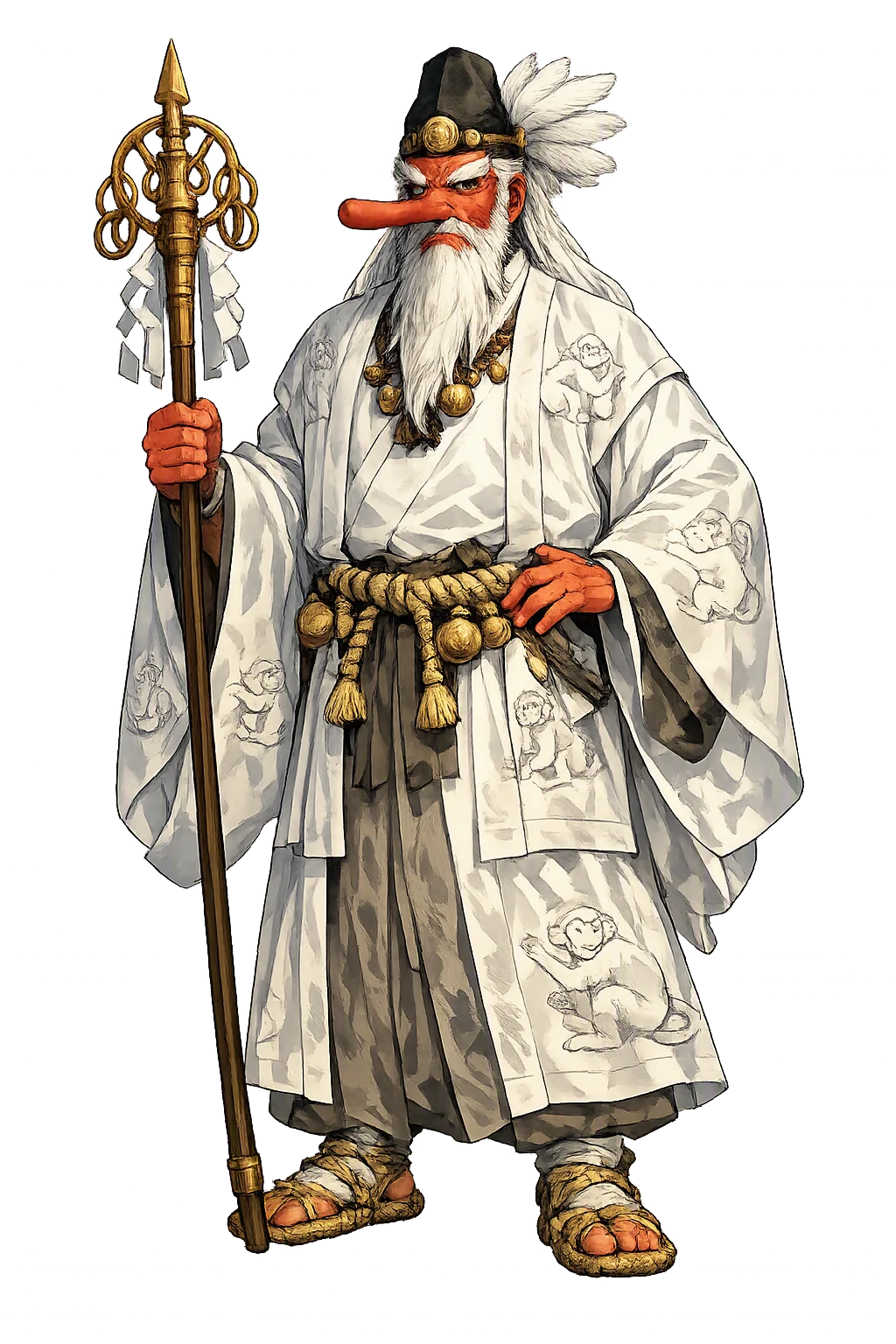
Sarutahiko is imaged as a red-faced, long-nosed, powerfully built figure with dangling arms and a shining face — a description that overlaps with the tengu of later folk art and with Ame-no-Uzume's mask. Shrine statues and ema votive tablets show him in rough robes, sometimes holding a jeweled spear, at other times paired with Uzume. His long nose became an emblem of discernment and spiritual acuity. In popular visual culture the type influenced the tengu mask and the comedic kyōgen repertoire; modern New-Year prints and shrine souvenirs still reproduce the red face and exaggerated features as instantly readable signs of guidance.

06

Reception & Transformation

The name after its own age — transmission, translation, survival

Afterlives

Sarutahiko's reception tracks the intersection of myth, performance, and folk religion. In the Kojiki he guides Ninigi's descent and marries Ame-no-Uzume, a narrative that legitimized both crossroads cults and the ritual arts. Medieval Shinto and Shugendō absorbed him as a guide and purifier, and his long-nosed iconographic type fed into the developing tengu lore of mountain asceticism. The early modern period saw him celebrated in festival performance and shrine lore, while the Tsubaki lineage consolidated his cult in the modern era. Today he is venerated as a patron of clear paths and decisive action, and his image circulates in manga, festival floats, and martial-arts symbolism, always anchored by the Tsubaki shrine network.

Identifications Across Traditions

Sarutahiko is an earthly kami who becomes an ally of the heavenly order. His long nose and red face connect him to other boundary figures in Japanese folk religion, and his marriage to Ame-no-Uzume unites two of the most dynamic kami in the pantheon. He is also venerated in Shugendō as a guide for mountain ascetics.

Modern Legacy

Sarutahiko is worshipped at Tsubaki Grand Shrine and other shrines associated with guidance and performance. His image influences Japanese masks, festival costumes, and the design of tenjin figures. He remains the kami you call upon when standing at a threshold.

07

The Meditation

What Sarutahiko means — beyond the dictionary

Sarutahiko stands at the edge of two worlds. He is not an enemy of heaven but its necessary guide: the one who knows the way down. His marriage to Uzume reminds us that the most stubborn boundaries can be crossed with courage, humor, and respect.

08

Frequently Asked Questions

Common questions about Sarutahiko, Crossroads, Guidance, and Unicode restoration

01How do you pronounce Sarutahiko?

In reconstructed pronunciation, Sarutahiko is /sa.ɾɯ.ta.hi.ko/ — approximately 'SAH-roo-tah-hee-koh' — the 'r' is a light tap, and all vowels are short.

02What does Sarutahiko mean?

Sarutahiko means Monkey-field prince in the japanese tradition.

03What are the symbols of Sarutahiko?

Sarutahiko is associated with Long nose (His most distinctive feature, symbolizing spiritual perception), Red face (The color of power and boundary-crossing deities), Jeweled spear (The weapon he brandished when blocking Ninigi's path), Crossroads (The thresholds he guards).

04Why restore Sarutahiko in Unicode?

Sarutahiko is written entirely in ASCII letters, so its restoration is about canonical fidelity rather than recovered diacritics: the temple fixes the name in its scholarly standard spelling, attested in the source tradition, instead of leaving it to drift.

05What is the most important myth about Sarutahiko?

“The Blockade at the Floating Bridge” — the Kojiki / Nihon Shoki story that anchors the mythology of Sarutahiko, told in full on the lore page.

09

Scholarly Sources

The philological foundations of this restoration

Every claim on this page is grounded in established scholarship. The orthographic restorations follow disciplinary convention. The etymological chain follows the best available reference works. This is not invention — it is resurrection through scholarship.

◈

Lexicography & Philology

  • Lexical and philological sources for Sarutahiko.
◎

Primary Texts

  • Kojiki
  • Nihon Shoki
  • Kojiki (Ninigi's descent; the marriage to Uzume; the drowning at Azaka)
  • Nihon Shoki, descent of Ninigi (variant account)
  • Philippi, Donald L., Kojiki (University of Tokyo Press, 1968)
◉

Archaeology & Art History

  • Material evidence — iconography, inscriptions, and temple archaeology — for Sarutahiko and related cults.
✦

Religious Studies

  • Aston, W. G., Nihongi (Japan Society, 1896)
  • Ohnuki-Tierney, Emiko, The Monkey as Mirror (Princeton, 1987)
  • Bocking, Brian, A Popular Dictionary of Shinto (1996)
Return

The Surface Awaits

You have traced the name from its earliest attestation to its Unicode restoration. Now return to the myth. The story is where the name lives.

Back to Lore
Sarutahiko mascot