Stories of Sarutahiko
Sarutahiko's mythology is compact but complete in its own way: the earth-born kami who blocks the heavenly descent and becomes its guide; the husband of the dancing goddess; a drowned god whose spirit is still named at Ise. Around these Kojiki and Nihon Shoki episodes, folk religion built a vast afterlife of crossroads, masks, and martial arts.
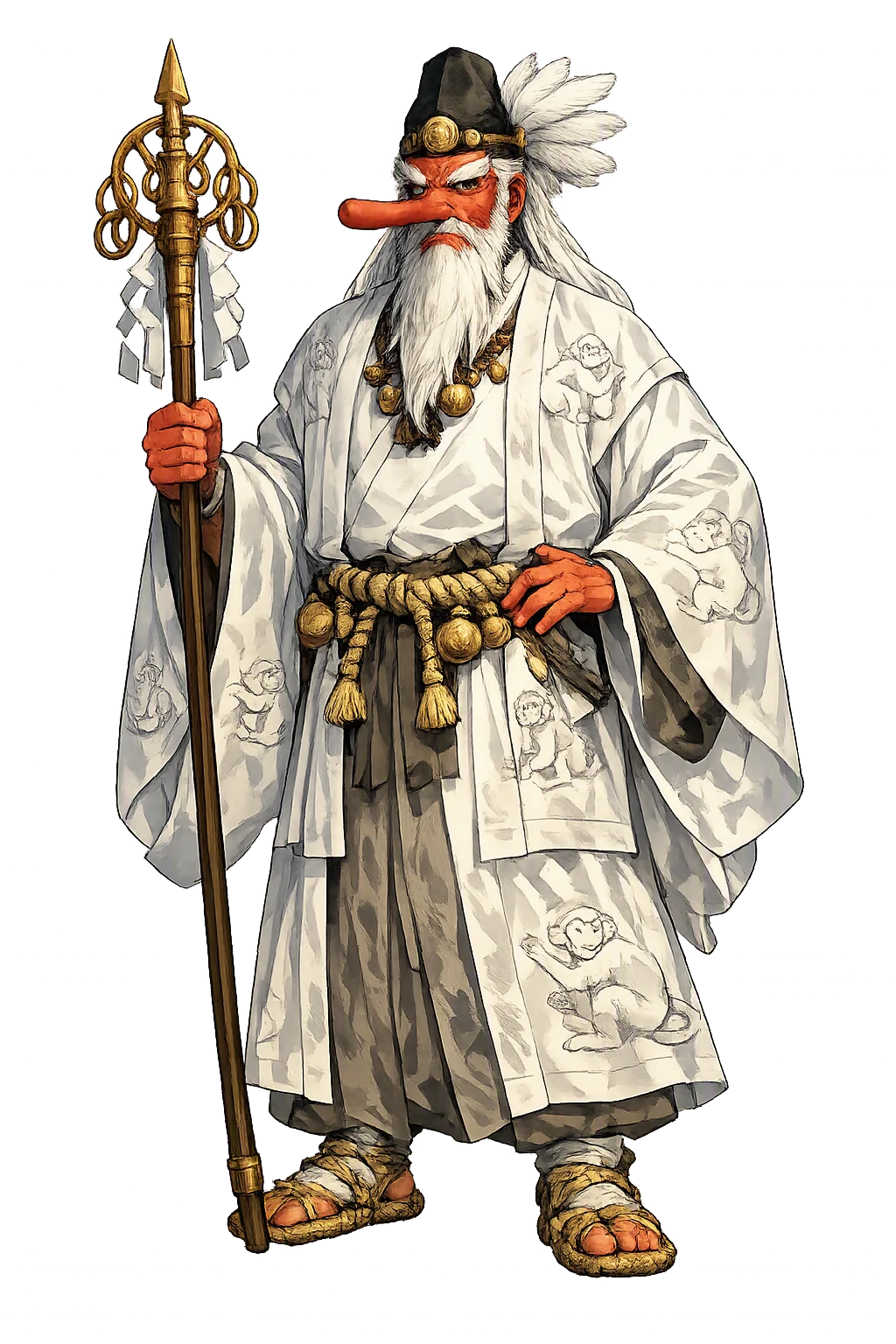
When Ninigi no Mikoto, grandson of Amaterasu, prepared to descend from Takamagahara to rule the Central Land of Reed-Plains, an awesome figure stood at the eight-fold crossroads at the earthward end of the Floating Bridge of Heaven. The Kojiki describes Sarutahiko with a long nose, a red and shining face, eyes like eight-span mirrors, and a beard that hung down; the Nihon Shoki variant measures him more exactly — a nose of seven hand-spans, a height over seven feet, eyes red like mirrors — and says the heavenly envoys sent to negotiate all stood back in fear. Only Ame-no-Uzume, goddess of dawn, mirth, and dance, stepped forward. She spoke to him boldly and well, and the gatekeeper was won: he asked who was coming and offered himself as guide. No force moved him and no god outranked him; what opened the road was speech. The myth's meaning is a charter of legitimacy: heaven's claim to the land passes through an earthly gatekeeper's consent — rule is negotiated at the threshold, not imposed from the sky.
After the descent was accomplished, Ame-no-Uzume married Sarutahiko, and the Kojiki draws the genealogical consequence: Uzume is the ancestress of the Sarume — the “monkey-women” — the order of female ritual dancers of the Yamato court, whose sacred performances are the root from which kagura, and in part the comic spirit of Noh, descend. The marriage folds the unruly leader of the earthly kami into the celestial order without domesticating him: he remains the red-faced giant, she remains the dancer who out-talked him, and together they become the founding couple of Japanese sacred performance. Structurally the pairing is exact — the goddess who moves between worlds weds the god who guards the crossing — and politically it is shrewd: the oldest indigenous power of the archipelago is not defeated by Ninigi's line but married into it. The myth remembers that Japan's ritual arts were born at a boundary, from a negotiation.
Even gatekeepers die. The Kojiki records that Sarutahiko went to Ise, to the Isuzu River at Azaka, where a giant clam closed upon his hand while he fished; he fell into the water and drowned. The tradition speaks the event in three divine names given to his spirit as he sank: Sokodokumitama, “Bottom-Reach-Spirit,” as he went to the riverbed; Tsubutatsumitama, “Rising-Bubble Spirit,” as his breath broke the surface; and Awasakumitama, “Bubble-Bursting Spirit,” as the bubbles burst and were gone. Anthropologist Emiko Ohnuki-Tierney reads the episode through the monkey symbolism latent in his name — the macaque with one hand trapped in a shell is a stock figure of Japanese folktale. The undertone of the myth is initiatory: the god of boundaries meets his own limit at the water's edge, and in the telling of his death the river at Ise gains a guardian presence that outlasts the god's body.
Only seven kami bear the title Ōkami, “Great Kami,” and Sarutahiko is almost alone among them in being an earthly (kunitsukami) rather than a heavenly deity — Inari is the other. Medieval Shugendō adopted him as a protector of mountain ascetics; later folk religion made him patron of roads, travelers, comedians, and performers — his grotesque mask leads the Menkake Gyōretsu, the masked procession still held at Kamakura's Tsurugaoka Hachimangū, and Ueshiba Morihei, founder of Aikido, made Sarutahiko's stance between heaven and earth the model of aiki, standing “one with the universe.” His cult geography is anchored by Tsubaki Grand Shrine in Mie — first among some two thousand branch shrines — and Sarutahiko Jinja beside the Isuzu River at Ise, near the place of his drowning. The pattern across the centuries is consistent: whoever stands at a threshold — pilgrim, dancer, martial artist — stands where Sarutahiko stood first.
Guide of the Heavenly Descent, Guardian of Crossroads
Sarutahiko is the kami who stands at the boundary between heaven and earth. When Ninigi descended from Takamagahara, Sarutahiko blocked the way until Ame-no-Uzume persuaded him to become the guide. With his long nose, glaring eyes, and red face, he became the model for the taikomochi and tenjin figures of Japanese folk performance and the patron of those who stand at thresholds.
He led Ninigi's descent from heaven to earth.
He protects boundaries, paths, and transitions.
Ame-no-Uzume married him after negotiating the heavenly descent.
His appearance influenced comedic and ceremonial performers.
From the original script to the living URL
猿田彦
The name in its original Japanese form. Sarutahiko (猿田彦) is attested in the source tradition — “Monkey-field prince”. Its original diacritics and script distinctions carry the full phonetic and orthographic weight of the source tradition.
sarutahiko
The plain sarutahiko form is identical to the Unicode restoration. Because this name is already written in Latin letters, no diacritics, stress, or script information were lost — only capitalization differs.
Sarutahiko
The Unicode restoration does not need to recover lost marks for Sarutahiko. Its value is canonical spelling and consistent cataloguing, not the reconstruction of erased orthography. The domain is readable as-is to both DNS and humanity.
Sarutahiko.com
This restoration is written entirely in ASCII letters — no Punycode encoding stands between Sarutahiko and the DNS. The domain reads identically to machines and to human eyes.
Owned, ideal, and ASCII forms of Sarutahiko
Sarutahiko
Restores 猿田彦. The full Unicode restoration. sarutahiko.com is not in the PuniCodex collection — it is watched for release; if it drops, this temple upgrades to an owned flagship.
How Sarutahiko was spoken
How Sarutahiko is preserved in writing
A bespoke provenance study for Sarutahiko is being prepared by the PUNICODEX scholarly team.
Contribute scholarly provenance →The lore you have read is the living myth. Extended Lore opens the scholarly vault beneath it: the cult and its material remains, a history of the image, the name after antiquity, a meditation on what the name still means, and the full scholarly apparatus — etymology, orthography, sources.
Enter Extended Lore