
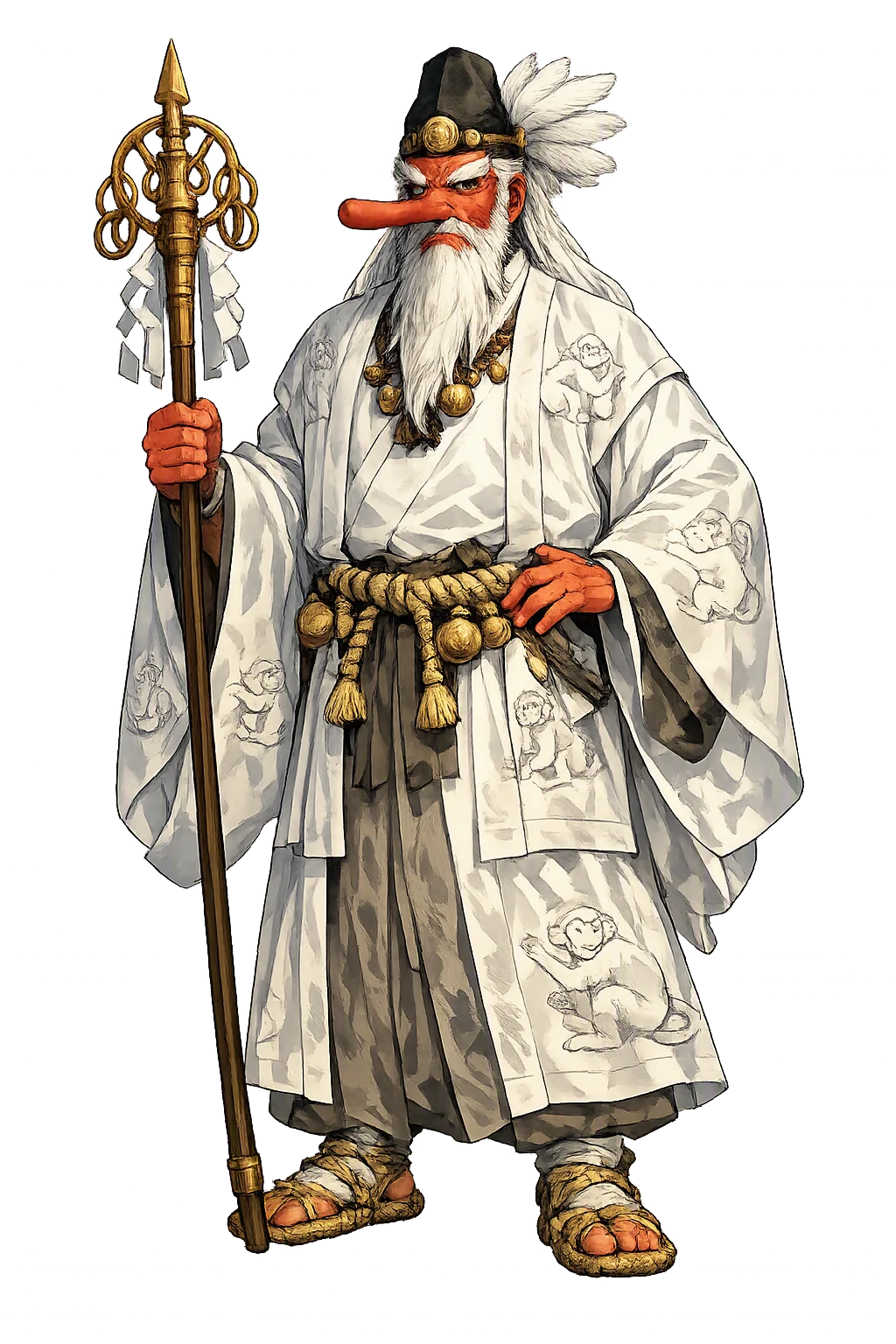
The appointments Sarutahiko made — and who is keeping them
One myth is a story. A cycle of myths is a specification. Read Sarutahiko's cycle in order and the industries fall out of it one by one.
At a Glance
- Temple: Sarutahiko
- Pantheon: Japanese
- Domain of influence: Crossroads, Guidance
- Pattern seats: 3
- Sectors touched: Technology & Innovation · Commerce & Governance · Culture & Entertainment
- Strongest seat: Communication, Messaging & Logistics
- Series: The Resonance Files, No. 428 of 548
The Cycle, Read Forward
Communication, Messaging & Logistics — through The Blockade at the Floating Bridge
When Ninigi no Mikoto, grandson of Amaterasu, prepared to descend from Takamagahara to rule the Central Land of Reed-Plains, an awesome figure stood at the eight-fold crossroads at the earthward end of the Floating Bridge of Heaven. The Kojiki describes Sarutahiko with a long nose, a red and shining face, eyes like eight-span mirrors, and a beard that hung down; the Nihon Shoki variant measures him more exactly — a nose of seven hand-spans, a height over seven feet, eyes red like mirrors — and says the heavenly envoys sent to negotiate all stood back in fear.
The atlas states the seat in one line: The long-nosed kami of crossroads and guidance who shows the way at every fork. The story above is the long version of the same sentence. That is the cycle working: story becomes duty, duty becomes trade.
Leadership, Governance & Public Administration — through The Marriage That Founded a Line
After the descent was accomplished, Ame-no-Uzume married Sarutahiko, and the Kojiki draws the genealogical consequence: Uzume is the ancestress of the Sarume — the “monkey-women” — the order of female ritual dancers of the Yamato court, whose sacred performances are the root from which kagura, and in part the comic spirit of Noh, descend. The marriage folds the unruly leader of the earthly kami into the celestial order without domesticating him: he remains the red-faced giant, she remains the dancer who out-talked him, and together they become the founding couple of Japanese sacred performance.
The atlas states the seat in one line: The kami who guides the great way; leadership as showing the path. The story above is the long version of the same sentence. The trade thinks it is optimizing a process. It is re-enacting a charter.
Travel, Tourism & Place Branding — through The Drowning at Azaka
Even gatekeepers die. The Kojiki records that Sarutahiko went to Ise, to the Isuzu River at Azaka, where a giant clam closed upon his hand while he fished; he fell into the water and drowned.
The atlas states the seat in one line: The kami who guides travelers at the crossroads; every journey begins with his leave. The story above is the long version of the same sentence. That is the cycle working: story becomes duty, duty becomes trade.
The Theme That Runs the Cycle
Sarutahiko's mythology is compact but complete in its own way: the earth-born kami who blocks the heavenly descent and becomes its guide; the husband of the dancing goddess; a drowned god whose spirit is still named at Ise. Around these Kojiki and Nihon Shoki episodes, folk religion built a vast afterlife of crossroads, masks, and martial arts.
The Method, Stated Plainly
The atlas is not a horoscope. Seats are earned from the sources — argued, weighted, published — and every one of them can be challenged at the methodology page. A match that cannot survive an argument does not survive review. That is the whole trick: the patterns are claims, and claims can be tested.
For the Ones Who Work There
If you work in communication, messaging & logistics, leadership, governance & public administration, or any trade this temple holds a seat in, this is the honest version of what a placement means: your industry beside the story it has been re-telling all along — on the temple floor itself, before an audience that came specifically to read it. The patron tier and the advertising terms describe the mechanics; the resonance above describes the fit.
The File Continues
One of 548 Resonance Files — the series where the pantheon goes to work. Read the founding dispatch for the name, the Restoration File for the spelling, or the whole archive end to end.
Continue the series — previous: Sarnath (read it) · next: Satī (read it).
The Resonance Files are argued from the same canonical record as the pattern atlas itself: the lexicon, the lore catalog, and the cited sources. Every seat can be challenged at the methodology page — and the challenge is the point.