
The appointments Samantabhadra made — and who is keeping them
One myth is a story. A cycle of myths is a specification. Read Samantabhadra's cycle in order and the industries fall out of it one by one.
At a Glance
- Temple: Samantabhadra
- Pantheon: Buddhist
- Domain of influence: Universal Good, Practice
- Pattern seats: 4
- Sectors touched: Society & Spirit · Health & Wellbeing
- Strongest seat: Faith & Spiritual Organizations
- Series: The Resonance Files, No. 423 of 548
The Cycle, Read Forward
Faith & Spiritual Organizations — through The Ten Great Vows
The Avataṃsaka Sūtra closes with his testament, the Bhadracarī-praṇidhāna or Vows of Good Conduct: homage to all buddhas as numerous as atoms, praise of their virtues, offerings as vast as space, confession of faults, rejoicing in others' merit, requesting the wheel of Dharma be turned, beseeching buddhas not to pass into nirvāṇa, constant imitation of their deeds, dedication of all merit, and its transfer to all beings — whatever good I have done, may all beings share it. The prayer is appended to the great sūtra in its Chinese recensions and has never left the tradition's daily life: Tibetan monasteries chant it at the close of every session, and East Asian liturgy still folds its verses into repentance rites.
The atlas states the seat in one line: Primary seat: Samantabhadra embodies universal good, practice — the core of faith. The story above is the long version of the same sentence. Industries do not invent their archetypes; they inherit them and call them best practice.
Mental Health & Emotional Wellness — through The Vow of the Lotus
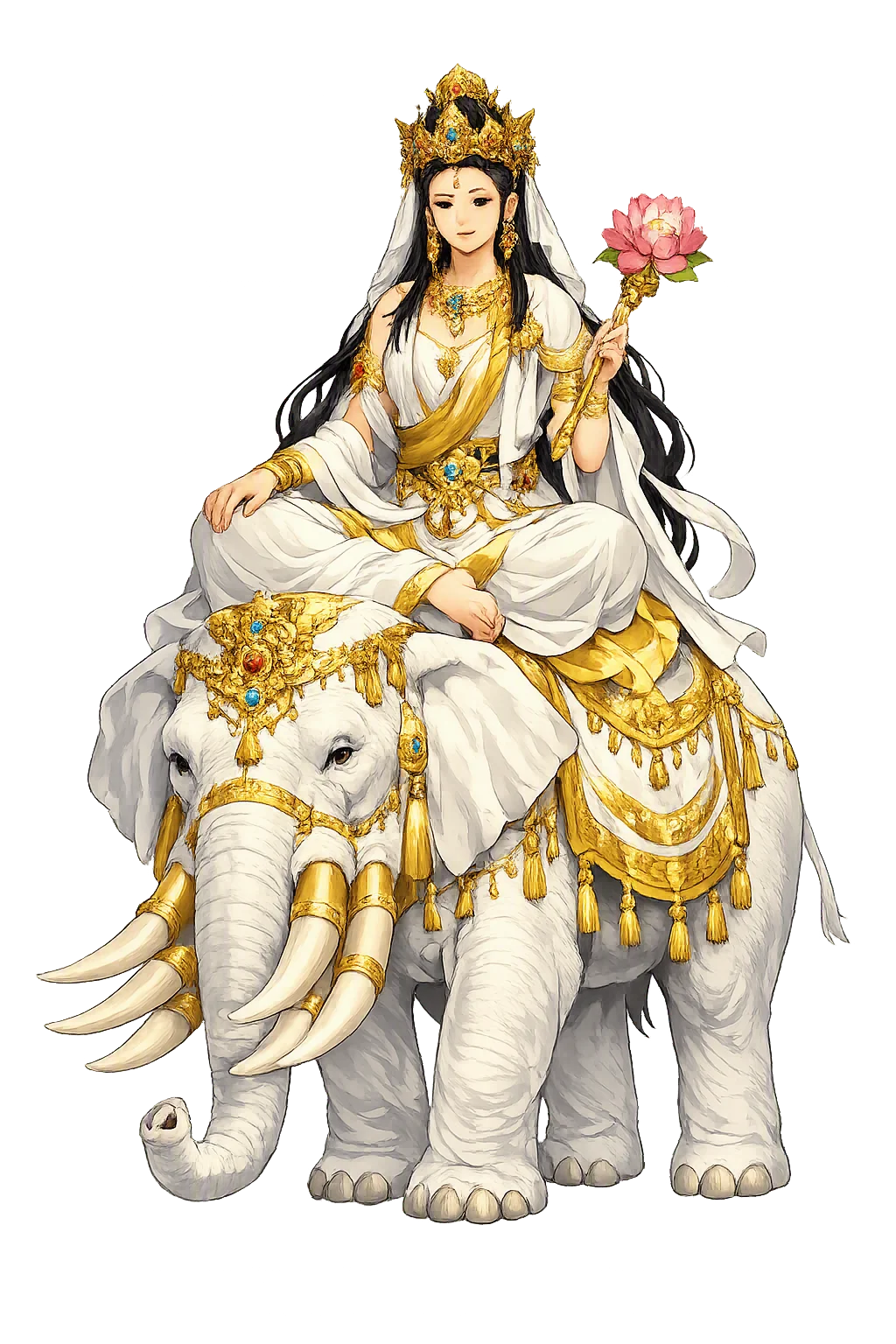
The Lotus Sūtra ends not with the Buddha but with a visitor. Its twenty-eighth chapter brings Samantabhadra from the eastern land, riding a great white elephant with six tusks, each tusk bearing seven lotuses, each lotus a radiant Buddha, surrounded by an entourage streaming across the sky — and he vows before the assembly to protect anyone who keeps, reads, or teaches the Lotus in the latter age, sending his fragrant elephant and his retinue to guard them, even laying his hand on their heads in blessing.
The atlas states the seat in one line: Resonant seat: Samantabhadra shares symbolic territory with mental health. The story above is the long version of the same sentence. The trade thinks it is optimizing a process. It is re-enacting a charter.
Philosophy, Ethics & Standards — through The Primordial Buddha of Tibet
In Tibet's oldest school, the Nyingma, Samantabhadra rose from bodhisattva to ground of being. Kun tu bzang po — the All-Good One — is the dharmakāya itself, the primordial Buddha who never entered samsara because there was nothing to enter: blue, naked, without ornaments of any kind, seated in equipoise with his consort Kun tu bzang mo in the gesture of the mind's own nature.
The atlas states the seat in one line: Resonant seat: Samantabhadra shares symbolic territory with philosophy ethics. The story above is the long version of the same sentence. Industries do not invent their archetypes; they inherit them and call them best practice.
Yoga, Meditation & Holistic Wellness — through The Elephant on the Golden Summit
China's geography made him its most walked mountain. Pǔxián's bodhimaṇḍa is Éméi shān, the lofty 'Eyebrow' peak of Sichuan — one of the four sacred Buddhist mountains, where the founding legend (recorded in the mountain's gazetteers) tells of a white elephant seen on the heights in the Eastern Han, and of a temple raised where it stood.
The atlas states the seat in one line: Resonant seat: Samantabhadra shares symbolic territory with wellness mind. The story above is the long version of the same sentence. Industries do not invent their archetypes; they inherit them and call them best practice.
The Theme That Runs the Cycle
Samantabhadra's mythology is the biography of goodness as a discipline. He closes the two greatest Mahāyāna sūtras with vows rather than visions, becomes Tibet's primordial Buddha without ever leaving his elephant, and turns a Sichuan peak into the most walked bodhimaṇḍa in China. His stories are quiet — and deliberately so.
The Method, Stated Plainly
The atlas is not a horoscope. Seats are earned from the sources — argued, weighted, published — and every one of them can be challenged at the methodology page. A match that cannot survive an argument does not survive review. That is the whole trick: the patterns are claims, and claims can be tested.
For the Ones Who Work There
If you work in faith & spiritual organizations, mental health & emotional wellness, or any trade this temple holds a seat in, this is the honest version of what a placement means: your industry beside the story it has been re-telling all along — on the temple floor itself, before an audience that came specifically to read it. The patron tier and the advertising terms describe the mechanics; the resonance above describes the fit.
The File Continues
One of 548 Resonance Files — the series where the pantheon goes to work. Read the founding dispatch for the name, the Restoration File for the spelling, or the whole archive end to end.
Continue the series — previous: Ṛta (read it) · next: Samshin (read it).
The Resonance Files are argued from the same canonical record as the pattern atlas itself: the lexicon, the lore catalog, and the cited sources. Every seat can be challenged at the methodology page — and the challenge is the point.