PuniCodex

Extended Lore

समन्तभद्र Samantabhadra

Etymology · Orthography · Cult · Iconography · Reception · Sources

Tier 2 Samantabhadra
Samantabhadra — Universal Good, Practice
01

Quick Facts

Essential information about Samantabhadra, Universal Good, Practice

Original Scriptसमन्तभद्र
Unicode RestorationSamantabhadra
Reconstructed Pronunciation/sɐ.ˈmɐn.tɐ.bʱɐd.ɾɐ/
PantheonBuddhist
DomainUniversal Good, Practice
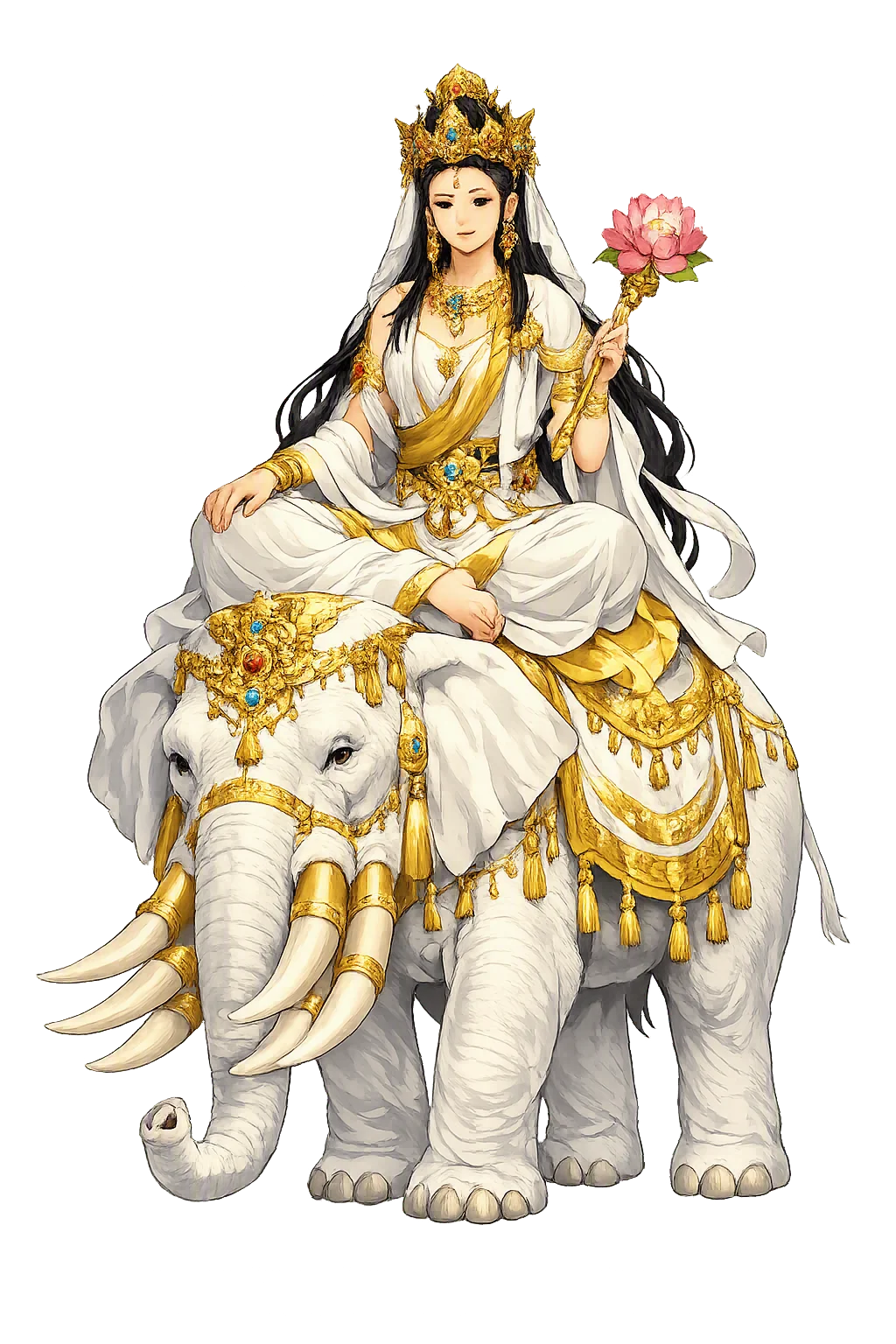
Meaning'Universal Beneficence' — the Bodhisattva of practice, rider of the white elephant
ClassificationTier 2
Primary DomainSamantabhadra
Sacred SymbolsThe six-tusked white elephant, The wish-fulfilling jewel, The sun and moon on his lotus seat, The golden-hued body, Kun tu bzang po with consort
02

Etymology & Word Family

From original script to Unicode restoration

Original Script समन्तभद्र Samantabhadra — "'Universal Beneficence' — the Bodhisattva of practice, rider of the white elephant"
Unicode Restoration Samantabhadra Canonical scholarly spelling — ASCII-identical
Modern ASCII samantabhadra Plain-ASCII fallback

The name Samantabhadra reaches the modern world through scholarly transliteration of the buddhist tradition. Because the conventional spelling uses only Latin letters, its Unicode and ASCII forms coincide — the tradition it carries is in the name itself, not in diacritics.

03

Unicode Character Breakdown

Character-by-character philological analysis

CharacterUnicodeNameBlockPhonetic Role
SU+0053Latin Capital Letter SBasic LatinSame, capitalized
aU+0061Latin Small Letter ABasic LatinSame
mU+006DLatin Small Letter MBasic LatinSame
aU+0061Latin Small Letter ABasic LatinSame
nU+006ELatin Small Letter NBasic LatinSame
tU+0074Latin Small Letter TBasic LatinSame
aU+0061Latin Small Letter ABasic LatinSame
bU+0062Latin Small Letter BBasic LatinSame
hU+0068Latin Small Letter HBasic LatinSame
aU+0061Latin Small Letter ABasic LatinSame
dU+0064Latin Small Letter DBasic LatinSame
rU+0072Latin Small Letter RBasic LatinSame
aU+0061Latin Small Letter ABasic LatinSame

The Tier 2 classification here reflects fidelity to the attested tradition, not recovered diacritics: every character of Samantabhadra already survives in ASCII. What the restoration preserves is the canonical spelling itself — the form scholarship standardised.

04

Cult & Worship

How the sacred was kept — rites, sanctuaries, remains

The Cult

Samantabhadra’s cult is liturgical rather than oracular. His Bhadracarī prayer — homage, praise, offering, confession, rejoicing, dedication — became the closing act of Mahāyāna practice itself: monasteries from Kyoto to Lhasa end their day’s rites with his ten vows, so that his liturgy is being recited somewhere on earth at every hour. In East Asia the Confession of Samantabhadra anchored repentance ceremonies; Tendai’s Lotus repentance rites placed Fugen at the center of its discipline, and the esoteric schools cultivated him as Fugen Enmei, the life-prolonging bodhisattva of the dhāraṇī bearing his name. Mount Emei made pilgrimage his peculiar cult, devotees climbing its stairs for centuries to salute the bodhisattva of practice on his own peak. His offering is anything and everything — the sūtra has him promising flowers as numerous as atoms, and the tradition simply obeyed.

In the Earth

His bronze at Wannian Temple on Mount Emei — Pǔxián riding an elephant, cast 980 CE under Song Taizu, some sixty-two tonnes of it — is among the largest and oldest surviving bronze Buddhist images in China, and the temple's founding legend reaches back to a Han-era sighting on the same slopes. The mountain's Golden Summit temples, rebuilt through the centuries, still anchor a living pilgrimage. At Dunhuang, ninth- and tenth-century mural fragments and banner paintings of the Avataṃsaka's assemblies preserve his early iconography, and the Tibetan manuscript caches of the same caves include early copies of the Kunjed Gyalpo — the primordial Buddha's text traveling the Silk Road in his name.

05

Iconography

How Samantabhadra was imaged across the ages

The Image

Samantabhadra travels on six tusks. His canonical image, drawn from the Lotus Sūtra’s closing vision, is a serene bodhisattva on a great white elephant whose six tusks each carry seven lotuses, each lotus a radiant buddha — generosity made transportable. By the Tang dynasty the type is settled in Chinese art: ninth-century banner paintings from Dunhuang, one now in the British Museum, show him riding his elephant beneath a jeweled canopy, guardians and attendants streaming behind — the procession formula East Asian painters repeated for a millennium. Japanese Shingon and Tendai art kept the grammar identical: elephant, lotus throne, vajra or wish-pearl in hand. The Pala bronzes of Bengal and Bihar cast him smaller but to the same plan. Nothing about him is weaponized; he may be the only great bodhisattva whose iconography never learned to threaten.

06

Reception & Transformation

The name after its own age — transmission, translation, survival

Afterlives

Samantabhadra travelled as a closing chapter. India gave him no biography, so his transmission is a relay of translations: Buddhabhadra’s Chinese Avataṃsaka (420 CE) closed with his vows; Śikṣānanda’s eighty-fascicle recension (699) enlarged them; Yijing issued a separate translation of the prayer around 700; and Prajña’s forty-fascicle version (798–99) published the vows as an independent sūtra — effectively a scripture that is one long promise. The text returned west with the caravans into the Tibetan canon, where the Kunjed Gyalpo made his name the ground of Dzogchen lineages down to the present. Europe met him when Burnouf presented the Gaṇḍavyūha to the Académie des Inscriptions (1844); Thomas Cleary’s English Flower Ornament Scripture (1984) gave Anglophone readers his vows entire. Two thousand years of transmission, and the prayer still ends the same way: whatever good I have done, may all beings share it.

Identifications Across Traditions

Across East Asia he is the third of the great bodhisattva triad — with Avalokiteśvara (compassion) and Mañjuśrī (wisdom) — the trio enthroned beside Śākyamuni in countless Chinese halls: the heart, the head, and the hands. Japan received Fugen with the same triad logic, and medieval honji-suijaku thought read him as the Buddhist truth behind several kami. Tibet's reception was the boldest: the Nyingma school made Kun tu bzang po the primordial Buddha, the dharmakāya personified, so that the bodhisattva of good conduct became the very ground of enlightenment — practice revealed as the nature of mind itself. The two identities never merged, and the tradition sees no contradiction: the elephant-rider is what the All-Good One looks like when he consents to have a form.

Modern Legacy

Samantabhadra's legacy is the most recited prayer in the Mahāyāna world: the Bhadracarī, his ten vows, closes the day's practice in monasteries from Dharamsala to Kyoto, and its verses — just as Samantabhadra practiced, so may I — are the template of Buddhist dedication across Asia. Mount Emei, his seat, is a UNESCO-listed sacred landscape climbed by pilgrims for two thousand years, its ten-thousand-year temple guarding his bronze elephant. In Japan, Fugen presides over the Lotus Sūtra's protection cult; in Tibet, Kun tu bzang po opens the Dzogchen teachings as the name of the mind's own nature. The restoration Samantabhadra needs no diacritics to carry its meaning — the name itself is the sentence: good, on all sides, without exception.

07

The Meditation

What Samantabhadra means — beyond the dictionary

Samantabhadra is the answer to the suspicion that the Mahāyāna is all vision and no work. The Avataṃsaka gives us a cosmos of jeweled interpenetration — and then, in its final pages, hands the whole thing to a bodhisattva on an elephant and ten vows. The placement is the teaching: contemplation without practice is a postcard; practice is the journey the postcard describes. His vows are famously unglamorous — homage, praise, offering, confession, rejoicing — none of them beyond a beginner, all of them infinite. That combination is the point: a practice anyone can start and no one can finish is precisely the shape of a life. He is also the bodhisattva of the collective: every vow ends in dedication, the merit poured back into the common account. If Mañjuśrī asks what you know, Samantabhadra asks what you did with it — and his elephant does not hurry, because goodness, unlike insight, is allowed to take forever.

08

Frequently Asked Questions

Common questions about Samantabhadra, Universal Good, Practice, and Unicode restoration

01How do you pronounce Samantabhadra?

In reconstructed pronunciation, Samantabhadra is /sɐ.ˈmɐn.tɐ.bʱɐd.ɾɐ/ — approximately 'suh-MUN-tuh-bhud-ruh' — the bh is aspirated like 'b-hud' in one breath; the name runs even and calm, like the practice it names.

02What does Samantabhadra mean?

Samantabhadra means 'Universal Beneficence' — the Bodhisattva of practice, rider of the white elephant in the buddhist tradition.

03What are the symbols of Samantabhadra?

Samantabhadra is associated with The six-tusked white elephant (The vehicle of practice: strength that never hurries, six tusks for the six pāramitās), The wish-fulfilling jewel (The cintāmaṇi he holds: the good whose granting never depletes it), The sun and moon on his lotus seat (His throne supports a lotus bearing the sun disc — practice illuminated at every hour), The golden-hued body (Like a mountain at dawn: the color of the golden light that fills the Avataṃsaka's cosmos), Kun tu bzang po with consort (In the Nyingma tradition, the primordial Buddha in union with Samantabhadrī — good as the ground of being itself).

04Why restore Samantabhadra in Unicode?

Samantabhadra is written entirely in ASCII letters, so its restoration is about canonical fidelity rather than recovered diacritics: the temple fixes the name in its scholarly standard spelling, attested in the source tradition, instead of leaving it to drift.

05What is the most important myth about Samantabhadra?

“The Ten Great Vows” — the Avataṃsaka Sūtra story that anchors the mythology of Samantabhadra, told in full on the lore page.

09

Scholarly Sources

The philological foundations of this restoration

Every claim on this page is grounded in established scholarship. The orthographic restorations follow disciplinary convention. The etymological chain follows the best available reference works. This is not invention — it is resurrection through scholarship.

◈

Lexicography & Philology

  • Mahayana texts
  • Buddhist texts
◎

Primary Texts

  • The Larger Sukhāvatī-vyūha Sūtra; the Smaller Sukhāvatī-vyūha Sūtra; the Amitāyurdhyāna Sūtra; the Lotus Sūtra.
◉

Archaeology & Art History

  • Material evidence — iconography, inscriptions, and temple archaeology — for Samantabhadra and related cults.
✦

Religious Studies

  • Avataṃsaka Sūtra (Bhadracarī-praṇidhāna)
  • Saddharma-puṇḍarīka Sūtra (Lotus Sūtra), ch. 28
  • Kunjed Gyalpo (All-Creating King Tantra)
  • Buswell and Lopez, The Princeton Dictionary of Buddhism
  • Williams, Mahāyāna Buddhism
Return

The Surface Awaits

You have traced the name from its earliest attestation to its Unicode restoration. Now return to the myth. The story is where the name lives.

Back to Lore
Samantabhadra mascot