
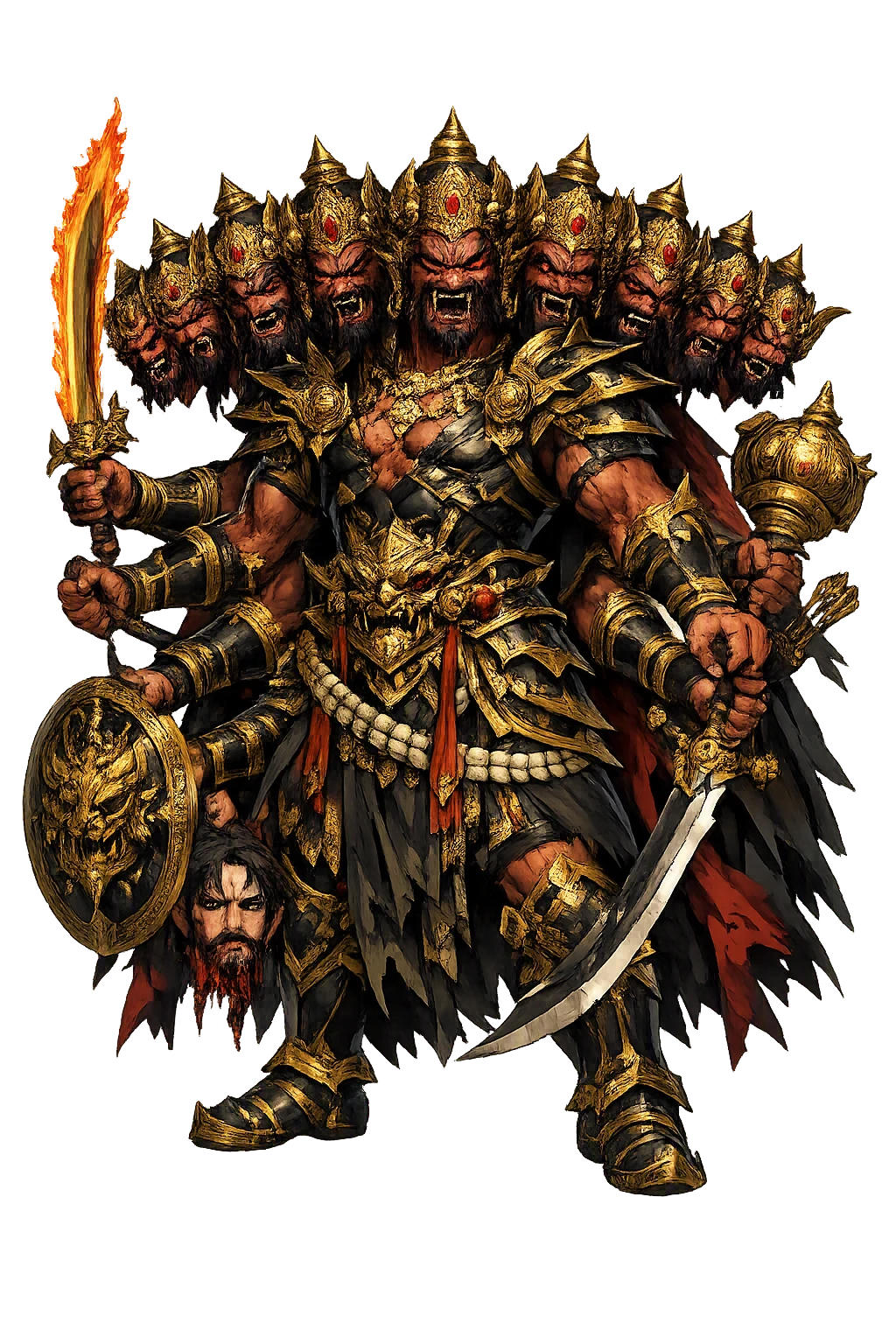
The working life of Rāvaṇa: from the myths to the modern trades
The myths did not retire. They moved offices. This is the file on where Rāvaṇa works now.
The Rāmāyaṇa builds Rāvaṇa as a complete king — scholar, musician, ascetic, conqueror of the three worlds — whose single failure of self-command draws Rāma across the ocean. His story spans the epic's frame: born in its seventh book, he dies in its sixth.
The pattern atlas — which maps every flagship temple to the industries its archetype demonstrably resonates with, each match argued and open to challenge — seats this temple in 7 industries. This file reads those seats the way they were earned: through the myths.
At a Glance
- Temple: Rāvaṇa
- Pantheon: Sanskrit
- Domain of influence: Ten-Headed King, Lanka
- Pattern seats: 7
- Sectors touched: Society & Spirit · Culture & Entertainment · Technology & Innovation
- Strongest seat: Faith & Spiritual Organizations
- Series: The Resonance Files, No. 417 of 548
The Myth at Work
Born of Sage and Demoness. In the Rāmāyaṇa's seventh book the villain's pedigree is nobler than his deeds: his father is Viśravas, a sage of flawless conduct, son of Pulastya, whom Brahmā generated from his own mind; his mother is Kaikasi, daughter of the daitya king Sumāli. From their union came four children — Rāvaṇa, the massive Kumbhakarṇa, the righteous Vibhīṣaṇa, and the fierce Śūrpaṇakhā (Vālmīki, Uttarakāṇḍa 9–11). — remember the shape of that act. You will see it again, wearing a logo.
The Shaking of Kailāsa. Striding forth to conquer the quarters, Rāvaṇa found the way to Śiva barred by the bull-bannered gatekeeper Nandin; mocked for his boast, he took hold of the mountain itself and began to wrench it from its roots, so that the peaks, forests, and every creature upon them cried out (Vālmīki, Uttarakāṇḍa 16). Śiva pressed the peak down with the toe of his foot and pinned the upstart's arms beneath it; the agony tore a roar from him so tremendous that the three worlds shook, and the pleased god named him on the spot: Rāvaṇa, 'he who roars' — for older tradition the roar was the cry of the crushed, and Kālidāsa would later retell the whole confrontation in the Kumārasambhava (canto 7). — hold that image; the industries below are where it goes to work.
The Seats
Each of these is argued in the atlas with a weight and a why-line. What the atlas cannot fit in one line is the whole myth — so here is each seat with its story restored.
Faith & Spiritual Organizations
Religious institutions, faith media, and devotional services. (Sector: Society & Spirit)
The why-line says it in one breath: The ten-headed sovereign of Laṅkā and the Rāmāyaṇa's great antagonist — a figure of power, learning, and penance in Hindu and Buddhist telling. That is not a resemblance; it is the same act, performed in a newer building.
Music, Arts & Performance
Music, theatre, dance, and the performing arts. (Sector: Culture & Entertainment)
The Rāvaṇa of the Rāmāyaṇa is a master of the vīṇā and a patron of music and the arts in South Asian tradition. — the atlas stops there, out of discipline. The myth keeps going: the function Rāvaṇa performs in the stories is precisely the function this industry sells.
Mythic Name Restoration
Scholarly Unicode restorations of mythic names for modern identity. (Sector: Culture & Entertainment)
The IAST form of the Ramayana antagonist, preserving Sanskrit length. — the atlas stops there, out of discipline. The myth keeps going: the function Rāvaṇa performs in the stories is precisely the function this industry sells.
Diacritic-First Domains
IDN domains where the restored marks are the entire point. (Sector: Technology & Innovation)
The macron on Rāvaṇa preserves Sanskrit vowel length in the domain. Swap the costume and the sentence is indistinguishable from the myth. That is what a resonance seat means.
Global Pantheon Brands
Cross-cultural deity and hero names as sovereign brand anchors. (Sector: Society & Spirit)
The IAST form of the Ramayana antagonist, a ten-headed sovereign of Lanka. — the atlas stops there, out of discipline. The myth keeps going: the function Rāvaṇa performs in the stories is precisely the function this industry sells.
The temple holds 2 further seats beyond these — the full, argued list lives on its patterns floor.
The Long Employment
Every autumn at Dussehra, across India and the diaspora, towering effigies of Rāvaṇa — ten-headed, twenty-armed, stuffed with firecrackers — are burned to cheers, reenacting the epic's climax on the festival that celebrates Rāma's victory. The ritual has its dissenters: in Bisrakh, the village near Delhi that claims his birthplace, some families keep mourning on the burning-day, and in Bastar, Gond tradition counts him an ancestor to be honored. The age changed. The work did not.
The Method, Stated Plainly
None of this is numerology. A seat exists only where the match can be argued from the deity’s documented domains and deeds — weighted, published, and falsifiable. The derivation, the weights, and the challenge process are public on the methodology page. If a seat in this file reads wrong, the atlas itself tells you how to prove it — and the correction becomes part of the record.
For the Ones Who Work There
If you work in faith & spiritual organizations, music, arts & performance, or any trade this temple holds a seat in, this is the honest version of what a placement means: your industry beside the story it has been re-telling all along — on the temple floor itself, before an audience that came specifically to read it. The patron tier and the advertising terms describe the mechanics; the resonance above describes the fit.
The File Continues
One of 548 Resonance Files — the series where the pantheon goes to work. Read the founding dispatch for the name, the Restoration File for the spelling, or the whole archive end to end.
Continue the series — previous: Ratnasambhava (read it) · next: Reginn (read it).
The Resonance Files are argued from the same canonical record as the pattern atlas itself: the lexicon, the lore catalog, and the cited sources. Every seat can be challenged at the methodology page — and the challenge is the point.