
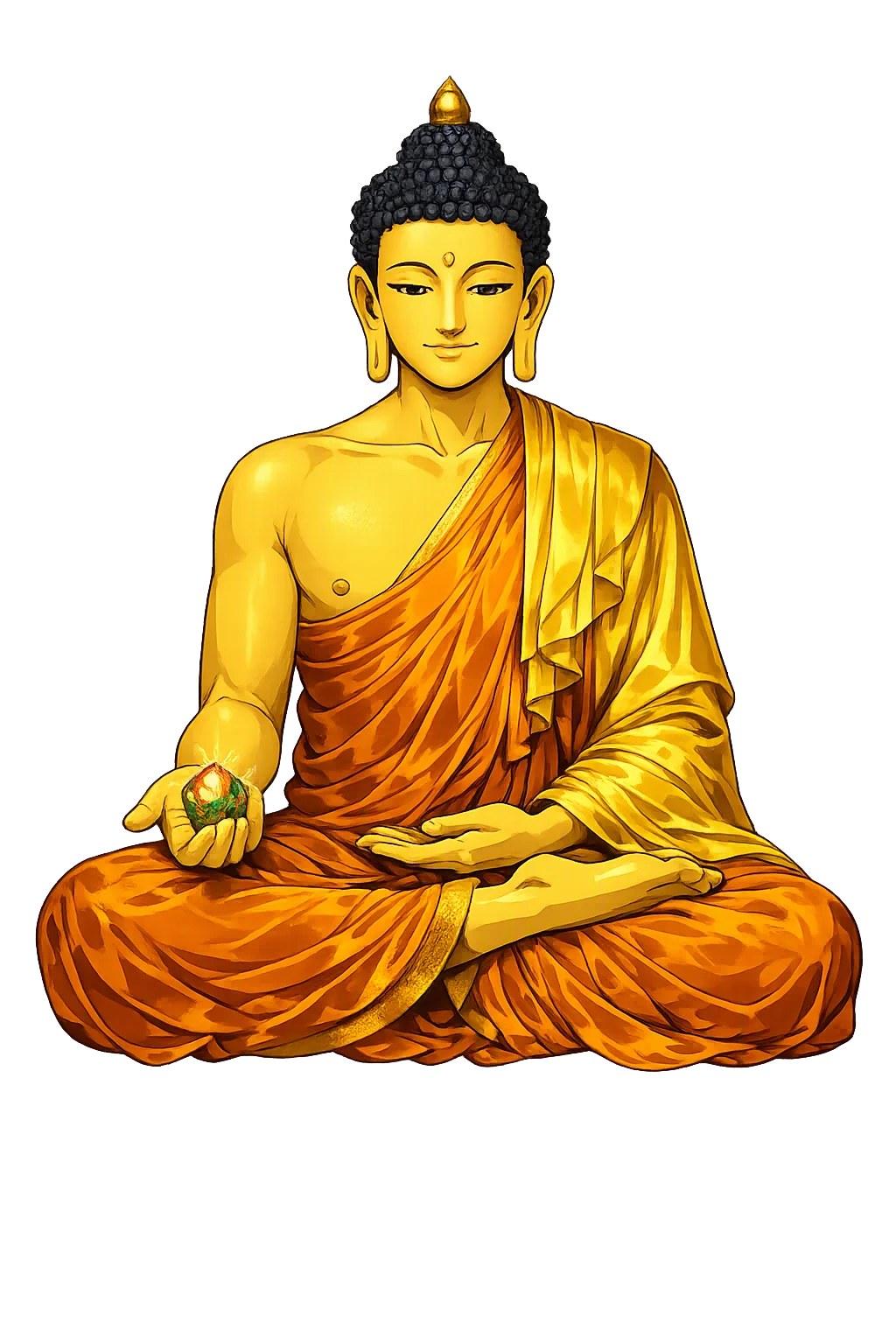
Ratnasambhava at work: faith & spiritual organizations, manufacturing, craft & automation, and the myths that got there first
The myths did not retire. They moved offices. This is the file on where Ratnasambhava works now.
Ratnasambhava has no biography of battles and loves; as a Dhyānibuddha his 'mythology' is a maṇḍala — a cosmic arrangement in which the south, the color gold, the gesture of giving, and the wisdom of equality converge on a single figure born of the wish-fulfilling jewel.
The pattern atlas — which maps every flagship temple to the industries its archetype demonstrably resonates with, each match argued and open to challenge — seats this temple in 5 industries. This file reads those seats the way they were earned: through the myths.
At a Glance
- Temple: Ratnasambhava
- Pantheon: Buddhist
- Domain of influence: Jewel-Born, South
- Pattern seats: 5
- Sectors touched: Society & Spirit · Technology & Innovation · Health & Wellbeing
- Strongest seat: Faith & Spiritual Organizations
- Series: The Resonance Files, No. 416 of 548
The Myth at Work
Born of the Jewel in Akaniṣṭha. In the Mahāyāna cosmology codified in the yoga-tantra canon — above all the Sarvatathāgatatattvasaṃgraha, the 'Compendium of the Truth of All Tathāgatas' — each of the five Dhyani Buddhas began as a bodhisattva who made universal vows before the Buddhas of former eons and attained perfect enlightenment in Akaniṣṭha, the highest heaven of form. Ratnasambhava's vow was the vow of giving: to ripen in all beings the capacity for generosity, the first of the perfections (pāramitā), until they too stood as self-arisen jewels. — that is not just a story. It is a business model, four thousand years early.
The South Gate of the Five Families. The five-family maṇḍala arranges the awakened mind as a cosmic cross: Vairocana at the center, Akṣobhya in the east, Ratnasambhava in the south, Amitābha in the west, Amoghasiddhi in the north. Each presides over a family (kula) of beings bound by one of the five poisons and liberated by its counter-wisdom. — that is not just a story. It is a business model, four thousand years early.
The Seats
Each of these is argued in the atlas with a weight and a why-line. What the atlas cannot fit in one line is the whole myth — so here is each seat with its story restored.
Faith & Spiritual Organizations
Religious institutions, faith media, and devotional services. (Sector: Society & Spirit)
The why-line says it in one breath: Primary seat: Ratnasambhava embodies jewel-born, south — the core of faith. That is not a resemblance; it is the same act, performed in a newer building.
Manufacturing, Craft & Automation
Fabrication, industrial craft, and robotics. (Sector: Technology & Innovation)
Resonant seat: Ratnasambhava shares symbolic territory with manufacturing craft. Swap the costume and the sentence is indistinguishable from the myth. That is what a resonance seat means.
Mental Health & Emotional Wellness
Therapy, emotional wellbeing, and mindfulness. (Sector: Health & Wellbeing)
Resonant seat: Ratnasambhava shares symbolic territory with mental health. Swap the costume and the sentence is indistinguishable from the myth. That is what a resonance seat means.
Philosophy, Ethics & Standards
Philosophy, ethics boards, and standards bodies. (Sector: Society & Spirit)
Resonant seat: Ratnasambhava shares symbolic territory with philosophy ethics. — the atlas stops there, out of discipline. The myth keeps going: the function Ratnasambhava performs in the stories is precisely the function this industry sells.
Yoga, Meditation & Holistic Wellness
Yoga, meditation, and mind-body practice. (Sector: Health & Wellbeing)
Resonant seat: Ratnasambhava shares symbolic territory with wellness mind. Swap the costume and the sentence is indistinguishable from the myth. That is what a resonance seat means.
The Long Employment
Ratnasambhava's cult never had a single great pilgrimage centre; it lives wherever the five-Buddha maṇḍala is painted — on the toranas of Nepalese stūpas, in the assembly halls of Ladakhi and Tibetan monasteries, in the Tang maṇḍalas preserved at Tō-ji and the thousand-year rites of Mount Kōya. His gift-gesture made him a patron of abundance, addressed by farmers and merchants alike. The age changed. The work did not.
The Method, Stated Plainly
None of this is numerology. A seat exists only where the match can be argued from the deity’s documented domains and deeds — weighted, published, and falsifiable. The derivation, the weights, and the challenge process are public on the methodology page. If a seat in this file reads wrong, the atlas itself tells you how to prove it — and the correction becomes part of the record.
For the Ones Who Work There
If you work in faith & spiritual organizations, manufacturing, craft & automation, or any trade this temple holds a seat in, this is the honest version of what a placement means: your industry beside the story it has been re-telling all along — on the temple floor itself, before an audience that came specifically to read it. The patron tier and the advertising terms describe the mechanics; the resonance above describes the fit.
The File Continues
One of 548 Resonance Files — the series where the pantheon goes to work. Read the founding dispatch for the name, the Restoration File for the spelling, or the whole archive end to end.
Continue the series — previous: Ratatoskr (read it) · next: Rāvaṇa (read it).
The Resonance Files are argued from the same canonical record as the pattern atlas itself: the lexicon, the lore catalog, and the cited sources. Every seat can be challenged at the methodology page — and the challenge is the point.