The Living Myth
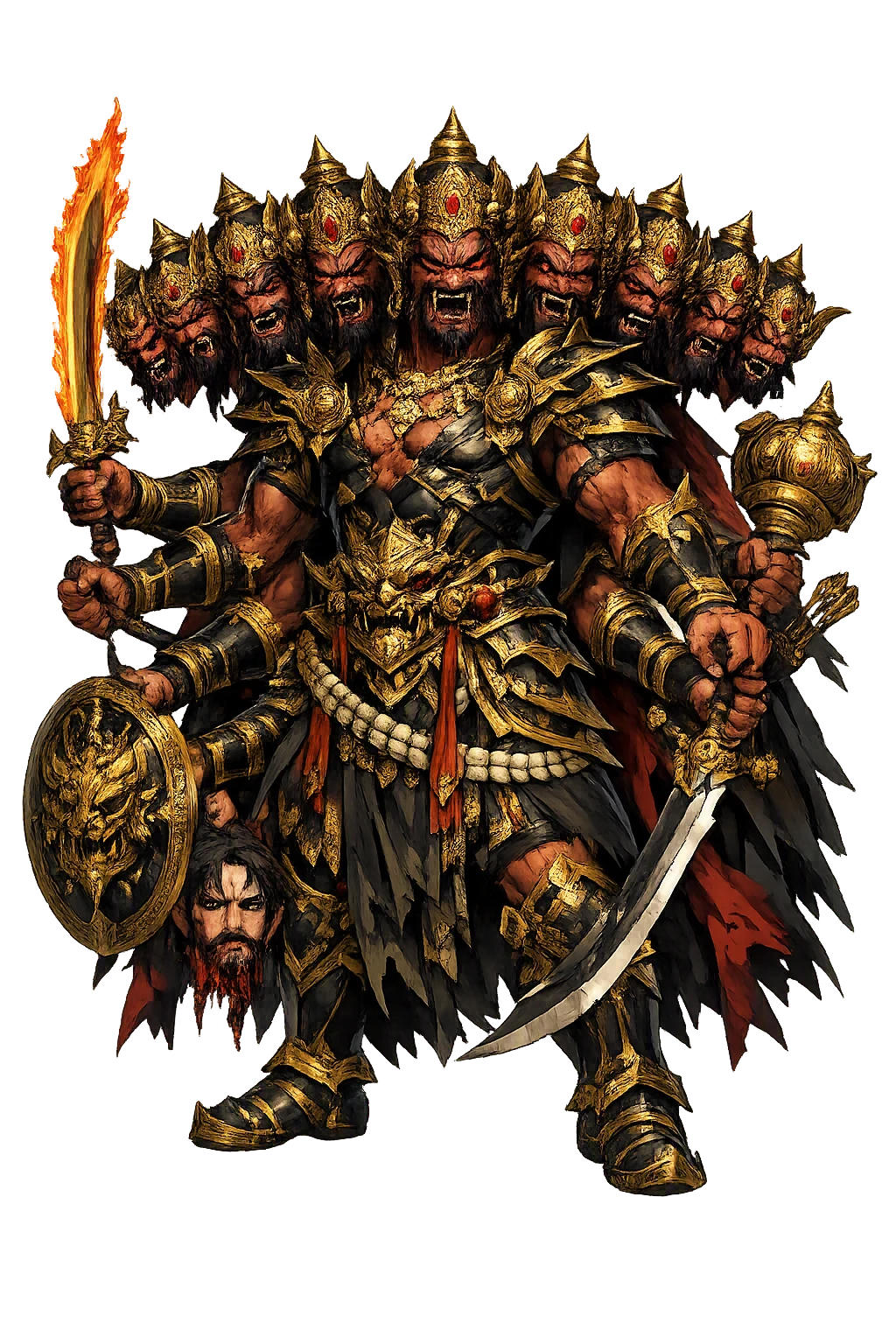
Ten-Headed King, Lanka · The ruler of Laṅkā and chief of the Rākṣasas, whose destruction by Rāmacandra forms the subject of the Rāmāyaṇa
Stories of Rāvaṇa
The Rāmāyaṇa builds Rāvaṇa as a complete king — scholar, musician, ascetic, conqueror of the three worlds — whose single failure of self-command draws Rāma across the ocean. His story spans the epic's frame: born in its seventh book, he dies in its sixth.
In the Rāmāyaṇa's seventh book the villain's pedigree is nobler than his deeds: his father is Viśravas, a sage of flawless conduct, son of Pulastya, whom Brahmā generated from his own mind; his mother is Kaikasi, daughter of the daitya king Sumāli. From their union came four children — Rāvaṇa, the massive Kumbhakarṇa, the righteous Vibhīṣaṇa, and the fierce Śūrpaṇakhā (Vālmīki, Uttarakāṇḍa 9–11). The young Daśagrīva performed a tapas of terrifying austerity — standing amid five fires, his arms raised, for a thousand years — until Brahmā, unable to refuse him, granted near-invulnerability: no god, gandharva, yakṣa, or demon might kill him. Men he omitted from the request, in contempt for their weakness (Uttarakāṇḍa 10). Later tellings deepen the bargain — nine times he offered his own head into the fire, and nine times it grew back, until ten heads stood where one had been. The epic's point is exact: its monster is born of a sage's house, and his doom is written into his own wish.
Striding forth to conquer the quarters, Rāvaṇa found the way to Śiva barred by the bull-bannered gatekeeper Nandin; mocked for his boast, he took hold of the mountain itself and began to wrench it from its roots, so that the peaks, forests, and every creature upon them cried out (Vālmīki, Uttarakāṇḍa 16). Śiva pressed the peak down with the toe of his foot and pinned the upstart's arms beneath it; the agony tore a roar from him so tremendous that the three worlds shook, and the pleased god named him on the spot: Rāvaṇa, 'he who roars' — for older tradition the roar was the cry of the crushed, and Kālidāsa would later retell the whole confrontation in the Kumārasambhava (canto 7). Crushed but unrepentant, Rāvaṇa sang — the Śivatāṇḍava stotra, the hymn still recited in Śaiva mornings — until the mountain lifted and Śiva, mollified, gave him the sword Candrahāsa. The myth defines him in a single tableau: strength enough to move a mountain, devotion enough to sing to the god who crushes him, and a roar that becomes his name.
In the forest of Pañcavaṭī the king of Laṅkā played the long game of vengeance. His sister Śūrpaṇakhā came home mutilated by Lakṣmaṇa after her advances; his cousins Khara and Dūṣaṇa marched out of Janasthāna with fourteen thousand troops and were annihilated. Then came the abduction itself: Mārīca, master of illusion, took the shape of a golden deer with silver spots, and Rāma, beguiled, chased it deep into the wood; the dying demon mimicked Rāma's voice crying for help, and Sītā — against her own knowledge of the rules of the forest — sent Lakṣmaṇa after him. With the hermitage empty, Rāvaṇa approached in the guise of a wandering ascetic and carried Sītā off through the sky in the Pushpaka chariot. The aged vulture Jaṭāyu, her only defender, struck until his wings were shorn and fell dying; from his last words Rāma learned the abductor's name. Every element of that hour is answered in kind before the epic ends — the epic's economy of violence is exact, and the abduction buys the destruction of everything Rāvaṇa loves.
Rāma's army was monkeys and bears under Sugrīva and Hanumān, and the ocean itself was crossed at Rāma's word: the Nala Setu, a bridge of mountain-peaks dropped into the sea from Rāmeśvaram to Laṅkā (Yuddhakāṇḍa 22). The siege that followed is the epic's great battle-book. Meghnāda, Rāvaṇa's sorcerer-son called Indrajit, bound the whole monkey host with the serpent-noose of the nāgāstra, and later struck Lakṣmaṇa down with the Brahmāstra itself; only the Himalayan herb Suṣeṇa prescribed, flown in by Hanumān, called him back from death. Vibhīṣaṇa — Rāvaṇa's own brother — had urged the return of Sītā and, his counsel scorned, crossed to Rāma's camp; from him the allies learned the secret of Indrajit's sacrificial rites and killed him at his own ritual. Kumbhakarṇa woke from his six-month sleep and fell like a landslide. The epic's verdict is spoken in its council scenes: Laṅkā does not fall to monkeys, but to a king who will listen to no one.
The last duel ran a day and a night. Rāma cut away head after head — and the necks sprouted anew, the severed heads regenerating like serpents' tails — until Vibhīṣaṇa revealed where the boon had hidden his brother's life, and Rāma strung the great arrow that Agastya had given him, charged with the power of the wind-god, and loosed it through the chest (Yuddhakāṇḍa 108–111). The ten-headed king fell as Vṛtra fell to Indra's bolt, and the earth shook to its oceans. What follows is the epic's most revealing grace-note: Rāma commands the full funeral rites for his enemy and says that no greater hero had ever lived, and the dying king, through Vibhīṣaṇa, gives Sītā his blessing and pronounces her chaste before the whole world. In the frame of the Uttarakāṇḍa and the Bhāgavata Purāṇa (7.1), Rāvaṇa had never truly been a demon at all, but Jaya — Viṣṇu's own gatekeeper, cursed to three enemy-births as the price of a wish. The epic dispatches its enemies; it never once permits itself to despise them.
Ten-Headed King, Lanka
Rāvaṇa is the ten-headed king of Laṅkā in the Sanskrit Rāmāyaṇa — grandson of a mind-born sage, son of a demon princess, devotee of Śiva, master of the Vedas, and the abductor whose war against Rāma costs him his kingdom, his sons, and his life. The epic builds him as its most learned villain: every virtue but one.
Daśagrīva — ten heads, twenty arms; later readers counted the four Vedas and six śāstras among the ten.
Son of the sage Viśravas and the daitya princess Kaikasi; sovereign of the golden island fortress and its rākṣasa hosts (Rāmāyaṇa, Uttarakāṇḍa 9).
The restoration Rāvaṇa recovers the long ā and retroflex ṇ that plain ASCII ravana flattens.
Chief antagonist of Vālmīki's Rāmāyaṇa — and, in the Jain Paümacariya, the noblest king of the story.
From the original script to the living URL
रावण
The name in its original Sanskrit form. Rāvaṇa (रावण) is attested in the source tradition — “The ruler of Laṅkā and chief of the Rākṣasas, whose destruction by Rāmacandra forms the subject of the Rāmāyaṇa”. Its macron-length vowels and nasal retroflexes carry the full phonetic and orthographic weight of the source tradition.
ravana
Reduced to plain ravana, the name loses everything that made it specific: macron-length vowels and nasal retroflexes. What remains is an ASCII string that machines can parse but that no longer speaks with its original voice.
Rāvaṇa
The Unicode restoration recovers what ASCII flattened. Rāvaṇa restores macron-length vowels and nasal retroflexes, returning the name to its original written dignity. The domain encodes to Punycode, but the browser displays the truth.
Rāvaṇa.com → xn--rvaa-qsa0806b.com
The non-ASCII characters in Rāvaṇa are encoded while the ASCII remains visible. To the DNS, it is Punycode. To humanity, it is Rāvaṇa.
Owned, ideal, and ASCII forms of Rāvaṇa
Rāvaṇa
Restores रावण. The live temple domain — rāvaṇa.com.
ravana
Flattens रावण. The plain ASCII fallback — what DNS and legacy systems see.
How Rāvaṇa was spoken
How Rāvaṇa travels from ancient script to the modern URL
The lore you have read is the living myth. Extended Lore opens the scholarly vault beneath it: the cult and its material remains, a history of the image, the name after antiquity, a meditation on what the name still means, and the full scholarly apparatus — etymology, orthography, sources.
Enter Extended Lore