
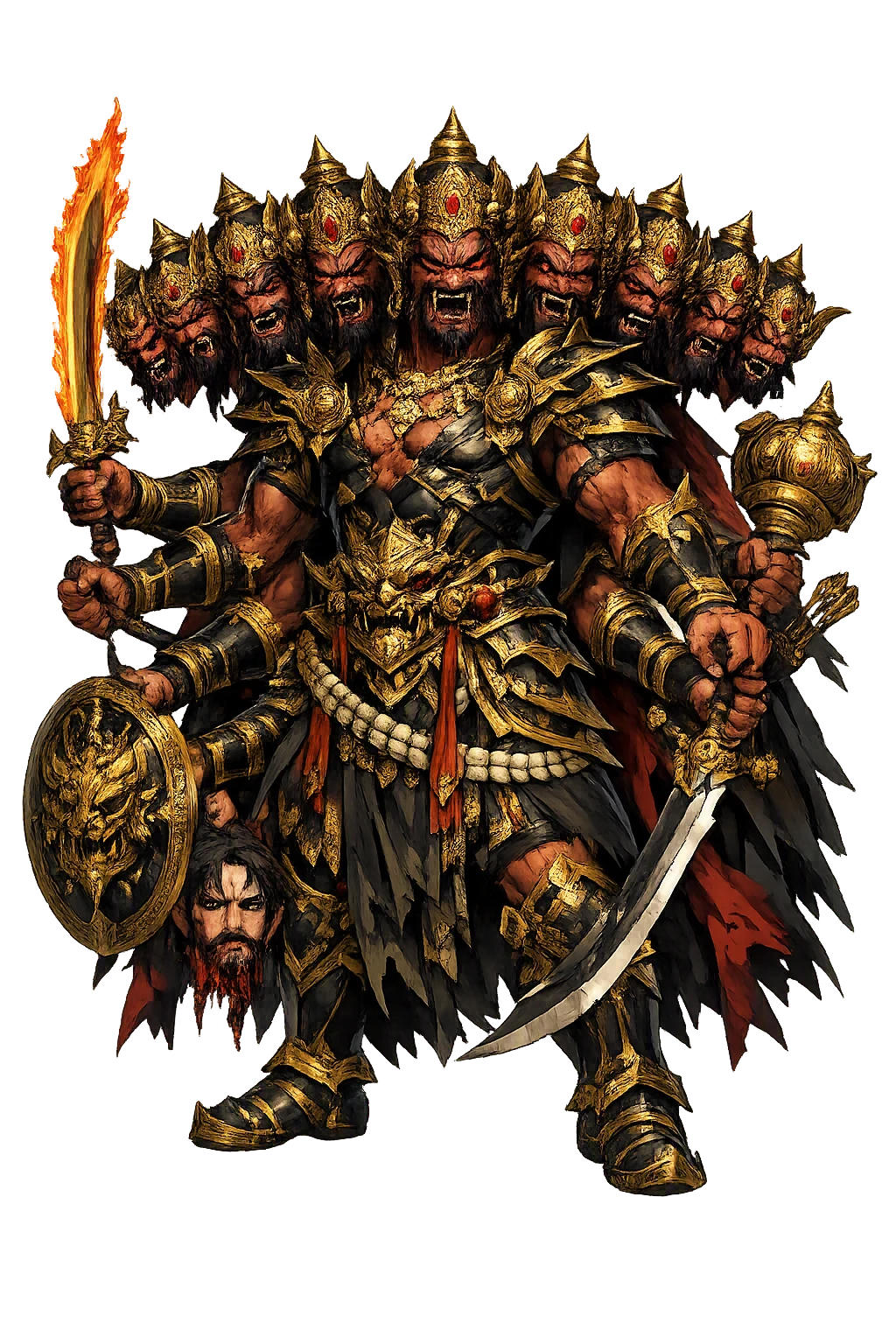
Why Rāvaṇa is spelled that way — and what it costs to get it right
There is a version of this name the early internet had to settle for: ravana. This is the file on how Rāvaṇa replaced it.
The Rāmāyaṇa builds Rāvaṇa as a complete king — scholar, musician, ascetic, conqueror of the three worlds — whose single failure of self-command draws Rāma across the ocean. His story spans the epic's frame: born in its seventh book, he dies in its sixth.
At a Glance
- Restored name: Rāvaṇa
- ASCII form: ravana
- Meaning: "The ruler of Laṅkā and chief of the Rākṣasas, whose destruction by Rāmacandra forms the subject of the Rāmāyaṇa"
- Domain of influence: Ten-Headed King, Lanka
- Pantheon: Sanskrit
- Classification: Tier 1
- Original script: रावण
- Series: The Restoration Files, No. 417 of 548
The Name Before the Marks
Strip Rāvaṇa to ravana and one piece of evidence vanishes:
- a → ā — Macron: long vowel: the vowel length the ASCII form cannot show.
These are the small, provable things a restoration is made of: not taste, not branding — attestation.
Spoken, the name runs `/raː.ʋɐ.ɳɐ/` — 'RAA-vuh-nuh' — long open first syllable, a soft w-like v, and a tongue-curled n for the ṇ.
The Temple That Stands Now
The restored name is not a plaque; it is an address. The temple of Rāvaṇa lives at /ravana/, with its mythology in the lore halls, its peer-reviewed record in the Scholarly Edition, and its place in the pattern atlas on the patterns floor.
The restoration preserves more than the ASCII form can express — stress, length, or a letter the Latin keyboard lost — which places it, mechanically, in Tier-1.
Where the Name Stood First
There is no material record of Rāvaṇa — no inscription, coin, or image survives from any period that names him, and the giant belongs entirely to the textual tradition, whose oldest witnesses are the medieval manuscripts of the Rāmāyaṇa itself. The landscape, however, has been thoroughly claimed by the epic. In Sri Lanka — Laṅkā of the tradition — the rock fortress of Sigīrya is popularly his palace (in fact the work of King Kāśyapa I, fifth century CE), and the cave above the falls at Ella is toured as Rāvaṇa's own. Between India and the island runs Ādām's Bridge, the chain of shoals the epic calls Nala's bridge (Yuddhakāṇḍa 22), and at Rāmeśvaram in Tamil Nadu the Rāmanāthaswāmy temple stands at the epic's launching point, its corridors among the longest in India. The archaeology of Rāvaṇa is thus the archaeology of reception — geology, temples, and place-names retelling the story in stone. The temple on the web is the newest of these addresses — the first one that fits in a pocket.
The Archetype at Work
The pattern atlas seats this temple in 7 industries, each match argued and weighted: Faith & Spiritual Organizations (the ten-headed sovereign of Laṅkā and the Rāmāyaṇa's great antagonist — a figure of power, learning, and penance in Hindu and Buddhist telling.); Music, Arts & Performance (the Rāvaṇa of the Rāmāyaṇa is a master of the vīṇā and a patron of music and the arts in South Asian tradition.); Mythic Name Restoration (the IAST form of the Ramayana antagonist, preserving Sanskrit length.). The Resonance File reads those seats through the myths themselves.
In the Sacred Texts
The Sanskrit tradition is not a vibe; it is a library. The Sacred Texts collection holds Rig Veda and Ramayana — the primary sources the temple's scholarship is built on. The temple is the argument; the texts are the evidence.
The File Continues
The temple's founding dispatch tells the name's story; its Resonance File reads the myths into the industries; the blog index holds the whole archive.
Continue the series — previous file: Ratnasambhava (read it here) · next file: Reginn (read it here).
The Restoration Files are written from the same canonical record as the temples themselves: the lexicon, the lore catalog, the pattern atlas, and the cited scholarly sources. If a file ever disagrees with its temple, the temple is right — tell us, and the file will be corrected.