
Why Ratnasambhava is spelled that way — and what it costs to get it right
There is a version of this name the early internet had to settle for: ratnasambhava. This is the file on how Ratnasambhava replaced it.
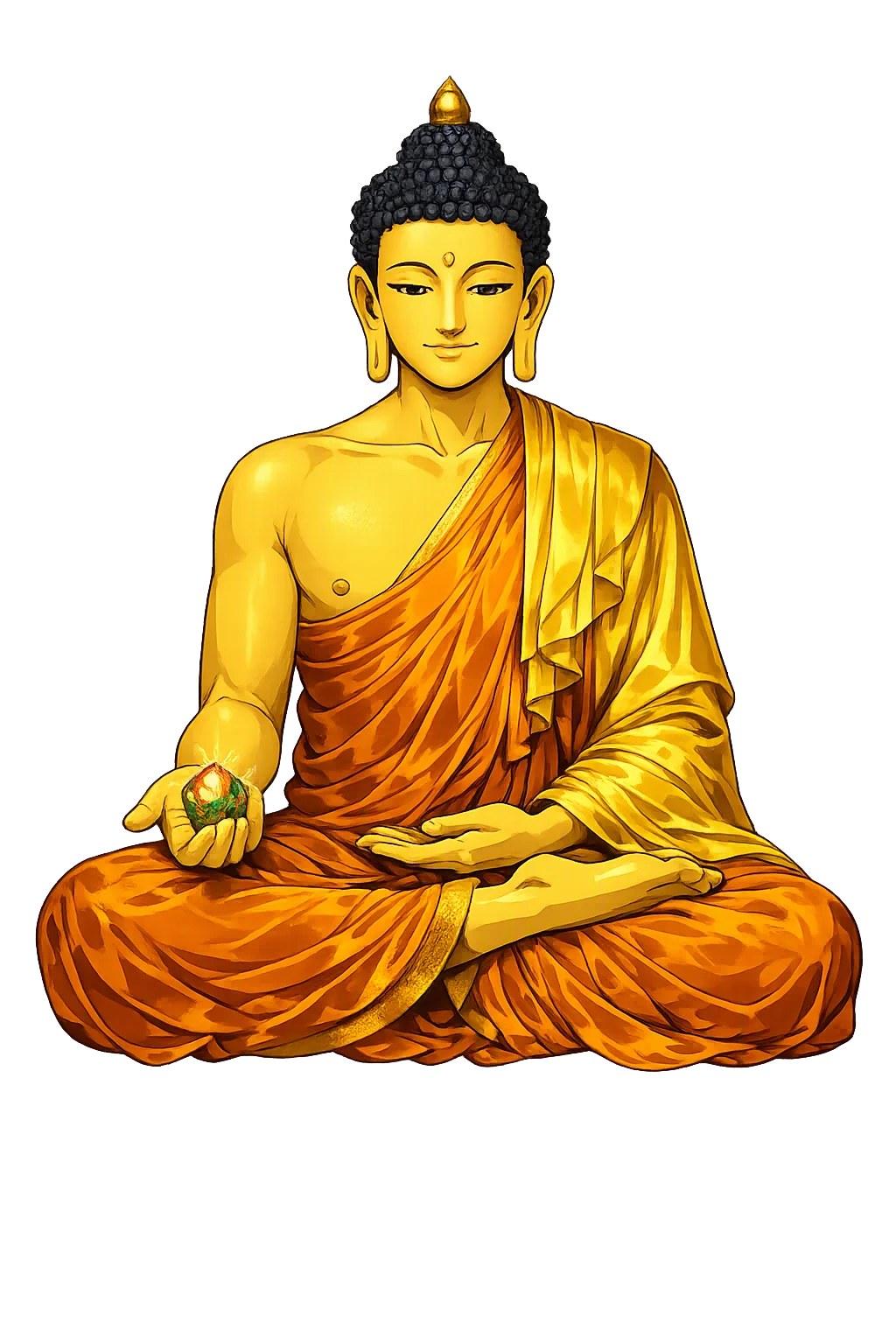
Ratnasambhava has no biography of battles and loves; as a Dhyānibuddha his 'mythology' is a maṇḍala — a cosmic arrangement in which the south, the color gold, the gesture of giving, and the wisdom of equality converge on a single figure born of the wish-fulfilling jewel.
At a Glance
- Restored name: Ratnasambhava
- ASCII form: ratnasambhava
- Meaning: "'Born of the Jewel' — the Dhyānibuddha of the southern jewel family"
- Domain of influence: Jewel-Born, South
- Pantheon: Buddhist
- Classification: Tier 2
- Original script: रत्नसम्भव
- Series: The Restoration Files, No. 416 of 548
The Name Before the Marks
Spoken, the name runs `/rɐt.nɐ.sɐm.bʱɐ.ʋɐ/` — 'ruht-nuh-SUHM-bhuh-vuh' — five even syllables, no hard stress; aim the breathy 'bh' in the middle of the word.
The Temple That Stands Now
The restored name is not a plaque; it is an address. The temple of Ratnasambhava lives at /ratnasambhava/, with its mythology in the lore halls, its peer-reviewed record in the Scholarly Edition, and its place in the pattern atlas on the patterns floor.
The restoration keeps one feature the ASCII form drops. One is enough to matter, and the label says so plainly: Tier-2.
Where the Name Stood First
The five-Dhyani-Buddha scheme is stamped across medieval Asian sacred geography. At Borobudur in Java (8th–9th century) the galleries distribute the five Buddhas with their characteristic mudrās. In the western Himalaya, the 11th-century temples of Alchi and Tabo preserve five-Buddha wall cycles in which the southern, golden figure displays the gift-bestowing hand. Pala-period (8th–12th century) bronze workshops of the Nālandā region exported small gilt images of the southern Buddha along the monastic routes into Tibet, and Newar craftsmen made the gilt-copper pañca-dhyāni set a fixture of every Kathmandu Valley stūpa — the crowning faces of Swayambhū and Boudhanath still include him. Tang and Japanese maṇḍala paintings preserved at Tō-ji, Shōgo-in, and the repositories of Mount Kōya fix his iconography in silk. The temple on the web is the newest of these addresses — the first one that fits in a pocket.
The Archetype at Work
The pattern atlas seats this temple in 5 industries, each match argued and weighted: Faith & Spiritual Organizations (primary seat: Ratnasambhava embodies jewel-born, south — the core of faith.); Manufacturing, Craft & Automation (resonant seat: Ratnasambhava shares symbolic territory with manufacturing craft.); Mental Health & Emotional Wellness (resonant seat: Ratnasambhava shares symbolic territory with mental health.). The Resonance File reads those seats through the myths themselves.
In the Sacred Texts
The Buddhist tradition is not a vibe; it is a library. The Sacred Texts collection holds Lotus Sutra and Sukhāvatīvyūha Sūtras — the primary sources the temple's scholarship is built on. The temple is the argument; the texts are the evidence.
The File Continues
The temple's founding dispatch tells the name's story; its Resonance File reads the myths into the industries; the blog index holds the whole archive.
Continue the series — previous file: Ratatoskr (read it here) · next file: Rāvaṇa (read it here).
The Restoration Files are written from the same canonical record as the temples themselves: the lexicon, the lore catalog, the pattern atlas, and the cited scholarly sources. If a file ever disagrees with its temple, the temple is right — tell us, and the file will be corrected.