The Living Myth
Jewel-Born, South · 'Born of the Jewel' — the Dhyānibuddha of the southern jewel family
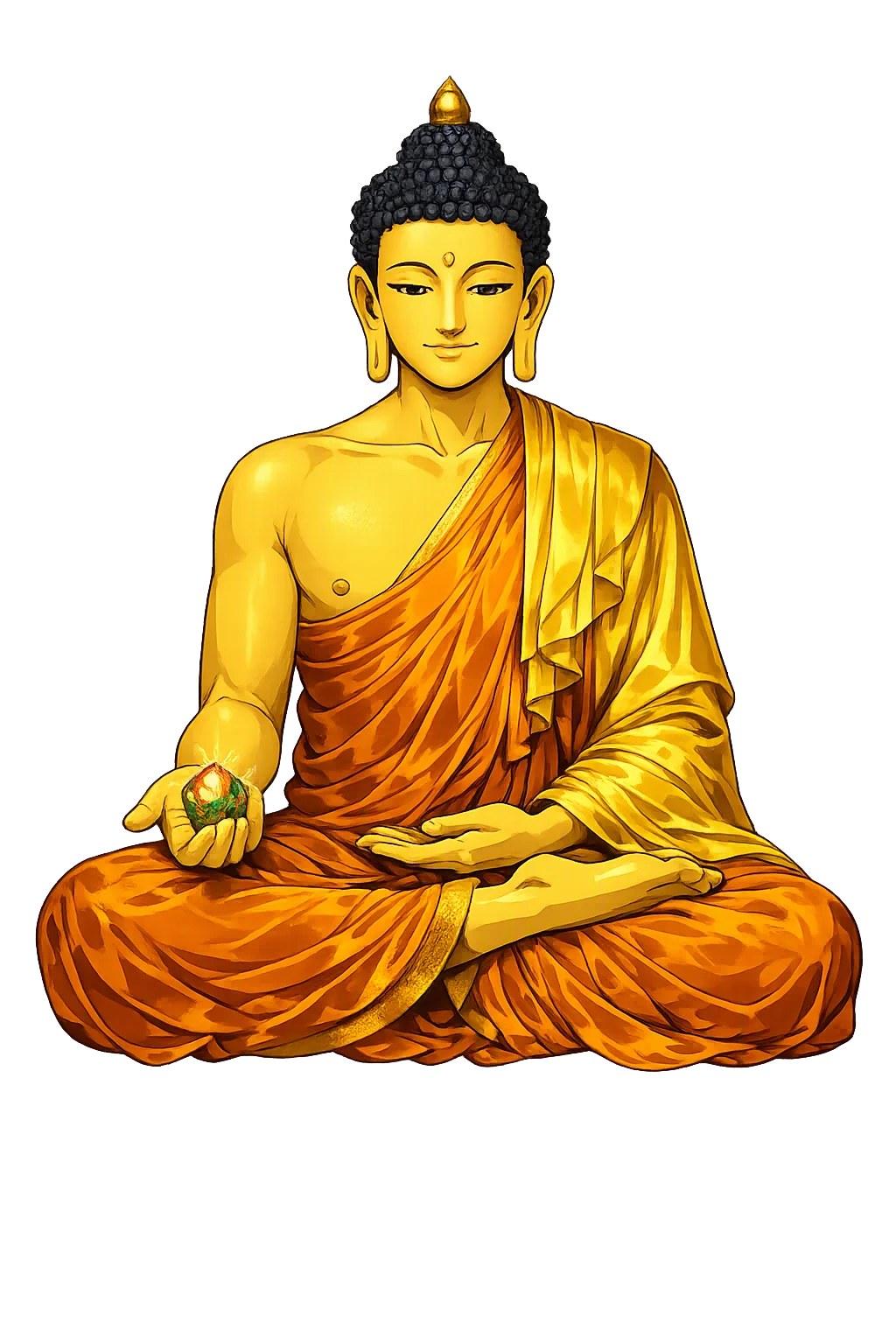
Stories of Ratnasambhava
Ratnasambhava has no biography of battles and loves; as a Dhyānibuddha his 'mythology' is a maṇḍala — a cosmic arrangement in which the south, the color gold, the gesture of giving, and the wisdom of equality converge on a single figure born of the wish-fulfilling jewel.
In the Mahāyāna cosmology codified in the yoga-tantra canon — above all the Sarvatathāgatatattvasaṃgraha, the 'Compendium of the Truth of All Tathāgatas' — each of the five Dhyani Buddhas began as a bodhisattva who made universal vows before the Buddhas of former eons and attained perfect enlightenment in Akaniṣṭha, the highest heaven of form. Ratnasambhava's vow was the vow of giving: to ripen in all beings the capacity for generosity, the first of the perfections (pāramitā), until they too stood as self-arisen jewels. When the vow was complete, he awoke as the Buddha of the south, and the other Buddhas assigned him the ratna family — the line of beings whose affliction is avarice and whose fruit is equality.
The 'myth' is doctrine wearing narrative dress: enlightenment here is not escape from the world but its enrichment — a Buddha whose very title declares that what is most precious arises from within.
The five-family maṇḍala arranges the awakened mind as a cosmic cross: Vairocana at the center, Akṣobhya in the east, Ratnasambhava in the south, Amitābha in the west, Amoghasiddhi in the north. Each presides over a family (kula) of beings bound by one of the five poisons and liberated by its counter-wisdom. Ratnasambhava's family is the ratna-kula: those in whom pride and greed dominate. His counter-agent is the wisdom of equality (samatā-jñāna) — the direct seeing that self and other, gold and dust, are equal in emptiness — and his emblematic act is the varada mudrā, the open hand. The Sarvatathāgatatattvasaṃgraha and its commentarial tradition assign him his mantra, his color, and his throne; Tibetan manuals such as those of the Sa skya school describe his visualization in detail for initiates.
The maṇḍala's teaching is exact: the poison of the south is not destroyed but converted — avarice, rightly seen, is the very energy of giving.
In the later tantric development of the five-Buddha system, each Dhyani Buddha is paired with a consort who embodies the wisdom (prajñā) complementing his method (upāya): Ākāśadhātvīśvarī with Vairocana, Locanā with Akṣobhya, Māmakī with Ratnasambhava, Pāṇḍaravāsinī with Amitābha, Tārā with Amoghasiddhi. Māmakī — 'the Stainless One', golden in color, her name a cult-title already known from the inscriptions and art of the Gupta age — stands at the south gate of the maṇḍala as the wisdom of equality in female form. In Tibetan iconography the pair appears in yab-yum, the divine embrace: two figures, one awakening. Snellgrove and other historians of Indo-Tibetan Buddhism trace this pairing through the yoga-tantra commentaries into the initiatory maṇḍalas still conferred in Tibetan lineages today.
The pairing is the theology of relationship: equality is not a solitary insight but one that arrives, as wisdom does, between two.
The historical career of Ratnasambhava's image runs along the monastic highways of medieval Asia. In the Pala-period east (8th–12th centuries), the great universities of Nālandā and Vikramaśīla taught the yoga-tantras in which the five-Buddha maṇḍala is codified, and their bronze workshops cast small gilt images for the caravan routes north. With the first wave of Buddhism's entry into Tibet — the invited scholars of the late 8th century, the founding of bSam yas — the southern Buddha crossed the Himalaya and received his Tibetan name, Rin chen 'byung. The Newars of the Kathmandu Valley absorbed the five Buddhas so completely that every stūpa carries a gilt pañca-dhyāni set at its crown, Ratnasambhava facing south. Eastward, the Tang esoteric masters rendered him as Baosheng Rulai and transmitted his maṇḍala to Japan, where the Shingon school enshrines him as Hōshō Nyorai in the Womb-Realm maṇḍala of Tō-ji and Mount Kōya.
No single event canonized him; a thousand caravans did. His afterlife is a map of the routes Buddhism itself travelled.
Jewel-Born
Ratnasambhava is the Dhyānibuddha of the southern quarter, the 'Born of the Jewel' whose open palm bestows the treasures of the Buddhist path. Head of the ratna, jewel family, he transmutes pride and avarice into the wisdom of equality — the insight that all beings, like all gems, share one nature.
ratna 'jewel' + sambhava 'arising': the name is a theology — awakening as something precious and self-generated, born from within.
He presides over the south, the direction of summer's ripening; his color is gold, his element earth, his mood abundance.
His mudrā is varada, the open palm of giving — generosity (dāna) is the first perfection and the gate of his jewel family.
Preserved as a flagship temple: the plain-ASCII name claims the jewel-born Buddha of the south for the Unicode web.
From the original script to the living URL
रत्नसम्भव
The name in its original Buddhist form. Ratnasambhava (रत्नसम्भव) is attested in the source tradition — “'Born of the Jewel' — the Dhyānibuddha of the southern jewel family”. Its original diacritics and script distinctions carry the full phonetic and orthographic weight of the source tradition.
ratnasambhava
The plain ratnasambhava form is identical to the Unicode restoration. Because this name is already written in Latin letters, no diacritics, stress, or script information were lost — only capitalization differs.
Ratnasambhava
The Unicode restoration does not need to recover lost marks for Ratnasambhava. Its value is canonical spelling and consistent cataloguing, not the reconstruction of erased orthography. The domain is readable as-is to both DNS and humanity.
Ratnasambhava.com
This restoration is written entirely in ASCII letters — no Punycode encoding stands between Ratnasambhava and the DNS. The domain reads identically to machines and to human eyes.
Owned, ideal, and ASCII forms of Ratnasambhava
Ratnasambhava
Restores रत्नसम्भव. The full Unicode restoration. ratnasambhava.com is not in the PuniCodex collection — it is watched for release; if it drops, this temple upgrades to an owned flagship.
How Ratnasambhava was spoken
How Ratnasambhava travels from ancient script to the modern URL
The lore you have read is the living myth. Extended Lore opens the scholarly vault beneath it: the cult and its material remains, a history of the image, the name after antiquity, a meditation on what the name still means, and the full scholarly apparatus — etymology, orthography, sources.
Enter Extended Lore