
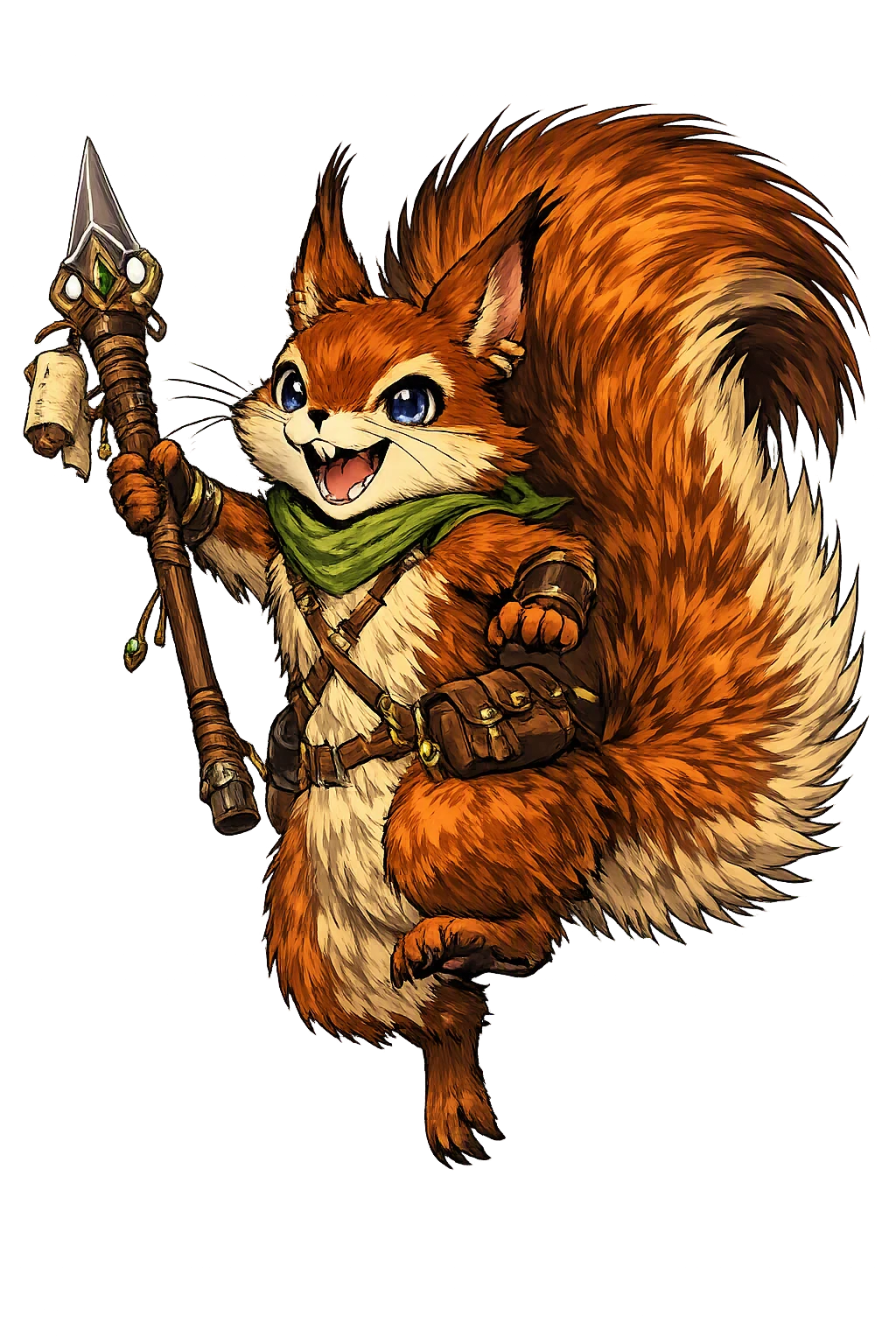
How Ratatoskr was rebuilt, mark by mark
Bench notes, Ratatoskr: what we found, what we rejected, and what we finally set down. Kept in the open, because a restoration you cannot audit is just a spelling with confidence.
What We Found
The attestation runs through the tradition's own sources: ᚱᛅᛏᛅᛏᚢᛋᚴᚱ. Meaning: "Drill-tooth".
The figure behind the name: Ratatoskr's dossier is two passages long and perfectly cut: one stanza of Grímnismál and one chapter of Gylfaginning.
What the Name Carried In
The Squirrel's Stanza. In Grímnismál, Óðinn — masked and bound between the fires of King Geirrøðr — recites the inhabitants of the world-ash, and the squirrel gets his stanza: Ratatoskr is the íkorni who must run on Yggdrasill's ash; the eagle's words he must carry from above and tell to Níðhǫggr below. The verb is skal — 'shall, must': the running is not a habit but an office, written into the tree's economy as fixedly as the dew that falls from its branches.
The Suffering Ash. The stanzas around the squirrel build the tree's full menagerie: four harts — Dáinn and Dvalinn, Duneyrr and Duraþrór — bite the new shoots; more serpents lie beneath the ash than any unwise ape would think, Góinn and Móinn, Grábakr and Grafvölluðr, Ófnir and Sváfnir, and they gnaw the roots forever; and the poem closes the survey with its most famous sentence: the ash of Yggdrasill suffers agony, more than men know — the hart bites from above, the trunk rots at the side, and Níðhǫggr gnaws from below. The squirrel does not appear in this list of devourers, which is precisely the point: Ratatoskr runs his messages through a tree that is being eaten alive at every level, adding no tooth of his own.
A spelling that has to carry stories like these is not a label. It is equipment.
Where It Stood Before Us
Ratatoskr is an entirely textual creature: no picture stone, runestone, amulet, or toponym preserves him, and the squirrel is otherwise invisible in Norse material culture. His two attestations hang on the great codices: Grímnismál in the Codex Regius of the Poetic Edda (c. 1270), and Gylfaginning in the Codex Regius of the Prose Edda and its sister manuscripts (early 14th c.), with the poem's stanza also copied into the Codex Wormianus and the Uppsala Edda tradition. The world-ash itself has material echoes — the tree-and-beasts carvings sometimes compared to Yggdrasill's menagerie — but none can be tied to the squirrel by name. His evidence is the manuscript page alone, which is fitting: Ratatoskr was always made of words. The bench inherits all of it — the web temple is the newest site, not the first.
What We Rejected
Any form invented for availability. The rule on the bench: if the evidence does not carry it, the domain does not get it — whatever the registrar has in stock.
What We Set Down
Ratatoskr — One decisive feature survives — a single, honest mark — which places the restoration in Tier-2: exact, and exactly labeled.
For the voice: 'RAH-tah-toskr' — stress on the first syllable, as in every Old Norse word; all vowels short; the final -r is the nominative ending, lightly sounded as in modern Icelandic Ratatoskur.
The temple stands at /ratatoskr/ — the notes above are public in its Scholarly Edition, sources and all.
At a Glance
- Restored name: Ratatoskr
- ASCII form: ratatoskr
- Meaning: "Drill-tooth"
- Domain of influence: Squirrel of Yggdrasil
- Pantheon: Norse
- Classification: Tier 2
- Original script: ᚱᛅᛏᛅᛏᚢᛋᚴᚱ
- Series: The Restoration Files, No. 415 of 548
The File Continues
The temple's founding dispatch tells the name's story; its Resonance File reads the myths into the industries; the blog index holds the whole archive.
Continue the series — previous file: Ranginui (read it here) · next file: Ratnasambhava (read it here).
The Restoration Files are written from the same canonical record as the temples themselves: the lexicon, the lore catalog, the pattern atlas, and the cited scholarly sources. If a file ever disagrees with its temple, the temple is right — tell us, and the file will be corrected.