
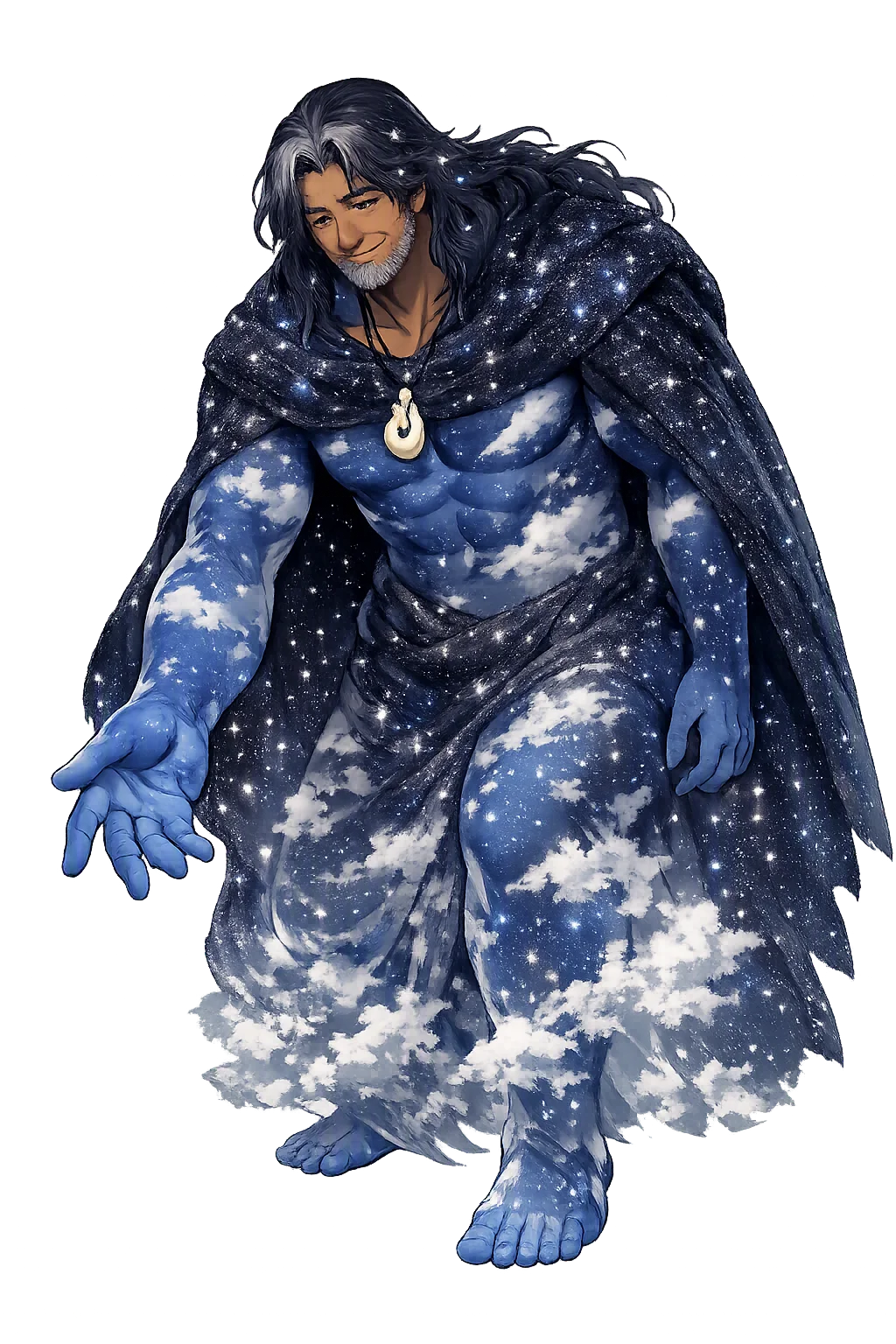
How Ranginui was rebuilt, mark by mark
Bench notes, Ranginui: what we found, what we rejected, and what we finally set down. Kept in the open, because a restoration you cannot audit is just a spelling with confidence.
What We Found
The attestation runs through the tradition's own sources: —. Meaning: "'Great heaven' (Māori rangi 'sky, heavens' + nui 'great'), the sky father prised apart from the earth mother Papatūānuku by their children.".
The figure behind the name: Ranginui's mythology is Māori cosmogony itself, as recorded by Sir George Grey and John White from oral tradition in the nineteenth century: the primordial embrace, the separation, and the war among the children that followed.
What the Name Carried In
The Embrace of Rangi and Papa. In the beginning the sky father Ranginui and the earth mother Papatūānuku clung together in an embrace that knew no end, and in the darkness between their bodies their children were born — seventy sons in the telling recorded by Grey in Polynesian Mythology (1854). There was no light: the world was the cramped hollow of the parents' clasp, and the children grew hemmed in on every side, some of them longing for room and for brightness, others content in the warm dark.
Tāne Pushes the Sky Away. The children argued over how to win light. Tūmatauenga, the fierce one, proposed killing the parents — a plan the others rejected with horror.
A spelling that has to carry stories like these is not a label. It is equipment.
Where It Stood Before Us
Māori tradition built no temples, so Ranginui's archaeology is the archaeology of the meeting house: the great carved wharenui of the nineteenth century are material cosmogonies. Te Hau-ki-Tūranga (carved c. 1842, now at Te Papa Tongarewa) shows the convention fully formed — the tahuhu ridge-pole as the sky father, the earth floor as Papatūānuku, and the carved ancestors standing between them. The textual witnesses are themselves artifacts: Grey recorded the separation cycle from Māori informants in Nga Mahi a nga Tupuna (1854), and White's Ancient History of the Māori (1887–90) preserved variants from the Tainui and Te Arawa traditions. Earlier than both stands the transmission they committed to paper — an unbroken oral and ceremonial custody, measured in centuries, that no excavation is needed to prove. The bench inherits all of it — the web temple is the newest site, not the first.
What We Rejected
Any form invented for availability. The rule on the bench: if the evidence does not carry it, the domain does not get it — whatever the registrar has in stock.
What We Set Down
Ranginui — One decisive feature survives — a single, honest mark — which places the restoration in Tier-2: exact, and exactly labeled.
For the voice: 'RAH-ngi-NOO-ee' — tap the 'r' as in Spanish 'pero'; 'ng' is the sound in 'singer'; the four light syllables run together.
The temple stands at /ranginui/ — the notes above are public in its Scholarly Edition, sources and all.
At a Glance
- Restored name: Ranginui
- ASCII form: ranginui
- Meaning: "'Great heaven' (Māori rangi 'sky, heavens' + nui 'great'), the sky father prised apart from the earth mother Papatūānuku by their children."
- Domain of influence: Sky, Fatherhood, Creation
- Pantheon: Polynesian
- Classification: Tier 2
- Original script: —
- Series: The Restoration Files, No. 414 of 548
The File Continues
The temple's founding dispatch tells the name's story; its Resonance File reads the myths into the industries; the blog index holds the whole archive.
Continue the series — previous file: Rāma (read it here) · next file: Ratatoskr (read it here).
The Restoration Files are written from the same canonical record as the temples themselves: the lexicon, the lore catalog, the pattern atlas, and the cited scholarly sources. If a file ever disagrees with its temple, the temple is right — tell us, and the file will be corrected.