Stories of Rāma
Rāma's mythology is the Rāmāyaṇa — Vālmīki's poem and the centuries of retelling it generated. It is a story of exile and fidelity, of an alliance of outcasts, of a war won by devotion rather than might, and of a kingship so perfect it breaks the king's own heart.
On the day Rāma was to be crowned, his stepmother Kaikeyī asked King Daśaratha for her two long-promised boons: the throne for her son Bharata, and fourteen years' exile for Rāma (Rāmāyaṇa, Ayodhyākāṇḍa 8–12). The king, bound by his word, collapsed between the pillars of his palace like a man already dead. Rāma received the sentence as he received everything — the text says he showed no more disturbance than if he had been told his meal was ready — and at once began giving away his possessions and dressing in bark and matted hair (Ayodhyākāṇḍa 20–26). Sītā and Lakṣmaṇa refused to be left behind, and the three walked out of Ayodhyā while the city wept and fainted in the streets; the king died of grief that night. The epic's hinge is this calm: dharma, for Rāma, is not what he prefers but what he accepts. Everything that follows — the forest journey, the war, the restoration — exists because a prince would not let even injustice make him unjust.
In the forest of Pañcavaṭī, the demoness Śūrpaṇakhā offered herself to Rāma and threatened Sītā; Lakṣmaṇa cut off her nose and ears (Araṇyakāṇḍa 17–18). She ran to her brother Rāvaṇa, king of Laṅkā, and the abduction was planned with a demon's cunning: a golden deer made from illusion lured Rāma away, a false cry for help in his own voice drew Lakṣmaṇa after, and the vulture-king Jāṭāyu — who alone tried to stop the chariot — died at the roadside with the news of which way Sītā had been taken (Araṇyakāṇḍa 43–49). Sītā, carried south through the sky, dropped her ornaments down to the band of monkeys below — a message flung from the clouds — and held the demon at arm's length with a chastity like a wall. Rāma returned to an empty hermitage, and his grief is the strangest in the epic: not weeping but method, the beginning of the long machinery of war. The abduction works because the demons attack not Rāma's strength but his love — the one flank an avatar cannot armor.
Rāma's alliance with the exiled monkey-king Sugrīva — sealed when Rāma's arrow won Sugrīva back his throne — gave him the army; Hanumān gave him the sea crossed. The monkeys hurled mountains into the waves, and a causeway grew from India to Laṅkā, stone by floating stone (Yuddhakāṇḍa 22). The war filled a whole kāṇḍa: Rāvaṇa's champions fell one by one; Indrajit nearly killed Lakṣmaṇa, and Hanumān carried the healing mountain through the night. On the final day Rāma and Rāvaṇa met in single combat, the demon reviving again and again from the ambrosia in his heart, until the Brahmā-blessed arrow flew and the ten heads rolled (Yuddhakāṇḍa 108–111). Before accepting Sītā, Rāma required the fire ordeal, and Agni returned her unburned. The bridge is the war's meaning in one image: a task no army could perform alone — moving the ocean — done by the many in common devotion, each monkey's stone held up by a single name.
Victory brought Rāma no peace. Standing before the assembled armies, he announced that he could not take back Sītā, since she had dwelt in a stranger's house; Sītā walked into a blazing pyre, and the fire-god Agni lifted her out unburned and bore witness to her purity before the gods and all the worlds (Yuddhakāṇḍa 116–118). Years later, when a washerman's gossip reached the palace, Rāma sent away his pregnant queen to the forest, choosing the people's honor over his own heart (Uttarakāṇḍa 26–41). Sītā gave birth to twins, Kuśa and Lava, at the hermitage of Vālmīki, and when mother and sons stood before him at last, the earth opened and took her back into her mother's lap. The epic does not soften this: the perfect king pays the perfect price. Rāma's dharma is austere enough to wound the innocent, and the text — which has the twins sing their father's story back to him — leaves the wound open on purpose. To read the Rāmāyaṇa honestly is to love Rāma and grieve for Sītā at once.
At the end of his life, Rāma performed the horse sacrifice, and the consecrated horse wandered — until two unknown princes stopped it near Vālmīki's hermitage: his own sons, Kuśa and Lava, who then sang the Rāmāyaṇa itself at the sacrifice, verse by verse, before their father (Uttarakāṇḍa 84–97). The epic closes in a perfect circle: the king hears his own story told by the children he never raised, and recognizes his wife in the song of her sons. When Sītā was summoned once more to swear her purity before the assembly, she did not speak to the court; she prayed to the earth, her first mother, and the ground opened and received her, and no hand could hold her back. Rāma reigned on — the ideal king of the ideal city — until a messenger from the gods called him; he gave the kingdom to his sons, walked into the Sarayū river with those who loved him, and returned to Viṣṇu. The frame tells its own meaning: the story outlives the tellers, and dharma's last act is release.
Virtue, Kingship, Avatar of Viṣṇu
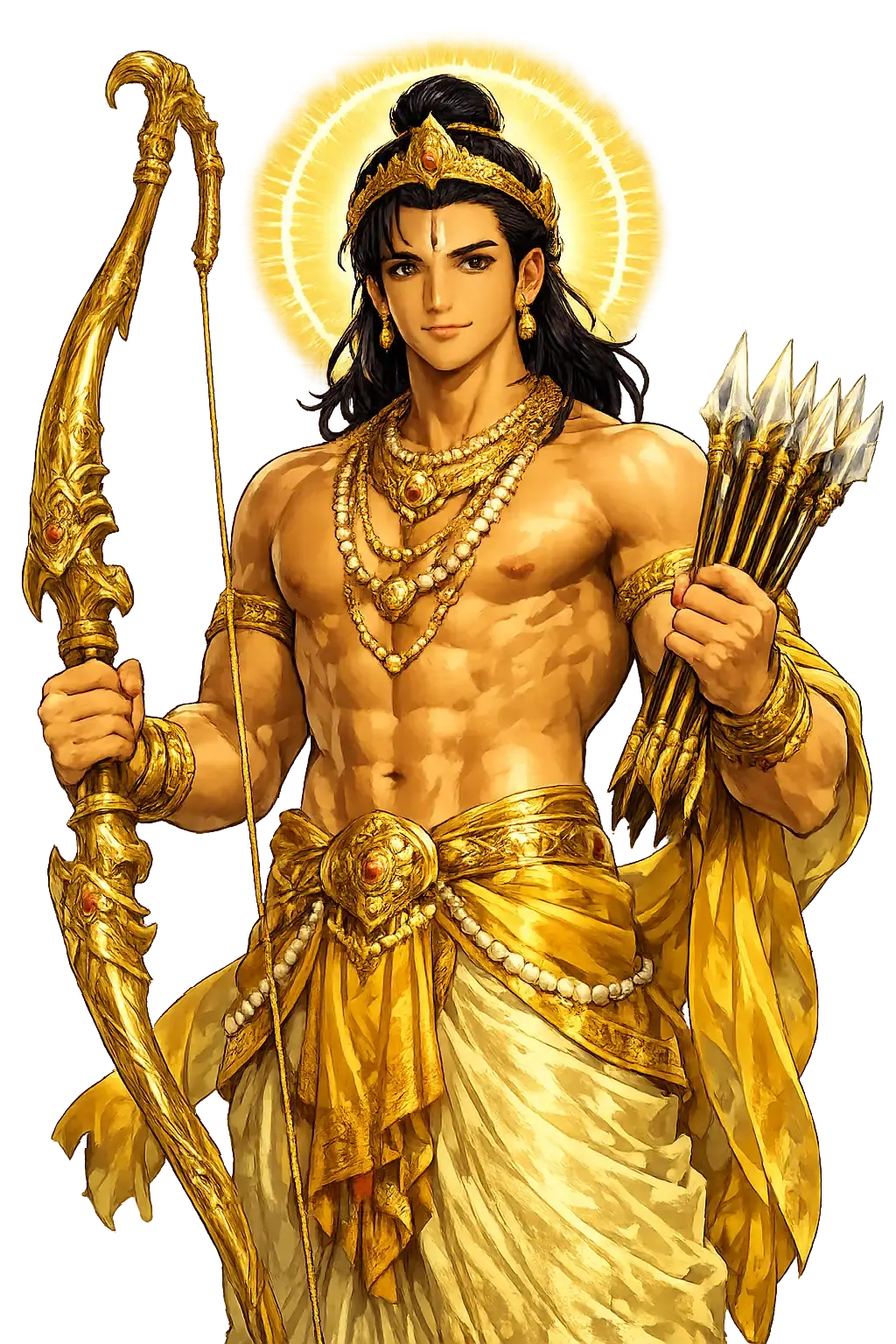
Rāma is the prince who became the pattern of righteous kingship: the seventh avatāra of Viṣṇu, who descended to destroy Rāvaṇa and restore dharma — yet a hero whose greatness lies not in battle fury but in obedience, sacrifice, and the willingness to suffer for duty. His story, Vālmīki's Rāmāyaṇa, has shaped Indian ideals of the son, husband, brother, king, and warrior for more than two millennia.
He is the king for whom law is not policy but personal discipline; even family feeling yields to righteousness.
'The best of men within limits' — he never transgresses the moral boundaries that define civilized life.
He accepts fourteen years of banishment without protest, showing that a king's first obligation is to his word.
With the aid of monkeys, bears, and his brother Lakṣmaṇa, he crosses the sea to defeat the ten-headed demon.
From the original script to the living URL
राम
The name in its original Sanskrit form. Rāma (राम) is attested in the source tradition — “The beloved prince of Ayodhyā — hero of the Rāmāyaṇa and seventh avatāra of Viṣṇu (from √ram, to delight)”. Its macron-length vowels carry the full phonetic and orthographic weight of the source tradition.
rama
Reduced to plain rama, the name loses everything that made it specific: macron-length vowels. What remains is an ASCII string that machines can parse but that no longer speaks with its original voice.
Rāma
The Unicode restoration recovers what ASCII flattened. Rāma restores macron-length vowels, returning the name to its original written dignity. The domain encodes to Punycode, but the browser displays the truth.
Rāma.com → xn--rma-1oa.com
The non-ASCII characters in Rāma are encoded while the ASCII remains visible. To the DNS, it is Punycode. To humanity, it is Rāma.
Owned, ideal, and ASCII forms of Rāma
Rāma
Restores राम. The live temple domain — rāma.com.
rama
Flattens राम. The plain ASCII fallback — what DNS and legacy systems see.
How Rāma was spoken
How Rāma travels from ancient script to the modern URL
Sanskrit Rāma; from the root ram- “to delight, to be pleasing"; the hero of the Rāmāyaṇa and an avatar of Viṣṇu.
Virtue, Kingship, Avatar of Vishnu
The IAST form Rāma uses registrable Latin diacritics; the Devanagari form is not supported in .com.
The lore you have read is the living myth. Extended Lore opens the scholarly vault beneath it: the cult and its material remains, a history of the image, the name after antiquity, a meditation on what the name still means, and the full scholarly apparatus — etymology, orthography, sources.
Enter Extended Lore