
How Pandōra got its accent back
The ASCII form pandora is missing something. Pandōra restores the marks the source language used to distinguish this name from a thousand others — and those marks change how the name is read, pronounced, and understood. This post explains, with the full scholarly record behind it, what each restored mark preserves: the Greek evidence, the reconstructed sound, the myths the name carries, and the mechanical logic of what each restored mark preserves. By the end, the marks in Pandōra will look less like ornaments and more like what they are — recovered evidence, pinned back in its proper place.
At a Glance
- Restored name: Pandōra
- ASCII form: pandora
- Meaning: "All-gifted"
- Domain of influence: First Woman, Box of Evils
- Pantheon: Greek
- Restoration: Preserves vowel length
- Original script: Πανδώρα (Greek)
- Live domain: pandōra.com
Overview
Pandōra (pandora) — First Woman, Box of Evils · All-gifted — belongs to the Greek tradition, where it is catalogued under the domain "First Woman, Box of Evils". The name means "All-gifted".
Pandōra belongs to the Greek tradition, where it is associated with first woman, box of evils.
PuniCodex restores the name as Pandōra and serves its temple at pandora.com. The original carries both stress and vowel length, and exactly one historically valid Unicode restoration exists. The plain ASCII form pandora survives as a modern convenience imposed by the early domain-name system; the restoration, not the fallback, is the form the project defends as philologically complete.
The Name
The name is attested in Greek as Πανδώρα. Etymologically it means "All-gifted".
The reconstructed proto-form is pan- + dōr-* (proto-indo-european, "all-gifted"). Greek Πανδώρα 'all-gifted', from πᾶν 'all' and δῶρον 'gift'; the first woman in Hesiod's Theogony.
The ASCII form pandora survives only because the early domain-name system could not carry diacritics; it is a technological compromise, not an ancient spelling. The Unicode restoration Pandōra recovers the vowel length of the original directly in the address bar. The original carries both stress and vowel length, and exactly one historically valid Unicode restoration exists.
The letter-by-letter transformation runs:
- p → P — Same
- a → a — Same
- n → n — Same
- d → d — Same
- o → ō — Macron: long omega
- r → r — Same
- a → a — Same
The canonical temple for this name is served at pandora.com.
Etymology & Roots
The recorded derivation reads: Greek Πανδώρα 'all-gifted', from πᾶν 'all' and δῶρον 'gift'; the first woman in Hesiod's Theogony.
The reconstructed proto-form is *pan- + dōr-* (proto-indo-european), glossed as "all-gifted".
The reconstruction is classed as attested.
The Original Script
The name is written in Greek as Πανδώρα. This original script is the form against which the ASCII fallback pandora and the PuniCodex restoration Pandōra are measured: the restoration preserves its vowel quantity of the written form, so that a reader typing the modern address still speaks the ancient name.
Pronunciation
The reconstructed pronunciation of the name is /pandora/ — Greek Reconstruction.
Phoneme by phoneme:
- P — Initial character of the restored form Pandōra.
- andōra — Remainder of the name, preserving the distinctive marks of the Greek tradition.
For the modern speaker, the closest approximation is: 'PANDORA' — pronounce the restored form with attention to the preserved diacritics and length.
Kindred and historical forms of the name:
- Greek — Pandōra, the restored Unicode form of the name
Pandōra preserves both features because the Greek form preserves distinctive features that ASCII loses: stress, length, or special characters.
Mythology
The stories of Pandōra circulate within the Greek corpus, where the figure embodies first woman, box of evils.
Primary Attestation (Sources)
Pandōra is attested in the canonical Greek sources as a figure associated with first woman, box of evils.
Name and Meaning (Etymology)
The name means "All-gifted" and reflects the figure's role in the tradition. Pandṓra is the first woman in Hesiodic cosmogony, fashioned by the gods as a punishment for Prometheus's theft of fire. She opens the jar (pithos) and releases evils into the world, retaining only Hope. The story explains the origin of human suffering while framing womanhood within a pessimistic theological economics. The jar—often mistranslated as a box in later European retellings—was a storage vessel, and Hope's retention inside it has been debated since antiquity.
A Beautiful Evil, Built by Committee (The Making)
After Promētheus stole fire, Zeus ordered Hephaistos to 'mix earth with water, and to put in it the voice and strength of humankind,' shaping 'a beautiful evil' in the likeness of a modest maiden (Hesiod, Theogony 570-584). The gods then worked her over like a dedication: Athēnâ dressed her in silver-white robes and set a veil on her head; the Horae crowned her with spring flowers; Aphrodítē 'shed grace upon her head and cruel longing and cares that weary the limbs'; Hermēs gave her 'a bitch's mind and a thievish character' and the gift of winning speech (Works and Days 60-80). Nothing in her is her own — she is a composite artifact, each Olympian's contribution a function. The myth makes the first woman a manufactured object, which is exactly the bitterness Hesiod wants us to taste: Pandōra is a tool disguised as a bride.
Sent to Epimētheus (The Sending)
Zeus named her Pandōra — 'because all the Olympians gave her a gift, a bane to industrious men' (Hesiod, Works and Days 80-82) — and had Hermēs take her to earth with a great storage-jar. Promētheus had already warned his brother Epimētheus never to accept a gift from Olympian Zeus; the Works and Days compresses the tragedy into a single line: Epimētheus 'took the evil, and only when he had it perceived the evil' (Op. 88-89). Apollodorus (Library 1.7.2) retells the same scene. The whole machinery of the myth depends on this one moment of ignored foresight: forethought is chained in the Caucasus, afterthought answers the door. From her, Hesiod adds in the Theogony (590-612), descends 'the race of women' — a passage later Greeks found as uncomfortable as we do.
All the Evils Take Wing (The Jar)
Hesiod continues with terrible speed (Works and Days 90-105): 'the woman took off the great lid of the jar with her hands and scattered all these evils, bringing sorry troubles upon mortals. Only Hope remained there, inside, in the unbreakable home, under the lip of the jar, and did not fly out.' Before this, men lived 'free from ills... without the evil diseases that bring death'; now the jar's winged sorrows fill sea and land — 'for the earth is full of evils, and the sea is full.' Hope stayed, Hesiod adds in a dark aside, 'by the plans of aegis-bearing Zeus,' leaving every reader to decide whether hope is the one mercy left to mortals or the final bait sealed in with them. The vessel, again, was a pithos — a household storage jar; the tradition's later 'box' is Erasmus' sixteenth-century mistranslation, not Hesiod's.
Symbols & Iconography
The iconography associated with Pandōra concentrates in a small set of recurring attributes, each a compressed statement about the name:
- Restored Name — The Unicode form Pandōra carries the original marks of the Greek tradition.
- Source Script — Attested in the original script as Πανδώρα.
- Domain — First Woman, Box of Evils
- Etymology — All-gifted
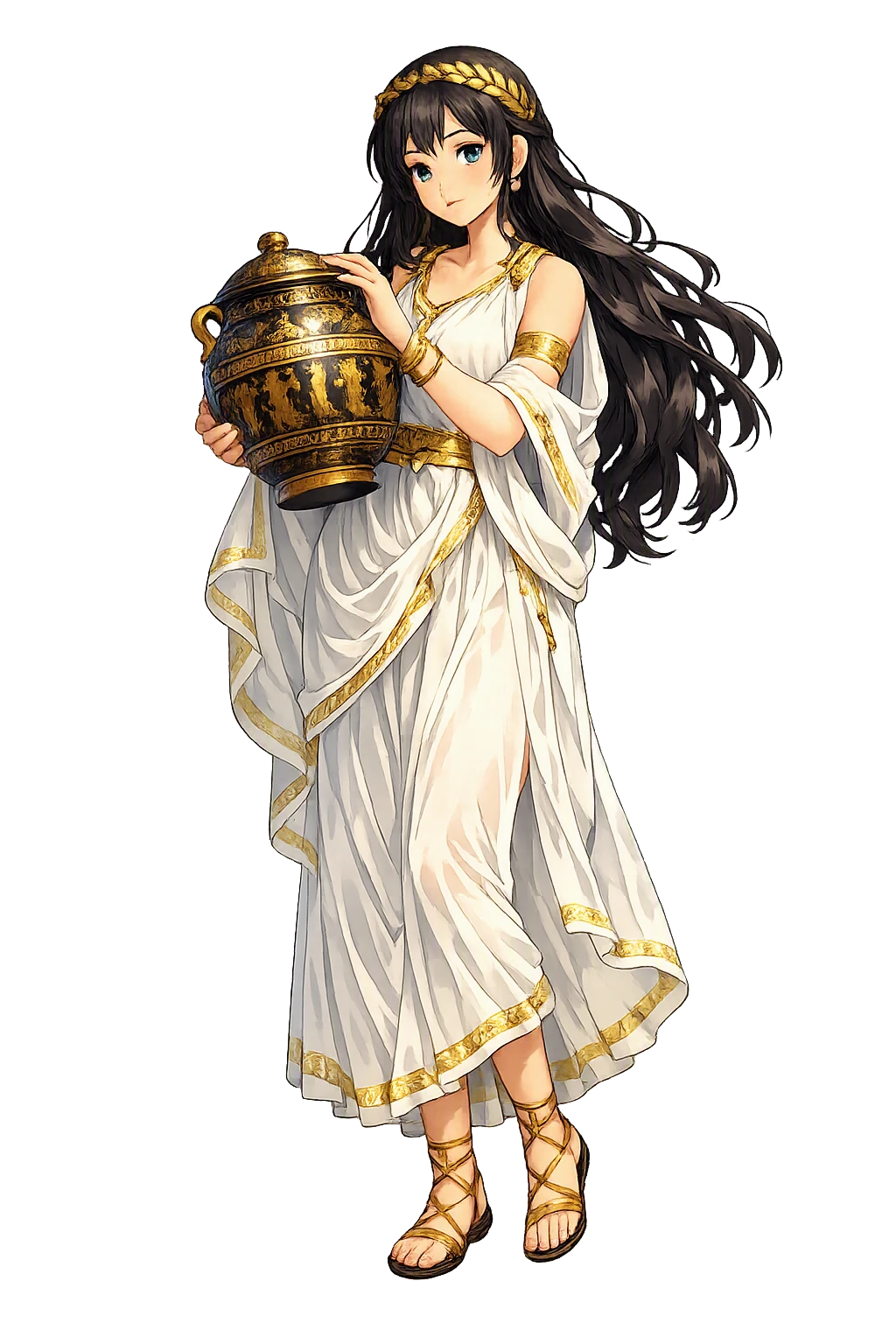
Pandōra is shown as a beautiful woman holding a large jar or pithos, often accompanied by Hephaistos, Athena, Hermes, and Eros. The lid of the jar is her defining attribute: lifted, it releases evils; replaced, it traps only Elpis (Hope).
The scene was popular on Attic vases and later became a moral allegory in Renaissance art.
- The storage-jar (pithos) — The great earthenware vessel from which every mortal ill escaped — a household jar, which is precisely Hesiod's point: evil enters the world through the home
- Clay — She was kneaded from earth and water by Hephaistos — a divine artifact built of human material
- The floral crown — The Horae crowned her with spring flowers, and Athēnâ veiled her — beauty as the wrapping of the trap (Works and Days 72-76)
- The girdle — Aphrodítē's contribution of longing and care — desire sewn into the gift so that it cannot be refused
Epithets & Cult Titles
Pandōra's name is itself an epithet: Πανδώρα (Pandōra, "all-gifted"), because every Olympian gave her a gift. In some contexts she is called Ἀνησιδώρα (Anēsidōra, "sender-up of gifts"), a title that distinguishes her gifts from the evils released from her jar.
Both names express the ambiguity of the first woman: she is bane and blessing inseparably united.
The Homeric Hymns
The myth of Pandōra is told not in the Homeric Hymns but in the proem of Hesiod's Works and Days and in the Theogony, both of which stand in the hymnic tradition. Zeus commands Hephaistos to mould the first woman as punishment for Prometheus's theft of fire, and the gods heap gifts upon her.
Hesiod's account is the foundational "hymn" of Pandora, explaining why toil and disease fill the human world.
Oracle Sites & Sanctuaries
Pandōra had no major oracular sanctuary, but her myth is tied to Thessaly, where Prometheus shaped mankind from clay, and to the Acropolis of Athens, where a cult of Pandora was associated with Athena. The jar itself became a ritual object symbolizing the containment of misfortune.
Her absence from oracular sites underscores that she is a cosmic figure rather than a local goddess.
Archaeology & Evidence
The material record for Pandōra survives in a small number of securely identified remains, catalogued below; the corpus is thin but unambiguous, and each site is tied to the name by ancient testimony.
Pandōra is attested in the textual and iconographic record of the Greek tradition.
Realm & Domain
Pandōra belongs to the Greek tradition, where it is associated with first woman, box of evils.
First Woman
The central domain of Pandōra in the greek tradition.
All-gifted
The name signifies "All-gifted".
Unicode Restoration
The restoration Pandōra recovers what plain ASCII pandora flattens.
Original Attestation
Attested in the sources as Πανδώρα. Her story also encodes Greek reflections on curiosity, female agency, and the unintended consequences of divine gifts.
The Fashioning
Hephaistos mixed earth and water into a 'beautiful evil'; Athēnâ dressed her and taught her weaving (Hesiod, Theogony 570-584; Works and Days 60-68).
The Jar of Evils
Not a box: a pithos, a great storage-jar, whose lifted lid releases toil, disease, and old age into the world (Works and Days 90-105).
Hope Remains
Only Elpis, Hope, stayed under the rim — a mercy, or Zeus's final cruelty; Hesiod leaves it deliberately unclear (Works and Days 96-104).
Across Cultures
Pandōra appears within the Greek tradition and has influenced later retellings, artistic depictions, and scholarly study. The Unicode restoration preserves the name's distinctive orthography for contemporary use.
Within the Greek tradition, closely related names in the corpus include Achérōn, Achilleús, Adámas, Aḗr, Aithḗr, and Anánkē.
Cultural Legacy
Pandōra continues to appear in scholarship, art, and popular reception as a significant figure of the Greek tradition. Restoring the name in Unicode returns the original marks that ASCII removes. "Pandora's box" has become a proverb for unintended consequences and a recurring motif in literature, art, and political commentary.
The Scholarly Record
The account of Pandōra given in this edition rests on the witnesses and reference works listed below. Lexica and etymological dictionaries secure the form and meaning of the name; the literary and religious texts supply the narrative evidence.
- Liddell-Scott-Jones Greek-English Lexicon, 9th ed. with 1996 supplement, 1940. Full text
- Wörterbuch der griechischen Eigennamen, 3rd ed., 1863. Full text
- Etymological Dictionary of Greek, 2 vols., Brill, 2010. Full text
A Meditation
Pandōra embodies first woman, box of evils in the Greek imagination. The name's restoration is not merely cosmetic: it recovers the stress, length, and script that make the figure recognizable in the source tradition.
The Unicode Restoration
Pandōra preserves vowel length. The ASCII fallback pandora still resolves everywhere, but it is the restored form that carries the name's full information. Across the 7 characters of the name, the restoration adjusts 1: 1 mark of length (ō). That is the whole thesis of this temple: the marks are the message.
Name Variations
The lexicon records 1 additional form of the name:
- Pandṓra (ideal) — Stacked macron+acute on the stressed long vowel, matching Greek Πανδώρα; philologically ideal but often untypeable on phones.
The temple uses Pandōra as the primary form: it is the spelling that best balances philological accuracy with the practical limits of DNS.
Character by Character
The journey from pandora to Pandōra, one character at a time:
- p → P — Same
- a → a — Same
- n → n — Same
- d → d — Same
- o → ō — Macron: long omega
- r → r — Same
- a → a — Same
The Domain Name
The restored name is live as a working domain: pandōra.com, which the DNS carries in punycode form as xn--pandra-egb.com — an ASCII-compatible encoding that lets a non-ASCII name travel the global network without breaking older infrastructure. The visitor sees Pandōra; the machines see the encoding. That duality is the engineering compromise on which the entire restoration rests, and it is why a name written the way its own tradition wrote it in Greek can now be typed into any browser on earth.
The Greek Pantheon
Pandōra is one of 269 entries the PuniCodex lexicon catalogues under the Greek pantheon. The Pantheon page gathers the tradition's major figures in one place, and the Lexicon lets you filter all 983 restorations by tradition or script — the fastest way to see where this name sits among its kin.
Frequently Asked Questions
What does Pandōra mean? The traditional gloss is "All-gifted."
Which tradition does Pandōra belong to? Pandōra is catalogued in the Greek pantheon of the PuniCodex lexicon.
What does Pandōra preserve that ASCII cannot show? The form itself answers: Pandōra preserves vowel length — and the marks in the restored spelling are exactly that evidence.
Is Pandōra a working domain? Yes — pandōra.com resolves today and routes to this temple.
What is the punycode for pandōra.com? The DNS encoding is xn--pandra-egb.com; browsers perform the translation automatically, so visitors only ever see the restored name.
Can I use Pandōra in a normal browser? Yes. The DNS resolves the punycode form automatically, and the type tool on this site converts pandora to Pandōra for copying and pasting.
Where does the scholarly information come from? The entry is built from lexica, inscriptional evidence, and reviewed scholarly sources listed in the Scholarly Edition. Every claim is traceable to a canonical source.
Typing Pandōra
You do not need a special keyboard to use this restoration. The PuniCodex Type Tool converts the ASCII form pandora into Pandōra as you type, and the browser extension offers the same conversion inside any text field. Copy the restored form, paste it into the address bar, and the DNS does the rest.
Sister Temples
Other temples in the Greek pantheon include Kálchas, Kalliópē, and Kalypsō — each with its own restoration story, its own scholarly record, and its own place in the lexicon.
Why This Restoration Matters
The marks in Pandōra were never lost; they were only waiting for a carrier that could hold them. Now that the carrier exists, the burden flips: every use of pandora is a choice to leave evidence on the table. The PuniCodex temple keeps the restored form in circulation — as a domain, a dataset entry, and a scholarly argument — so that the choice to use it stays easy. Accent by accent, macron by macron, that is how the original names come back: not with a single grand gesture, but with a spelling that finally works everywhere.
Explore Further
This post is one doorway into the temple. The home page carries the full character breakdown and the ambient canvas; the lore page tells the myths in long form; the Scholarly Edition preserves the sources, pronunciation data, and revision history; and the patron wall supports the restoration directly. For the wider map, browse the Lexicon, explore the Pantheon, or return to the PuniCodex blog.
A Closer Look at the Marks
A restored name is a small map. In Pandōra, the journey from the ASCII fallback pandora to the Unicode form can be read letter by letter, and each letter tells a story. Of the 7 characters, 6 remain unchanged; they anchor the name to its modern shape. The remaining adjustments recover marks the source tradition used to distinguish this name from every other word built from the same letters.
The p stays as it is — Same.
The a stays as it is — Same.
The n stays as it is — Same.
The d stays as it is — Same.
The o becomes ō — Macron: long omega.
The r stays as it is — Same.
The a stays as it is — Same.
Together these changes are not decoration. They are the minimum set of marks needed to keep the name legible in its own tradition. Remove them and you still have a string of letters; you no longer have the name as it was written.
Related Names
Sources
The full scholarly apparatus — every citation, revision, and review — lives in the Scholarly Edition. Key references for this post:
- Liddell-Scott-Jones Greek-English Lexicon, 9th ed. with 1996 supplement, 1940.
- Wörterbuch der griechischen Eigennamen, 3rd ed., 1863.
- Etymological Dictionary of Greek, 2 vols., Brill, 2010.
- Hesiod, Works and Days 42–105.
- Hesiod, Theogony 570–612.
- Pausanias, Description of Greece 1.24.7 (Pandora on the base of Athena Parthenos).
- Lexicon authorities for this entry: LSJ, Pape-Benseler, Beekes.