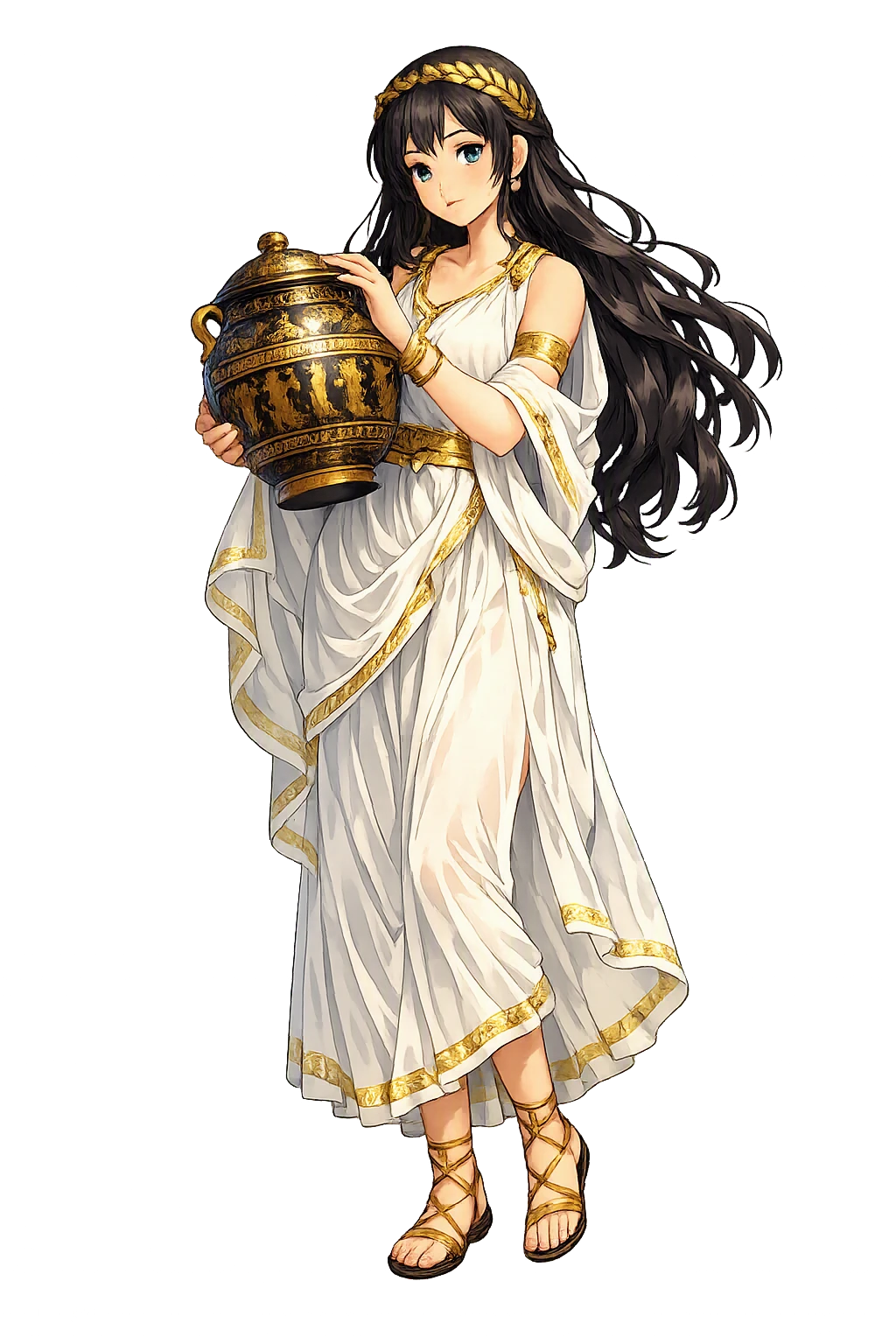
Stories of Pandōra
Pandōra's story is told almost entirely by Hesiod, twice — in the Theogony and the Works and Days — and it is the Greek myth of myth-making itself: how the gods answered fire with a counter-gift, and how a name can mean blessing and bane at once. Later ages added the box; Hesiod's jar is the original.
After Promētheus stole fire, Zeus ordered Hephaistos to 'mix earth with water, and to put in it the voice and strength of humankind,' shaping 'a beautiful evil' in the likeness of a modest maiden (Hesiod, Theogony 570-584). The gods then worked her over like a dedication: Athēnâ dressed her in silver-white robes and set a veil on her head; the Horae crowned her with spring flowers; Aphrodítē 'shed grace upon her head and cruel longing and cares that weary the limbs'; Hermēs gave her 'a bitch's mind and a thievish character' and the gift of winning speech (Works and Days 60-80). Nothing in her is her own — she is a composite artifact, each Olympian's contribution a function. The myth makes the first woman a manufactured object, which is exactly the bitterness Hesiod wants us to taste: Pandōra is a tool disguised as a bride.
Zeus named her Pandōra — 'because all the Olympians gave her a gift, a bane to industrious men' (Hesiod, Works and Days 80-82) — and had Hermēs take her to earth with a great storage-jar. Promētheus had already warned his brother Epimētheus never to accept a gift from Olympian Zeus; the Works and Days compresses the tragedy into a single line: Epimētheus 'took the evil, and only when he had it perceived the evil' (Op. 88-89). Apollodorus (Library 1.7.2) retells the same scene. The whole machinery of the myth depends on this one moment of ignored foresight: forethought is chained in the Caucasus, afterthought answers the door. From her, Hesiod adds in the Theogony (590-612), descends 'the race of women' — a passage later Greeks found as uncomfortable as we do.
Hesiod continues with terrible speed (Works and Days 90-105): 'the woman took off the great lid of the jar with her hands and scattered all these evils, bringing sorry troubles upon mortals. Only Hope remained there, inside, in the unbreakable home, under the lip of the jar, and did not fly out.' Before this, men lived 'free from ills... without the evil diseases that bring death'; now the jar's winged sorrows fill sea and land — 'for the earth is full of evils, and the sea is full.' Hope stayed, Hesiod adds in a dark aside, 'by the plans of aegis-bearing Zeus,' leaving every reader to decide whether hope is the one mercy left to mortals or the final bait sealed in with them. The vessel, again, was a pithos — a household storage jar; the tradition's later 'box' is Erasmus' sixteenth-century mistranslation, not Hesiod's.
Already in antiquity the name was argued over. Hesiod glosses it one way — 'all-gifted,' pan-dōra, because every god gave her a gift (Theogony 590; Works and Days 81) — but the same formation can mean 'all-giving,' she from whom all gifts flow, and some ancient readers heard an earth-mother's title beneath it. The Hesiodic Catalogue of Women (fr. 5 M-W) knows a second Pandōra entirely: a daughter of Deukalíōn who bore Graecus to Zeus, ancestress of the Greeks rather than their punishment. Modern scholarship (West, ad Op. 80) notes that both readings are grammatically live. The ambiguity is the myth in miniature: the same figure who pours out every evil also — through the children of her line — becomes the mother of everyone who came after. Her name cannot decide whether she is the vessel of ruin or the source of all that followed.
First Woman and the Jar of Evils
Pandōra is the woman the gods made as punishment: shaped from earth and water, dressed by Athēnâ, filled with longing by Aphrodítē, and sent to Epimētheus with a jar that holds every sorrow mortal life would ever know. Her name means 'All-gifted' — because every Olympian gave her something.
Hephaistos mixed earth and water into a 'beautiful evil'; Athēnâ dressed her and taught her weaving (Hesiod, Theogony 570-584; Works and Days 60-68).
Aphrodítē poured in grace and cruel longing, Hermēs a lying tongue and a thievish heart — 'because all the Olympians gave her a gift, a bane to men' (Works and Days 69-82).
Not a box: a pithos, a great storage-jar, whose lifted lid releases toil, disease, and old age into the world (Works and Days 90-105).
Only Elpis, Hope, stayed under the rim — a mercy, or Zeus's final cruelty; Hesiod leaves it deliberately unclear (Works and Days 96-104).
From the original script to the living URL
Πανδώρα
The name in its original Greek form. Pandōra (Πανδώρα) is attested in the source tradition — “All-gifted”. Its long vowels and acute accents carry the full phonetic and orthographic weight of the source tradition.
pandora
Reduced to plain pandora, the name loses everything that made it specific: long vowels and acute accents. What remains is an ASCII string that machines can parse but that no longer speaks with its original voice.
Pandōra
The Unicode restoration recovers what ASCII flattened. Pandōra restores long vowels and acute accents, returning the name to its original written dignity. The domain encodes to Punycode, but the browser displays the truth.
Pandōra.com → xn--pandra-egb.com
The non-ASCII characters in Pandōra are encoded while the ASCII remains visible. To the DNS, it is Punycode. To humanity, it is Pandōra.
Owned, ideal, and ASCII forms of Pandōra
Pandōra
Restores Πανδώρα. The live temple domain — pandōra.com.
Pandṓra
Restores Πανδώρα. A second live spelling — pandṓra.com.
pandora
Flattens Πανδώρα. The plain ASCII fallback — what DNS and legacy systems see.
How Pandōra was spoken
How Pandōra is preserved in writing
A bespoke provenance study for Pandōra is being prepared by the PUNICODEX scholarly team.
Contribute scholarly provenance →The lore you have read is the living myth. Extended Lore opens the scholarly vault beneath it: the cult and its material remains, a history of the image, the name after antiquity, a meditation on what the name still means, and the full scholarly apparatus — etymology, orthography, sources.
Enter Extended Lore