
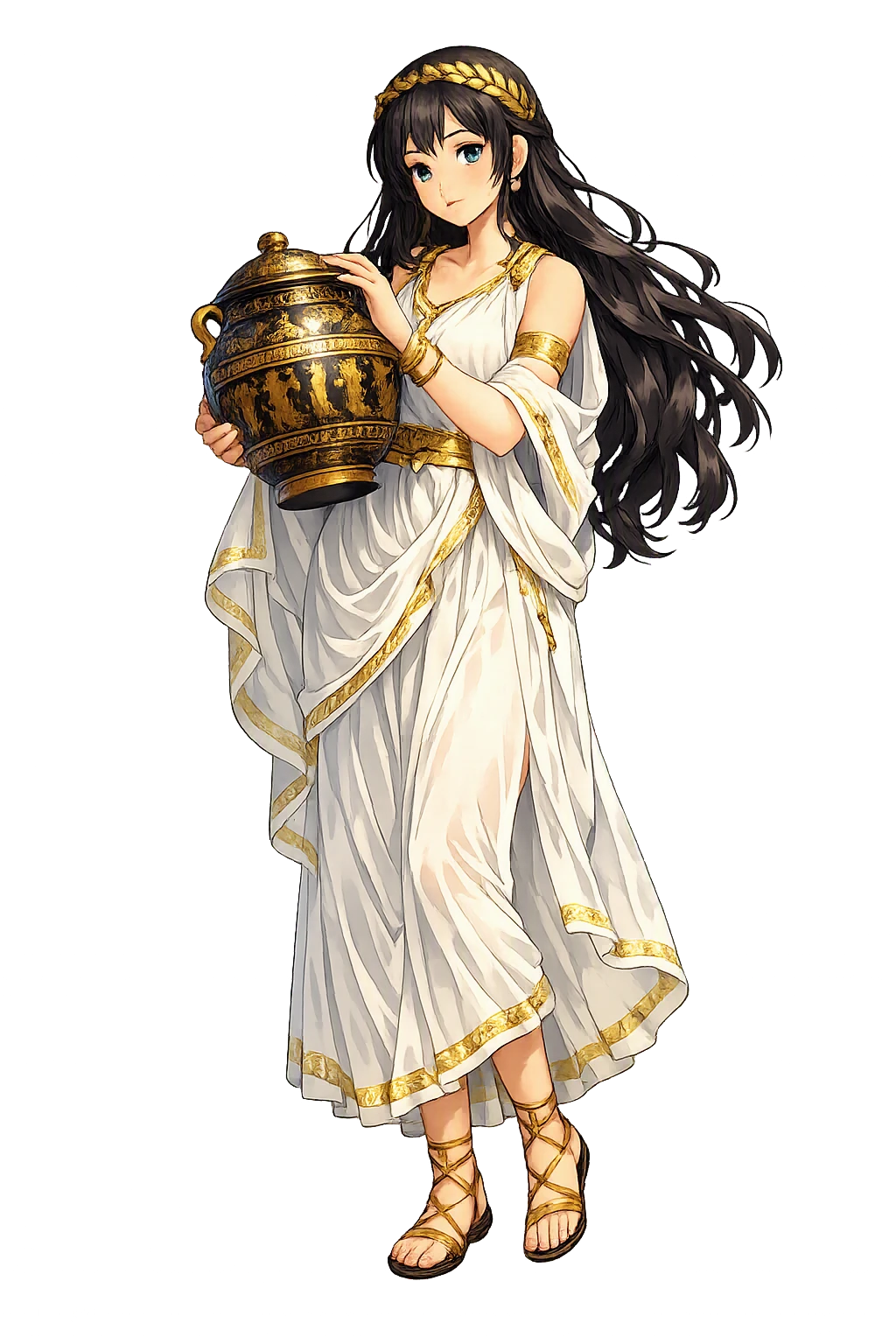
Why Pandōra is spelled that way — and what it costs to get it right
There is a version of this name the early internet had to settle for: pandora. This is the file on how Pandōra replaced it.
Pandōra's story is told almost entirely by Hesiod, twice — in the Theogony and the Works and Days — and it is the Greek myth of myth-making itself: how the gods answered fire with a counter-gift, and how a name can mean blessing and bane at once. Later ages added the box; Hesiod's jar is the original.
At a Glance
- Restored name: Pandōra
- ASCII form: pandora
- Meaning: "All-gifted"
- Domain of influence: First Woman, Box of Evils
- Pantheon: Greek
- Classification: Tier 1
- Original script: Πανδώρα
- Series: The Restoration Files, No. 380 of 548
The Name Before the Marks
The name is attested as Πανδώρα, in the attestation Hesiod, Works and Days 60-105 and Hesiod, Theogony 570-616 give us. On the evidence, it means "All-gifted".
Strip Pandōra to pandora and one piece of evidence vanishes:
- o → ō — Macron: long omega: the vowel length the ASCII form cannot show.
These are the small, provable things a restoration is made of: not taste, not branding — attestation.
Spoken, the name runs `/pan.dɔ́ː.ra/` — 'pan-DOH-rah' — the stress rides the long middle syllable; hold the 'o,' as befits the word 'gift.'
The Temple That Stands Now
The restored name is not a plaque; it is an address. The temple of Pandōra lives at /pandora/, with its mythology in the lore halls, its peer-reviewed record in the Scholarly Edition, and its place in the pattern atlas on the patterns floor.
The restoration preserves more than the ASCII form can express — stress, length, or a letter the Latin keyboard lost — which places it, mechanically, in Tier-1.
Where the Name Stood First
No sanctuary of Pandōra is known; her archaeology is iconographic and Attic. White-ground lekythoi of ca. 470-450 BCE — fine funerary oil-flasks — show her emergence from the earth with Hephaistos standing by, hammer still raised, a motif unique to Athens and plausibly tied to the contemporary stage. Later red-figure vases show her simply as a bride, which is Hesiod's bitter point made visible: the gods' punishment arrives wearing wedding clothes. The imagery dies with the classical period and returns only in Renaissance and Romantic painting, where she is reborn as the tragic first woman. The temple on the web is the newest of these addresses — the first one that fits in a pocket.
The Archetype at Work
The pattern atlas seats this temple in 7 industries, each match argued and weighted: Global Pantheon Brands (all-gifted in Greek; the name has become a global byword for curiosity and first discovery.); Mythic Name Restoration (all-gifted in Greek; the restored spelling recovers the original vowel length.); Writing, Publishing & Media (the all-gifted first woman and her box is a story still retold in every medium; the name is a publishing archetype.). The Resonance File reads those seats through the myths themselves.
In the Sacred Texts
The Greek tradition is not a vibe; it is a library. The Sacred Texts collection holds Theogony, Homeric Hymns, and Works and Days — the primary sources the temple's scholarship is built on. The temple is the argument; the texts are the evidence.
The File Continues
The temple's founding dispatch tells the name's story; its Resonance File reads the myths into the industries; the blog index holds the whole archive.
Continue the series — previous file: Pān (read it here) · next file: Pángǔ (read it here).
The Restoration Files are written from the same canonical record as the temples themselves: the lexicon, the lore catalog, the pattern atlas, and the cited scholarly sources. If a file ever disagrees with its temple, the temple is right — tell us, and the file will be corrected.