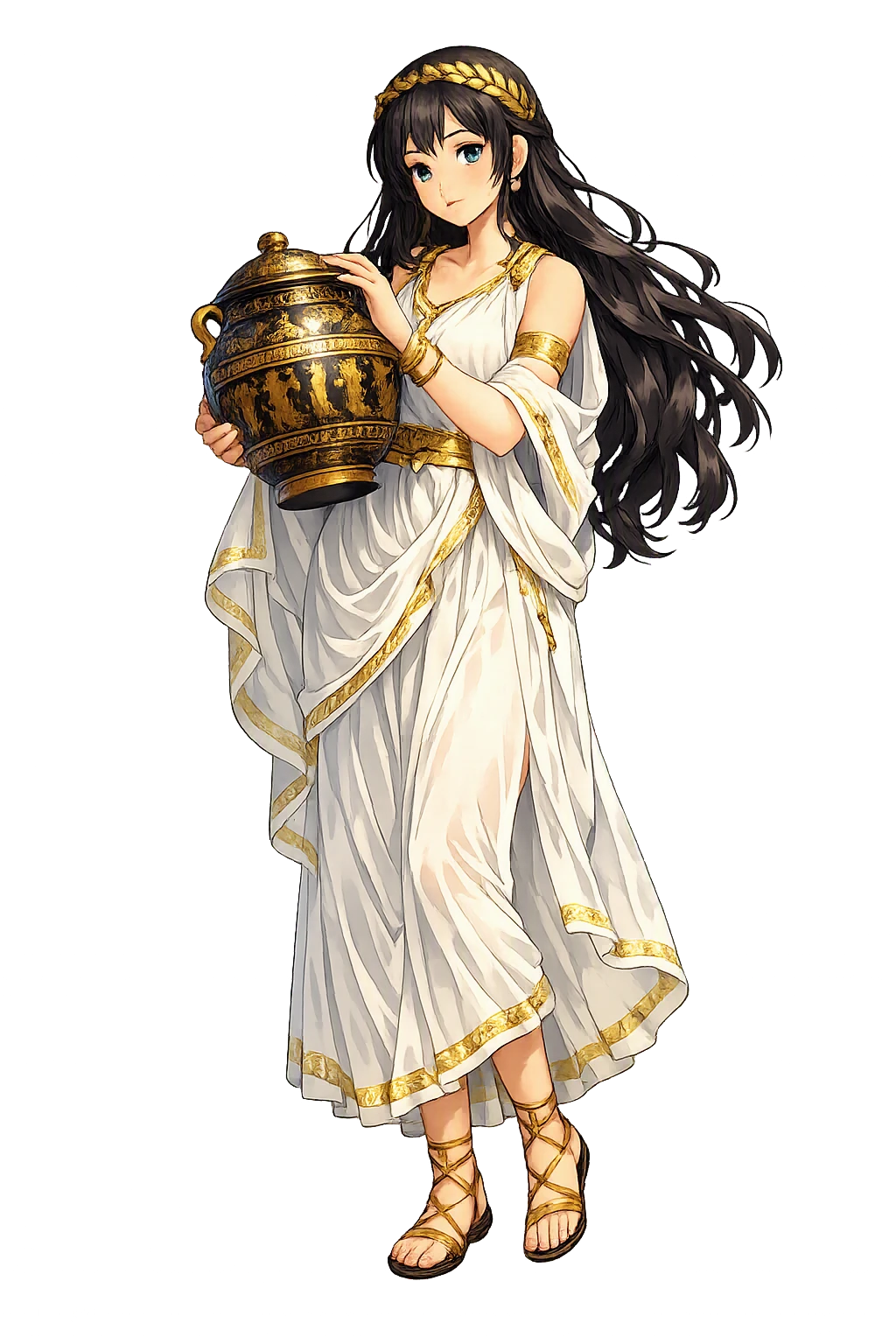
PuniCodex

Extended Lore

Πανδώρα Pandōra

Etymology · Orthography · Cult · Iconography · Reception · Sources

Tier 1 Pandōra.com · Pandṓra.com
Pandōra — First Woman, Box of Evils
01

Quick Facts

Essential information about Pandōra, First Woman, Box of Evils

Original ScriptΠανδώρα
Unicode RestorationPandōra
Reconstructed Pronunciation/pan.dɔ́ː.ra/
PantheonGreek
DomainFirst Woman, Box of Evils
MeaningAll-gifted
ClassificationTier 1
Primary DomainPandōra.com
Sacred SymbolsThe storage-jar (pithos), The lid, Elpis (Hope), Clay, The floral crown
02

Etymology & Word Family

From original script to Unicode restoration

Proto-indo-european *pan- + *dōr- all-gifted
Original Script Πανδώρα Pandōra — "All-gifted"
Unicode Restoration Pandōra Restored stress, length, and script
Modern ASCII pandora Plain-ASCII fallback

Greek Πανδώρα 'all-gifted', from πᾶν 'all' and δῶρον 'gift'; the first woman in Hesiod's Theogony.

03

Unicode Character Breakdown

Character-by-character philological analysis

CharacterUnicodeNameBlockPhonetic Role
PU+0050Latin Capital Letter PBasic LatinSame
aU+0061Latin Small Letter ABasic LatinSame
nU+006ELatin Small Letter NBasic LatinSame
dU+0064Latin Small Letter DBasic LatinSame
ōU+014DLatin Small Letter O with MacronLatin Extended-AMacron: long omega
rU+0072Latin Small Letter RBasic LatinSame
aU+0061Latin Small Letter ABasic LatinSame

The Tier 1 classification reflects how much of the original phonology this restoration preserves — stress and vowel length for Greek names, distinctive letters and diacritics for every other tradition.

04

Cult & Worship

How the sacred was kept — rites, sanctuaries, remains

The Cult

No sanctuary, festival, priesthood, or votive of Pandōra is attested — the evidence is as thin as the record can honestly be, and this field should say so. Her ritual footprint, if the word is allowed, is funerary and Athenian: white-ground oil-flasks of c. 470–450 BCE show her rising from the earth, a scheme at home in graves but implying no cult. Later tradition gave her none either; she lived entirely inside Hesiod's two poems.

In the Earth

No sanctuary of Pandōra is known; her archaeology is iconographic and Attic. White-ground lekythoi of ca. 470-450 BCE — fine funerary oil-flasks — show her emergence from the earth with Hephaistos standing by, hammer still raised, a motif unique to Athens and plausibly tied to the contemporary stage. Later red-figure vases show her simply as a bride, which is Hesiod's bitter point made visible: the gods' punishment arrives wearing wedding clothes. The imagery dies with the classical period and returns only in Renaissance and Romantic painting, where she is reborn as the tragic first woman.

05

Iconography

How Pandōra was imaged across the ages

The Image

Pandōra's image is one of the strangest in Greek art, because her first portraits show her not yet born. On Attic white-ground lekythoi of c. 470–450 BCE she rises half-length from the ground like a plant or a ghost, while Hephaistos stands by with hammer raised — the moment of manufacture, painted on funerary ware. An Attic painter of the next generation is even named for her: modern scholarship calls him the 'Pandora Painter' after just such a birth scene. The text supplies her wardrobe and the painters followed it: veil, crown of flowers, golden necklace, bridal robes — Hesiod's bitter joke that the punishment arrives dressed for a wedding. The jar, her defining attribute in every later age, is surprisingly rare on the vases. Later red-figure simply shows a bride; the scheme dies with the classical period, and the image everyone now knows — a woman lifting a decorated lid — belongs to the post-Erasmian box and to later painting, not to antiquity.

06

Reception & Transformation

The name after its own age — transmission, translation, survival

Afterlives

Pandōra's transmission is the biography of a text — Hesiod's — and of one mistranslation. Antiquity added almost nothing: Apollodorus condenses the Works and Days, Hyginus condenses Apollodorus, and a second Pandōra in the Hesiodic Catalogue shows the tradition branching early. Print then changed her fate: the editio princeps of Hesiod (Milan, c. 1480) put the poems into every schoolman's hands, and Renaissance mythography — Natale Conti's Mythologiae (1551), Cartari's Imagini degli dei (1556) — spread a learned, allegorical Pandora across Europe. Erasmus' pyxis (1508) conquered the vernaculars, and by the seventeenth century 'Pandora's box' was proverbial in English. Goethe worked her into an unfinished festival play (Pandora, 1807–08). The nineteenth-century criticism born of the Homeric Question made Hesiod's text a battleground, and she rode the debate into modern scholarship, where the scapegoat reading finally found her.

Identifications Across Traditions

The Romans had no native equivalent and simply kept her Greek name; Hyginus (Fabulae 142) condenses Hesiod for handbook readers, and Ovid passes over her fashioning in silence while retelling the flood around her in-laws. Her great metamorphosis is philological: in 1508 Erasmus, rendering a proverb about ill-considered gifts, translated Hesiod's pithos — a storage-jar — as pyxis, a box, and 'Pandora's box' entered every European language. The Renaissance and Romantic eras remade her as the tragic first woman; Rossetti painted her as a burning-haired femme fatale; modern feminist and psychoanalytic rereading has reclaimed her as the scapegoat of a male poet's misogyny — a reading the text half-invites, since the gods, not she, built the jar and its contents.

Modern Legacy

'To open Pandora's box' is among the most durable idioms in English and the European languages — for any act that releases consequences no one can recall. The name branded a global jewelry house, a moon of Saturn, and countless works of science fiction; her jar launched the forbidden-container trope that runs from Eden's tree to Bluebeard's chamber. In myth scholarship she remains the case study of how a didactic fable about work and women became the West's default image of unintended consequence. Restoring Pandōra — stress and long omega — restores the name as Hesiod's audience heard it: 'All-gifted,' a phrase that has never stopped meaning two things at once.

07

The Meditation

What Pandōra means — beyond the dictionary

Pandōra is a story about storytelling. Hesiod, a didactic poet singing to farmers, needed a reason the world demands labor, and he built it from a name: 'all-gifted.' Everything the gods each contributed, she is a bundle of divine functions wearing a bridal veil. It is one of the most misogynistic passages in Greek literature — and one of the most analyzed, because the cruelty is so visibly constructed. Pandōra did not choose to open the jar in any version Hesiod tells with blame; the evils simply fly, and hope simply stays, and the poet leaves both facts standing.

What she means beyond the dictionary is this: every culture narrates its troubles into being, and the vessel of those troubles always turns out to be someone who had no part in making them. To read her carefully is to unmake the scapegoat and see, instead, the hands that built the jar.

08

Frequently Asked Questions

Common questions about Pandōra, First Woman, Box of Evils, and Unicode restoration

01How do you pronounce Pandōra?

In reconstructed pronunciation, Pandōra is /pan.dɔ́ː.ra/ — approximately 'pan-DOH-rah' — the stress rides the long middle syllable; hold the 'o,' as befits the word 'gift.'.

02What does Pandōra mean?

Pandōra means All-gifted in the greek tradition.

03What are the symbols of Pandōra?

Pandōra is associated with The storage-jar (pithos) (The great earthenware vessel from which every mortal ill escaped — a household jar, which is precisely Hesiod's point: evil enters the world through the home), The lid (Her hand on the rim is the most reproduced gesture in the tradition; the myth turns on a single motion that cannot be reversed), Elpis (Hope) (The one presence left inside the jar — read by ancient and modern readers alike both as the last mercy and as the gods' final bait), Clay (She was kneaded from earth and water by Hephaistos — a divine artifact built of human material), The floral crown (The Horae crowned her with spring flowers, and Athēnâ veiled her — beauty as the wrapping of the trap (Works and Days 72-76)).

04Why are there different spellings of Pandōra?

Each form is a historically attested restoration rather than a mistake: Pandṓra is the ideal form (Stacked macron+acute on the stressed long vowel, matching Greek Πανδώρα; philologically ideal but often untypeable on phones.). PUNICODEX registers the full set so the tradition is preserved under every defensible spelling.

05Why restore Pandōra in Unicode?

Plain ASCII pandora strips the stress, length, and script that make the name specific. Unicode restoration returns the name to its original written dignity.

06What is the most important myth about Pandōra?

“A Beautiful Evil, Built by Committee” — the The Making story that anchors the mythology of Pandōra, told in full on the lore page.

09

Scholarly Sources

The philological foundations of this restoration

Every claim on this page is grounded in established scholarship. The orthographic restorations follow disciplinary convention. The etymological chain follows the best available reference works. This is not invention — it is resurrection through scholarship.

◈

Lexicography & Philology

  • Liddell, H. G., Scott, R., & Jones, H. S. A Greek-English Lexicon. Oxford: Clarendon Press, 9th ed. 1996.
  • Pape, W., & Benseler, G. E. Wörterbuch der griechischen Eigennamen. Braunschweig: Vieweg, 1884.
  • Beekes, R. S. P. Etymological Dictionary of Greek. Leiden: Brill, 2010.
◎

Primary Texts

  • Hesiod, Works and Days 60-105
  • Hesiod, Theogony 570-616
  • Hesiod, Catalogue of Women fr. 5 M-W (the second Pandōra)
  • Apollodorus, Library 1.7.2
  • Erasmus, Adagia (1508) — source of the 'box' mistranslation; West, Hesiod: Works and Days, ad 80-105
◉

Archaeology & Art History

  • Material evidence — iconography, inscriptions, and temple archaeology — for Pandōra and related cults.
✦

Religious Studies

  • Hyginus, Fabulae 142
Return

The Surface Awaits

You have traced the name from its earliest attestation to its Unicode restoration. Now return to the myth. The story is where the name lives.

Back to Lore
Pandōra mascot