
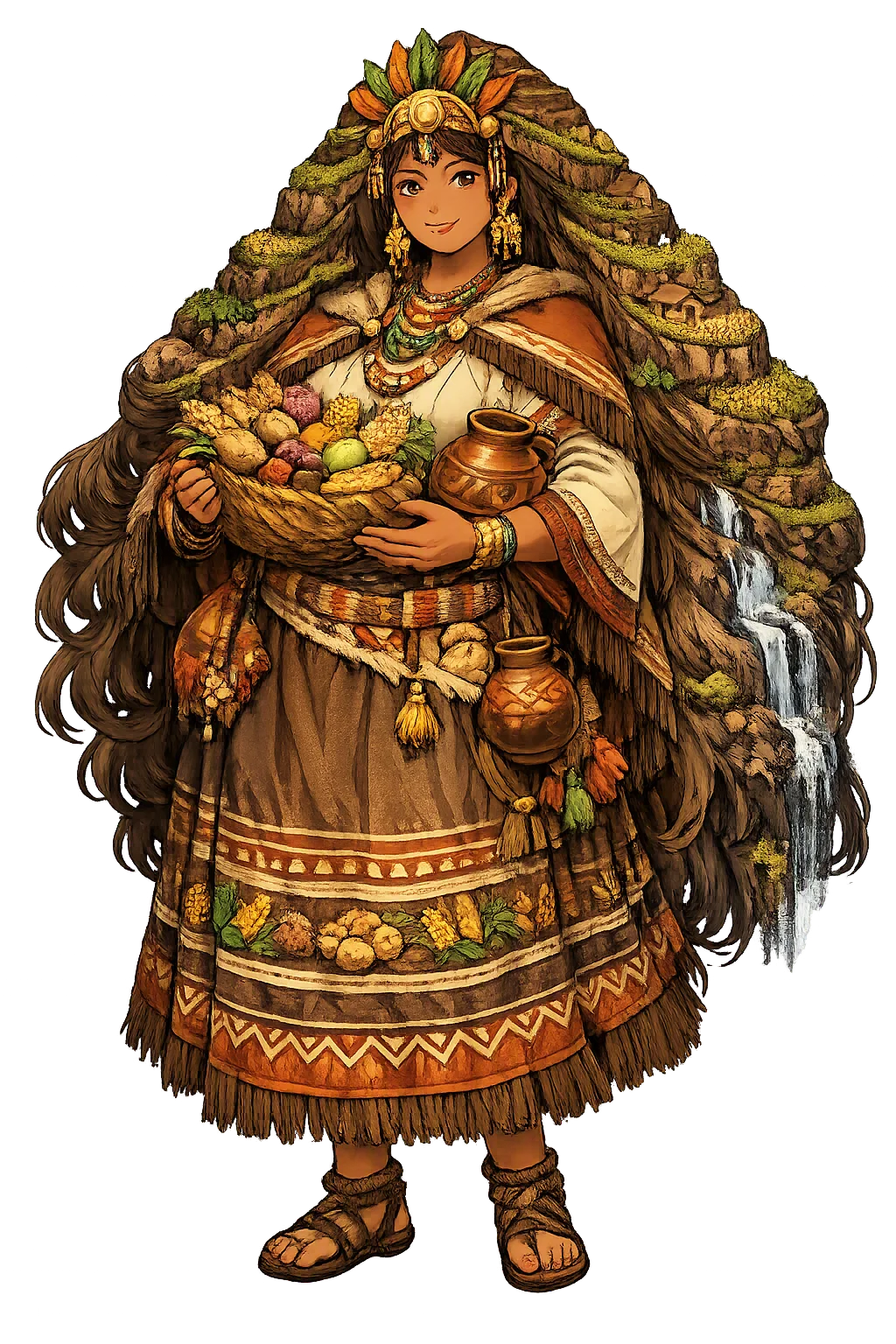
Why Pachamama is spelled that way — and what it costs to get it right
There is a version of this name the early internet had to settle for: pachamama. This is the file on how Pachamama replaced it.
Pachamama has no surviving epic. Andean theology lived in ritual, not scripture, and the written record begins only with the conquest, in chronicles already half-Christian. Her 'myths' are therefore creation reports, foundation legends, and — most authentically — the living practice of feeding the earth.
At a Glance
- Restored name: Pachamama
- ASCII form: pachamama
- Meaning: "Mother Earth"
- Domain of influence: Earth, Harvest, Mother
- Pantheon: Incan
- Classification: Tier 2
- Original script: —
- Series: The Restoration Files, No. 376 of 548
The Name Before the Marks
Spoken, the name runs `/pa.tʃaˈma.ma/` — 'pa-cha-MA-ma' — four even syllables with the weight on 'MA'; the 'ch' is the same sound as in English 'church,' not 'chase.'
The Temple That Stands Now
The restored name is not a plaque; it is an address. The temple of Pachamama lives at /pachamama/, with its mythology in the lore halls, its peer-reviewed record in the Scholarly Edition, and its place in the pattern atlas on the patterns floor.
Tier-2 here means one preserved truth — not less important, just singular. The temple shows it and names it.
Where the Name Stood First
Her material traces are everywhere and marked with nothing: the Andes built few temples to her because the whole cultivated landscape was her body. At Cusco, the Coricancha — the 'golden enclosure' that was the ritual heart of the empire — stood amid terraces and foundation offerings; at Moray, the great concentric agricultural terraces near the Sacred Valley are read by many archaeologists as a ritual-agricultural complex where highland cultigens were adapted under the earth's eye. Qollqas — the circular stone storehouses that grid the hillsides above the Inca road — embody the doctrine of deposit and return: surplus guarded against years of famine. Excavations at Inca administrative centers such as Huánuco Pampa have recovered coca caches, miniature vessels, and guinea-pig offerings consistent with earth-payments, and the peak shrines of the capacocha rites, excavated on volcanoes such as Llullaillaco (1999), belong to her wider mountain family — the apus who hold the high ground while Pachamama keeps the tilled. The temple on the web is the newest of these addresses — the first one that fits in a pocket.
The Archetype at Work
The pattern atlas seats this temple in 5 industries, each match argued and weighted: Agriculture, Food & Harvest (primary seat: Pachamama embodies earth, harvest, mother — the core of agriculture food.); Environmental & Climate Services (resonant seat: Pachamama shares symbolic territory with environment climate.); Forestry, Conservation & Outdoor Industries (resonant seat: Pachamama shares symbolic territory with forestry conservation.). The Resonance File reads those seats through the myths themselves.
The File Continues
The temple's founding dispatch tells the name's story; its Resonance File reads the myths into the industries; the blog index holds the whole archive.
Continue the series — previous file: Ọya (read it here) · next file: Padmasambhava (read it here).
The Restoration Files are written from the same canonical record as the temples themselves: the lexicon, the lore catalog, the pattern atlas, and the cited scholarly sources. If a file ever disagrees with its temple, the temple is right — tell us, and the file will be corrected.