PuniCodex

Extended Lore

Pachamama

Etymology · Orthography · Cult · Iconography · Reception · Sources

Tier 2 Pachamama
Pachamama — Earth, Harvest, Mother
01

Quick Facts

Essential information about Pachamama, Earth, Harvest, Mother

Scholarly TransliterationPachamama
Unicode RestorationPachamama
Reconstructed Pronunciation/pa.tʃaˈma.ma/
PantheonIncan
DomainEarth, Harvest, Mother
MeaningMother Earth
ClassificationTier 2
Primary DomainPachamama
Sacred SymbolsCoca leaves, Chicha de jora, The foot-plough (taklla), The clay storage jar, The open earth of August
02

Etymology & Word Family

From original script to Unicode restoration

Scholarly Transliteration Pachamama Pachamama — "Mother Earth"
Unicode Restoration Pachamama Canonical scholarly spelling — ASCII-identical
Modern ASCII pachamama Plain-ASCII fallback

The name Pachamama reaches the modern world through scholarly transliteration of the incan tradition. Because the conventional spelling uses only Latin letters, its Unicode and ASCII forms coincide — the tradition it carries is in the name itself, not in diacritics.

03

Unicode Character Breakdown

Character-by-character philological analysis

CharacterUnicodeNameBlockPhonetic Role
PU+0050Latin Capital Letter PBasic LatinSame
aU+0061Latin Small Letter ABasic LatinSame
cU+0063Latin Small Letter CBasic LatinSame
hU+0068Latin Small Letter HBasic LatinSame
aU+0061Latin Small Letter ABasic LatinSame
mU+006DLatin Small Letter MBasic LatinSame
aU+0061Latin Small Letter ABasic LatinSame
mU+006DLatin Small Letter MBasic LatinSame
aU+0061Latin Small Letter ABasic LatinSame

The Tier 2 classification here reflects fidelity to the attested tradition, not recovered diacritics: every character of Pachamama already survives in ASCII. What the restoration preserves is the canonical spelling itself — the form scholarship standardised.

04

Cult & Worship

How the sacred was kept — rites, sanctuaries, remains

The Cult

Pachamama's cult was never a temple cult. The chroniclers — Cobo, Pachacuti Yamqui — describe a worship conducted at the furrow's edge: chicha poured into the planting hole, coca leaves buried, the first fruits returned to the soil that gave them. No priestly college served her; the household head paid her, at sowing, at harvest, and before any building touched her body. The great ceremonies belonged to her sons and daughters — the apus of the peaks, Inti of the sky — while she received the small, constant payments that keep reciprocity alive. Archaeology reads her cult indirectly, in the caches and foundation offerings of Inca sites. What is attested without interruption is the practice itself: five centuries after the conquest, Andean households still pour the August payment.

In the Earth

Her material traces are everywhere and marked with nothing: the Andes built few temples to her because the whole cultivated landscape was her body. At Cusco, the Coricancha — the 'golden enclosure' that was the ritual heart of the empire — stood amid terraces and foundation offerings; at Moray, the great concentric agricultural terraces near the Sacred Valley are read by many archaeologists as a ritual-agricultural complex where highland cultigens were adapted under the earth's eye. Qollqas — the circular stone storehouses that grid the hillsides above the Inca road — embody the doctrine of deposit and return: surplus guarded against years of famine. Excavations at Inca administrative centers such as Huánuco Pampa have recovered coca caches, miniature vessels, and guinea-pig offerings consistent with earth-payments, and the peak shrines of the capacocha rites, excavated on volcanoes such as Llullaillaco (1999), belong to her wider mountain family — the apus who hold the high ground while Pachamama keeps the tilled.

05

Iconography

How Pachamama was imaged across the ages

The Image

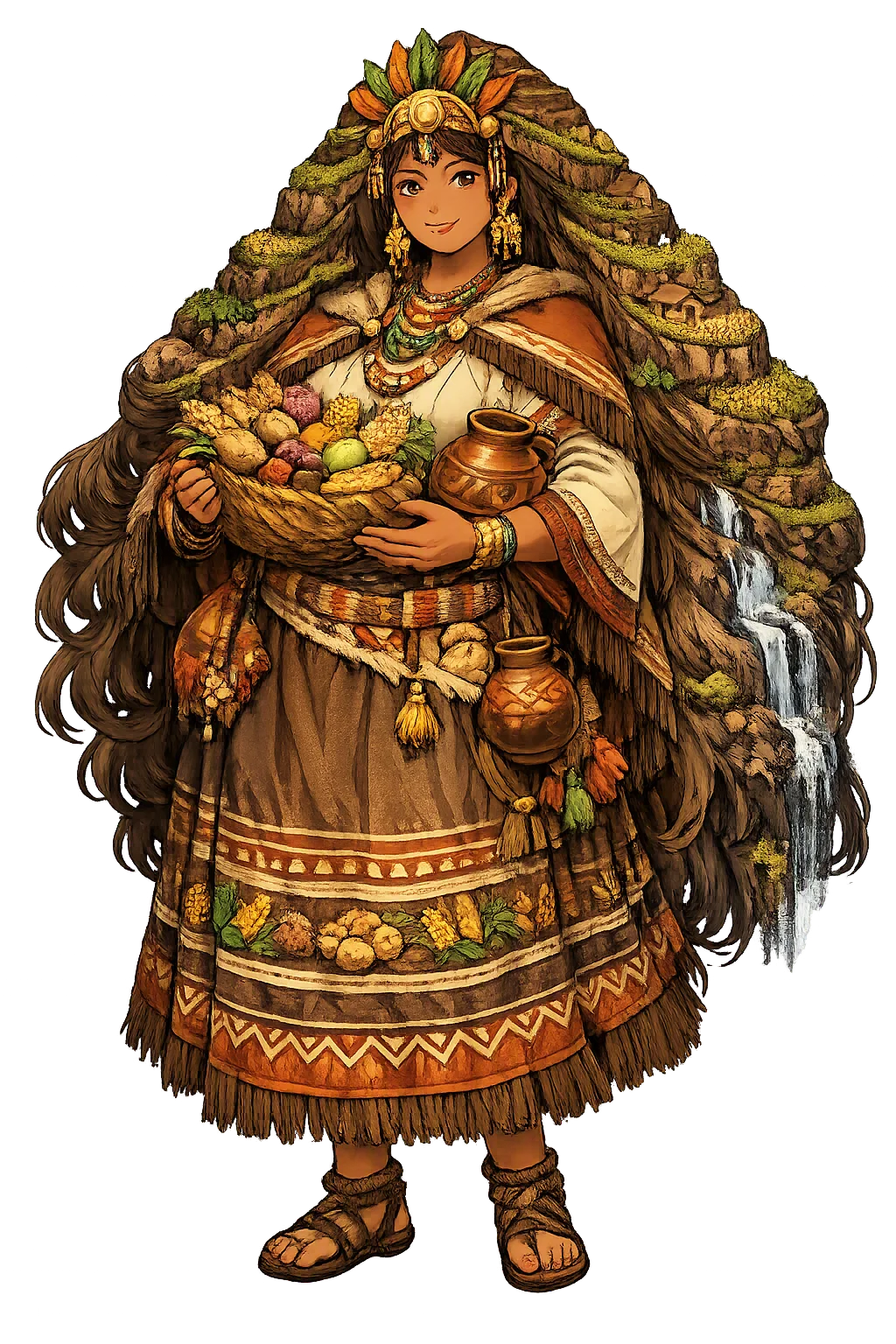
Pachamama was never imaged, and that was her doctrine. The chroniclers insist the Inca made her no statue: the tilled earth, the furrow, the stored grain were her only icon — a goddess whose temple was the whole cultivated horizon. Colonial art filled the silence sideways, personifying her as the mountain itself: the great vírgenes del cerro paintings of the viceroyalty — the Cerro Rico of Potosí rendered as a crowned mother whose body is the mine, rich exactly where the silver runs — survive in collections from Potosí to Lima. Modern indigenous painting completed her face: the fecund mountain-mother of mural and retablo, terraces for breasts, ochre and rust for soil. The iconography moves one way only — earth becoming woman, never woman ruling earth. She is among the few great goddesses whose image the whole world eventually made and whose first believers needed none.

06

Reception & Transformation

The name after its own age — transmission, translation, survival

Afterlives

Pachamama's transmission begins in the colonial archive she was never meant to survive. The chroniclers fixed her name — Pachacuti Yamqui's Relación (1613), Cobo's Historia (1653) — and the Church answered with suppression: Arriaga's Extirpación de la idolatría (1621) catalogs the earth-payments as crimes, which is how we know they continued. Two centuries of quiet followed, in which her worship lived exactly where the written record is thinnest. The nineteenth century made her visible again: archaeology rebuilt the Inca past, and romantic indigenismo gave that past a literature. Twentieth-century ethnography then documented the practice unbroken and taught the wider world to read reciprocity — ayñi — as economics and theology at once. Recent scholarship (de la Cadena's Earth Beings, 2015) has asked how much of today's pan-Andean Pachamama is a pre-Hispanic goddess and how much a modern unification of local earth-beings. Her name's passage into ordinary Spanish — the academy dictionary carries pachamama as a common noun — completes the arc: the chroniclers' cult word became the Americas' everyday word for the living land.

Identifications Across Traditions

Colonial Catholicism met Pachamama with the Virgin Mary, and the meeting was less a conquest than an overlay. The Virgin of Copacabana (1583), the Virgin of Candelaria at Puno, and countless village chapels stand on pre-Hispanic wak'as, and Andean feasts were deliberately moved onto Marian dates — so that the August cycle of earth-payments now runs beside the feasts of the Virgin. Nineteenth- and twentieth-century indigenismo recovered her as the emblem of indigenous identity, and in the late twentieth century she became political: Ecuador's 2008 and Bolivia's 2009 constitutions name Pachamama as the bearer of nature's rights, giving the old reciprocity the force of law. In New Age and eco-spiritual circles abroad she has been adopted as a global 'Mother Earth,' sometimes with little sense of her Andean specificity — a reception the tradition itself treats with the tolerant pragmatism of a goddess who accepts all payments.

Modern Legacy

Pachamama never stopped being worshipped. On the first of August, from Colombia's highlands to Bolivia's altiplano, households still pour chicha into the ground, bury coca, and feast; builders in Lima and La Paz commission ritual specialists to 'pay the earth' before breaking ground. The word itself entered all the languages of the Andes: pachamama is now ordinary Spanish for the living land, and her ethic — ayñi, reciprocity — is quoted in debates about mining, water rights, and climate. Indigenous movements made her a political symbol, and her name in two national constitutions made that symbol law. Few goddesses anywhere have traveled so far while staying home: she is simultaneously a household grandmother, a field spirit, and a constitutional principle.

07

The Meditation

What Pachamama means — beyond the dictionary

Pachamama teaches a grammar the modern world has largely forgotten: the dative case of the earth. English says we use land; Quechua says we are given by it. The difference is not semantic decoration. A civilization that thinks of soil as property eventually exhausts it; one that thinks of soil as a mother who must be fed plans in centuries. The Andean payment — a splash of chicha, a pinch of coca — looks small until you notice it has never stopped, through conquest, evangelization, republics, and revolutions.

To speak her name is to be reminded that reciprocity is not charity but physics: every withdrawal is a debt, and the earth always collects. Her modern constitutional career, granting standing to mountains and rivers, is only the old kitchen theology written large. Pachamama asks each of us the question the chronicles recorded: what have you paid the ground that carries you?

08

Frequently Asked Questions

Common questions about Pachamama, Earth, Harvest, Mother, and Unicode restoration

01How do you pronounce Pachamama?

In reconstructed pronunciation, Pachamama is /pa.tʃaˈma.ma/ — approximately 'pa-cha-MA-ma' — four even syllables with the weight on 'MA'; the 'ch' is the same sound as in English 'church,' not 'chase.'.

02What does Pachamama mean?

Pachamama means Mother Earth in the incan tradition.

03What are the symbols of Pachamama?

Pachamama is associated with Coca leaves (The divine plant of the Andes (Cobo calls it the most sacred of all); chewed, shared with guests, and burned or buried as her portion of every meal.), Chicha de jora (Maize beer poured into the earth as payment before drinking begins; the first swallow belongs to her.), The foot-plough (taklla) (Opening the first furrow is a rite, not a chore; the clods are fed before they are planted.), The clay storage jar (Household maize and potatoes guarded in her name; abundance is hers on deposit, not the family's to keep.), The open earth of August (In her month the earth's mouth is open and hungry; whatever is spilled is received, and the fields are fed.).

04Why restore Pachamama in Unicode?

Pachamama is written entirely in ASCII letters, so its restoration is about canonical fidelity rather than recovered diacritics: the temple fixes the name in its scholarly standard spelling, attested in the source tradition, instead of leaving it to drift.

05What is the most important myth about Pachamama?

“The World the Creator Entrusted to Her” — the Creation story that anchors the mythology of Pachamama, told in full on the lore page.

09

Scholarly Sources

The philological foundations of this restoration

Every claim on this page is grounded in established scholarship. The orthographic restorations follow disciplinary convention. The etymological chain follows the best available reference works. This is not invention — it is resurrection through scholarship.

◈

Lexicography & Philology

  • Cerrón-Palomino
◎

Primary Texts

  • Primary sources in the incan tradition for Pachamama.
◉

Archaeology & Art History

  • Material evidence — iconography, inscriptions, and temple archaeology — for Pachamama and related cults.
✦

Religious Studies

  • Juan de Santa Cruz Pachacuti Yamqui, Relación de antigüedades deste Reyno del Piru (1613)
  • Bernabé Cobo, Historia del Nuevo Mundo (1653)
  • Pedro Sarmiento de Gamboa, Historia Índica (1572)
  • Bauer, Brian S., The Sacred Landscape of the Inca (1998)
  • D'Altroy, Terence N., The Incas (2002)
  • Urton, Gary, Inca Myths (1999)
Return

The Surface Awaits

You have traced the name from its earliest attestation to its Unicode restoration. Now return to the myth. The story is where the name lives.

Back to Lore
Pachamama mascot