The Living Myth
Earth, Harvest, Mother · The fertile earth beneath every step
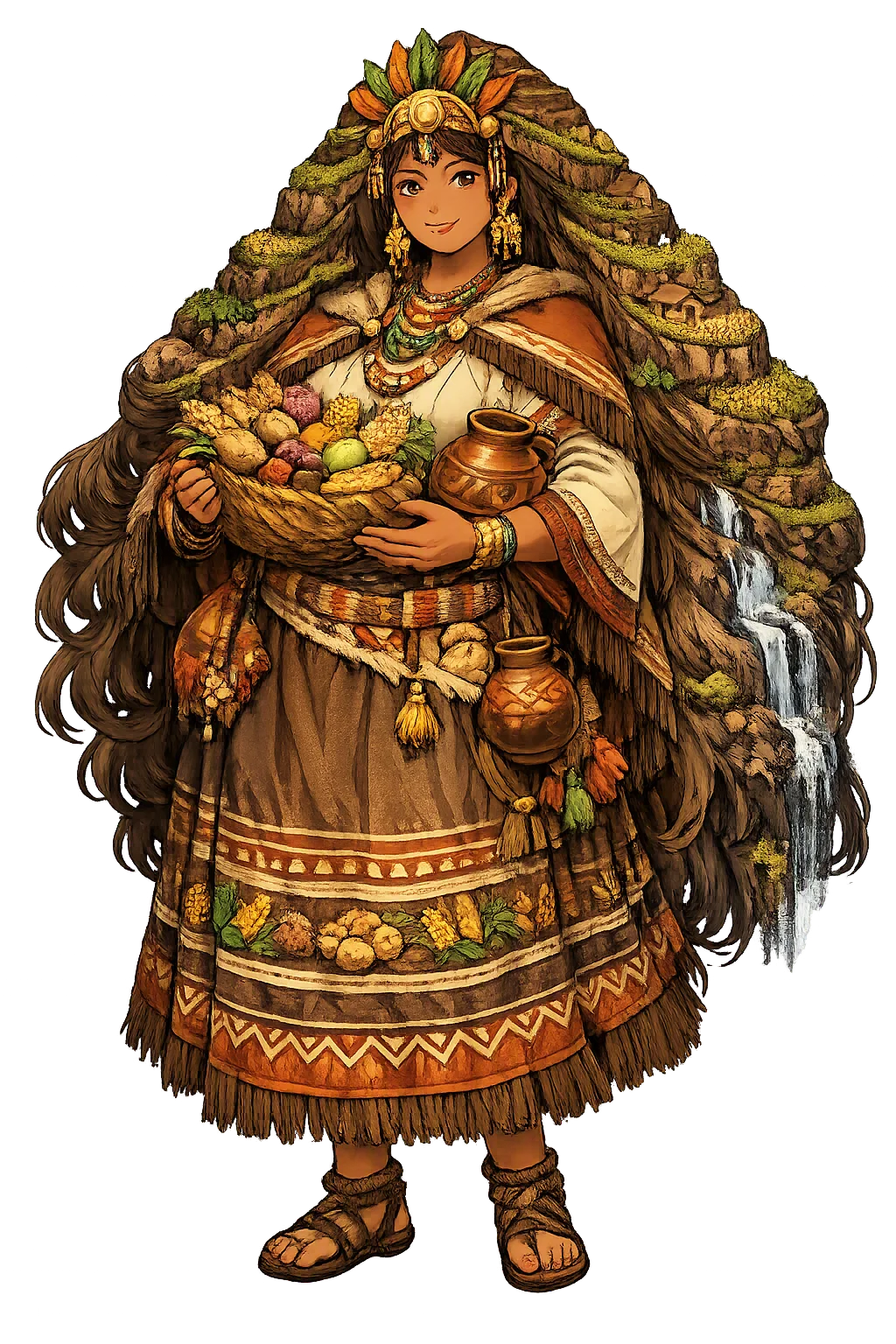
Stories of Pachamama
Pachamama has no surviving epic. Andean theology lived in ritual, not scripture, and the written record begins only with the conquest, in chronicles already half-Christian. Her 'myths' are therefore creation reports, foundation legends, and — most authentically — the living practice of feeding the earth.
Pachamama has no surviving epic of her own; the Andean world kept its theology in ritual, and the written record begins only with the Spanish conquest, in chronicles already half-Christian. Juan de Santa Cruz Pachacuti Yamqui, in his Relación de antigüedades deste Reyno del Piru (1613), and the Jesuit Bernabé Cobo, in his Historia del Nuevo Mundo (1653), tell a creation in which the god Viracocha — he of the staff and the tears — rose from the depths of Lake Titicaca at Tiahuanaco, made the sun, moon, and stars, and fashioned each people from stone before sending them under the earth to their appointed lands. The earth that received this ordered world, the ground beneath every field and city, is Pachamama. She is older than the Inca state and wider than it: the mother in whom pacha — earth, world, time — is made flesh. The myth, such as we have it, says something quietly radical: creation was delegated. Viracocha shaped the world, but he did not stay to farm it; that daily labor belongs to her.
The founding myth of Cusco is also a myth of her consent. Bernabé Cobo tells that the Sun, Inti, grieving over the savagery of humankind, sent his own children — Manco Cápac and his sister-wife Mama Ocllo — out of Lake Titicaca to find a valley where a golden staff, sunk into the earth, would disappear: a sign of ground blessed enough to found a city. Where the staff sank at last, they raised Cusco, 'the navel of the world.' Pedro Sarmiento de Gamboa's Historia Índica (1572) gives the rival version, in which the ancestors emerge not from the lake but from the caves of Pacaritambo; the chroniclers openly disagree, and modern scholarship treats both as legitimating tales of later dynasties. What the versions share is the theology: the land is not conquered but asked. Every foundation, in the Andean telling, is a pact between the traveling children of the Sun and the earth who accepts their weight. Pachamama's acceptance — the swallowing of the staff — is the true founding act; without it, Cusco is only a camp.
August is Pachamama's month, and the Andes still keep it. In the depths of the dry season, before the first rains, the earth is said to be hungry: her mouth is open, and whatever falls into it — a spilled drink, a dropped morsel — belongs to her. Households respond with the pago, the payment: coca leaves and chicha are offered to the ground, holes are dug in the fields and fed with food and liquor, and no one drinks the first sip or eats the first bite before some of it has been given back. Bernabé Cobo, describing the Inca ritual calendar, records August as a season of earth-rites and sacrifice; the modern festival of Pachamama Raymi, kept across Peru, Bolivia, and Ecuador, is its direct descendant. This is not a narrative myth but something rarer: a living practice in which the goddess is fed continuously, household by household. Its meaning is the core of Andean religion — the earth is not property but a partner in reciprocity, and partnership must be paid for to endure.
The conquest did not end her; it disguised her. The great Marian shrine of the Andes, the Virgin of Copacabana on the shore of Lake Titicaca — carved by the Inca craftsman Tito Yupanqui and enshrined in 1582-83 — stands exactly where the earth and the lake had been worshipped, and her feast in early August falls across the old harvest payments. Across the Andes, churches rose on the platform shrines (wak'as) of the old religion, and Quechua speakers did not so much convert as translate: the Virgin received the devotions once carried to Pachamama, and Pachamama, under the mantle, kept the fields. The translation became constitutional in our own century: the 2008 constitution of Ecuador and the 2009 constitution of Bolivia grant nature enforceable rights under her name — Pachamama appearing where other constitutions write 'environment.' The myth that began as colonial survival has become one of the world's most influential legal theologies of the earth.
Earth
Pachamama is the living earth of the Andes — mother of harvests, herds, and households, the ground that feeds and the ground that opens. Hers is a religion of reciprocity: nothing is taken from the earth without payment returned to it. She is not a goddess of temples alone but of every furrow, kitchen, and burial in the Inca world and beyond.
The name itself is the doctrine: pacha 'earth, world, time' + mama 'mother' — the earth as parent, in Quechua.
Maize, potatoes, and llama herds depend on her goodwill; a neglected Pachamama withholds, an honored one multiplies.
Chicha poured into the soil, coca leaves buried or burned — the pago, the thanks and the debt acknowledged before eating.
When offended she stirs: the earth trembles, the underworld mouth opens; her anger is the mountain shaking itself.
From the original script to the living URL
Pachamama
The name survives in scholarly transliteration. Pachamama is the standard Incan romanisation, documented in academic sources — “Mother Earth”. Because the spelling uses only Latin letters, the form is the same in both ASCII and Unicode.
No indigenous writing system is securely attested for individual incan names. The form shown is a modern scholarly transliteration.
pachamama
The plain pachamama form is identical to the Unicode restoration. Because this name is already written in Latin letters, no diacritics, stress, or script information were lost — only capitalization differs.
Pachamama
The Unicode restoration does not need to recover lost marks for Pachamama. Its value is canonical spelling and consistent cataloguing, not the reconstruction of erased orthography. The domain is readable as-is to both DNS and humanity.
Pachamama.com
This restoration is written entirely in ASCII letters — no Punycode encoding stands between Pachamama and the DNS. The domain reads identically to machines and to human eyes.
Owned, ideal, and ASCII forms of Pachamama
Pachamama
The full Unicode restoration. pachamama.com is not in the PuniCodex collection — it is watched for release; if it drops, this temple upgrades to an owned flagship.
How Pachamama was spoken
How Pachamama is preserved in writing
No indigenous writing system is securely attested for individual incan names. The form shown is a modern scholarly transliteration.
Contribute scholarly provenance →The lore you have read is the living myth. Extended Lore opens the scholarly vault beneath it: the cult and its material remains, a history of the image, the name after antiquity, a meditation on what the name still means, and the full scholarly apparatus — etymology, orthography, sources.
Enter Extended Lore