
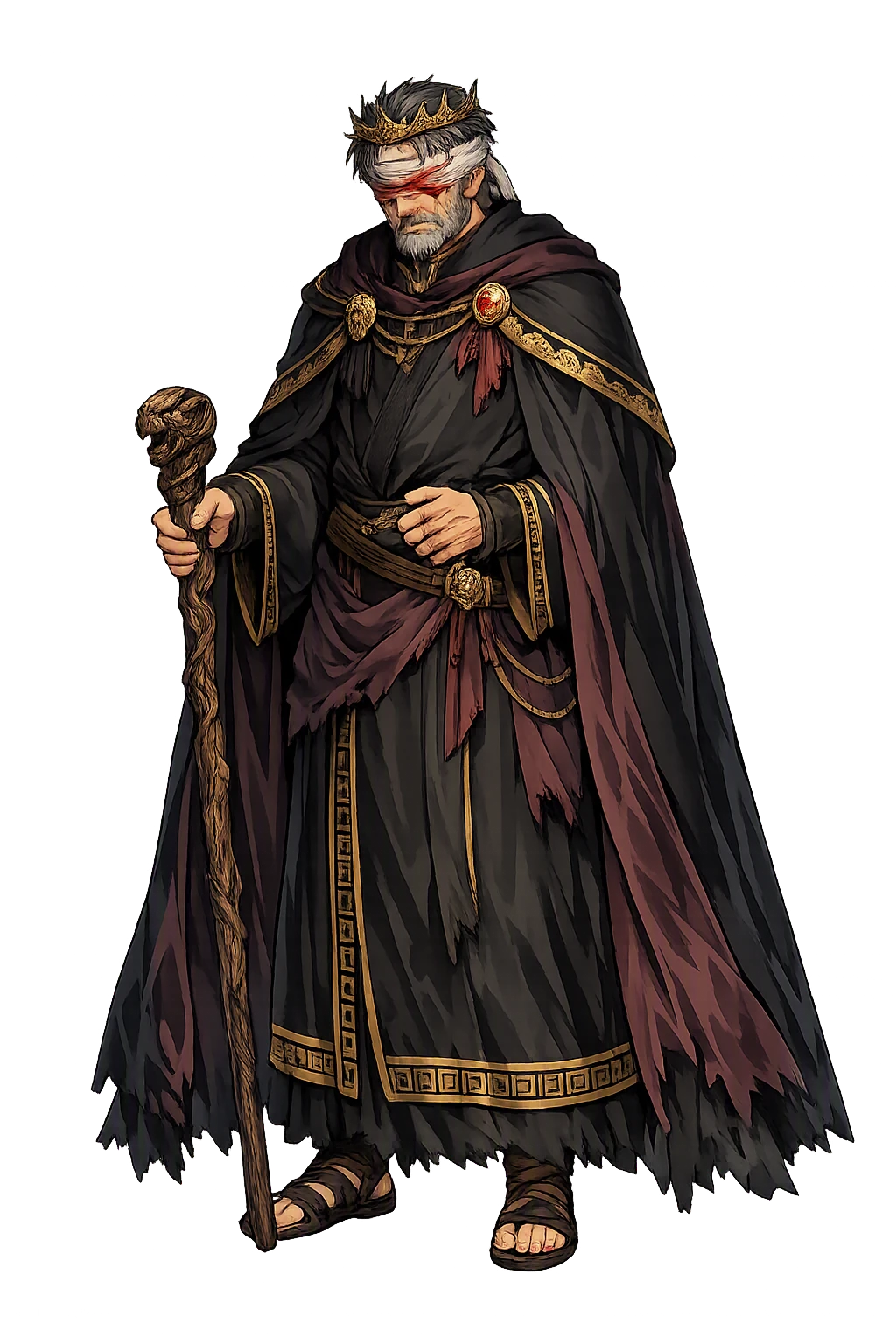
The many faces of Oidípous
No important name has only one face. Oidípous appears as a figure of myth, a scholarly reconstruction, a piece of material culture, a memory carried across languages, and — most recently — a Unicode domain. This post looks at each face in turn: the name and its roots, the Greek original, the reconstructed pronunciation, the mythological record, the symbols and sanctuaries, the cross-cultural afterlife, and the engineering that lets the restored spelling resolve in a browser. Taken together, those faces explain why oidipous was never going to be enough — and why the restored form is worth a domain of its own.
At a Glance
- Restored name: Oidípous
- ASCII form: oidipous
- Meaning: "Swollen-foot (from οἰδάω + πούς)"
- Domain of influence: Fate, Riddles, Thebes
- Pantheon: Greek
- Restoration: Preserves stress
- Original script: Οἰδίπους (Greek)
- Live domain: oidípous.com
Overview
Oidípous (oidipous) — Fate, Riddles, Thebes · Swollen-foot (from οἰδάω + πούς) — belongs to the Greek tradition, where it is catalogued under the domain "Fate, Riddles, Thebes". The name means "Swollen-foot (from οἰδάω + πούς)".
Oidípous belongs to the Greek tradition, where it is associated with fate, riddles, thebes.
PuniCodex restores the name as Oidípous and serves its temple at oidipous.com. The original preserves a prosodic feature — stress — that ASCII loses, and exactly one historically valid Unicode restoration exists. The plain ASCII form oidipous survives as a modern convenience imposed by the early domain-name system; the restoration, not the fallback, is the form the project defends as philologically complete.
The Name
The name is attested in Greek as Οἰδίπους. Etymologically it means "Swollen-foot (from οἰδάω + πούς)".
The reconstructed proto-form is h₁eyd- (proto-indo-european, "to swell"). Greek Οἰδίπους 'swollen-foot', from οἰδάω 'to swell' and πούς 'foot'; the name encodes the injury inflicted on the infant exposed by his parents.
The ASCII form oidipous survives only because the early domain-name system could not carry diacritics; it is a technological compromise, not an ancient spelling. The Unicode restoration Oidípous recovers the stress accent of the original directly in the address bar. The original preserves a prosodic feature — stress — that ASCII loses, and exactly one historically valid Unicode restoration exists.
The letter-by-letter transformation runs:
- o → O — Omicron
- i → i — Iota
- d → d — Delta
- i → í — Acute on iota
- p → p — Pi
- o → o — Omicron
- u → u — Upsilon
- s → s — Sigma
The canonical temple for this name is served at oidipous.com.
Etymology & Roots
The recorded derivation reads: Greek Οἰδίπους 'swollen-foot', from οἰδάω 'to swell' and πούς 'foot'; the name encodes the injury inflicted on the infant exposed by his parents.
The reconstructed proto-form is *h₁eyd- (proto-indo-european), glossed as "to swell".
The reconstruction is classed as attested.
The Original Script
The name is written in Greek as Οἰδίπους. This original script is the form against which the ASCII fallback oidipous and the PuniCodex restoration Oidípous are measured: the restoration preserves its pitch accent of the written form, so that a reader typing the modern address still speaks the ancient name.
Pronunciation
The reconstructed pronunciation of the name is /oidipous/ — Greek Reconstruction.
Phoneme by phoneme:
- O — Initial character of the restored form Oidípous.
- idípous — Remainder of the name, preserving the distinctive marks of the Greek tradition.
For the modern speaker, the closest approximation is: 'OIDIPOUS' — pronounce the restored form with attention to the preserved diacritics and length.
Kindred and historical forms of the name:
- Greek — Oidípous, the restored Unicode form of the name
Oidípous preserves both features because the Greek form preserves a distinctive prosodic feature that ASCII loses — stress — and exactly one historically valid Unicode restoration exists.
Mythology
The stories of Oidípous circulate within the Greek corpus, where the figure embodies fate, riddles, thebes.
Primary Attestation (Sources)
Oidípous is attested in the canonical Greek sources as a figure associated with fate, riddles, thebes.
Name and Meaning (Etymology)
The name means "Swollen-foot (from οἰδάω + πούς)" and reflects the figure's role in the tradition. Oidípous is the Theban king destined to kill his father and marry his mother. The Sphinx blocks Thebes until Oedipus solves her riddle; his reward is the throne and a marriage that fulfills the oracle's curse. Sophocles's Oedipus Tyrannus dramatizes the slow uncovering of this truth, making Oedipus the model of human knowledge that discovers its own blindness. The plague that strikes Thebes at the play's opening is understood as pollution caused by the unsolved murder of Laius, forcing Oedipus to hunt down himself.
Pinned Ankles on Kithairon (The Exposure)
Laios, king of Thebes, was warned by the Delphic oracle that the son born to him would kill his father. When the child came, he ordered it exposed on Mount Kithairon with a pin driven through its ankles to fix it to the ground; a shepherd took pity and passed the baby to a Corinthian, who carried it to the childless king Polybos. The wound named the child — Oidípous, ‘Swollen-foot’ — and the name told the story to every Greek who heard it. Homer already knows the tale in outline (Odyssey 11.271–280), Pindar tells how Laios, ‘who met the glorious oracle’, was destroyed by the son he feared (Olympian 2.35–42), and Sophocles keeps the pins (Oidipous Tyrannos 1034–1046).
The myth's engine is visible from the first scene: every act of prevention is a further link in the chain. The shepherd's pity — the one merciful gesture in the story — is exactly the mechanism by which the oracle is armed.
The Singer at the Gates (The Riddle)
On his road to Thebes Oidípous met the Sphinx — ‘who plagued the Cadmeans’, as Hesiod calls her, the daughter of Typhon and Echidna (Theogony 326–329) — and she put the riddle: what creature walks on four legs at dawn, two at noon and three in the evening. Citizens of Thebes had died for failing it; Oidípous answered man, who crawls, walks upright and leans on a staff in old age, and the Sphinx threw herself down from her rock. Grateful Thebes gave him the vacant throne and the widowed queen Jocasta. Sophocles has him tell it plainly: the man who saved the city by answering a question about the human condition could not ask the question that mattered about himself (OT 391–402).
The riddle is the tragedy in miniature. He solved the case of humanity in general and failed his own — and the two failures are one failure, of self-knowledge.
The Hour of Truth (The Revelation)
Years later a plague fell on Thebes, and the oracle answered: drive out the killer of Laios. Oidípous, now king, swore to find him. Tiresias named the king himself and was dismissed in rage; the testimony of the survivor of Laios' party, then of the old shepherd who had received the exposed infant, closed the circuit piece by piece. Jocasta understood first and hanged herself; Oidípous, raging through the palace, took the golden brooches from her dress and put out his own eyes, so as never again to see what he had done (Sophocles, OT 1146–1297). Homer preserves an older variant in which the queen — there called Epicaste — hangs herself and the gods at once make the whole thing known, yet Oidipous ‘endured’ and continued to rule in Thebes (Odyssey 11.271–280): the tradition itself is of two minds about what the knowledge costs.
Sophocles' version is the one the world kept, because it stages the structure of self-discovery exactly: the answer is known from the start to everyone except the one man who most needs it, and recognition, not the deed, is the drama.
Symbols & Iconography
The iconography associated with Oidípous concentrates in a small set of recurring attributes, each a compressed statement about the name:
- Restored Name — The Unicode form Oidípous carries the original marks of the Greek tradition.
- Source Script — Attested in the original script as Οἰδίπους.
- Domain — Fate, Riddles, Thebes
- Etymology — Swollen-foot (from οἰδάω + πούς)
Oidípous is shown with the Sphinx at his feet, the riddle solved; later images add the swollen ankles marked by pins. On Attic vases he is often a mature king, while Hellenistic and Roman art prefers the blinded wanderer led by Antigone.
The contrast between solver and victim is the visual core of his myth.
- The pierced ankles — The wound in the name: the pins that made the exposed child ‘Oidípous’
- The golden brooches — Jocasta's dress-pins, with which Oidípous put out his own eyes at the hour of recognition (Sophocles, OT 1268–1279)
- The crossroads — The place where three roads meet — the geometry of a prophecy fulfilling itself
- The grove at Colonus — The Eumenides' ground outside Athens where the exile found his rest (Sophocles, Oidipous at Colonus 84–110)
Epithets & Cult Titles
Oidípous is defined by epithets of pain and knowledge: οἰδίπους (oidipous, "swollen-foot") records the piercing of his infant ankles; λυτήρ (lytēr, "riddler") marks his defeat of the Sphinx; and μητρολέκτης (mētrolektēs, "mother-marriage") names his tragic transgression. Thebes called him παῖς Λαΐου (pais Laiou, son of Laius).
Every epithet is a plot summary, binding name to destiny.
The Homeric Hymns
Oidípous does not appear in the Homeric Hymns, but the Odyssey places him among the great sinners in the underworld, already famous for the parricide and incest that define his legend. The Theban cycle, of which Oedipus is the central figure, predates the extant hymns and shaped their audience's understanding of fate.
The absence of a hymn to Oedipus is itself significant: his story belongs to tragedy, not cult praise.
Oracle Sites & Sanctuaries
The oracle of Apollo at Delphi sets Oidípous's tragedy in motion: Laius is told that his son will kill him, and Oedipus later learns there that he is the polluter of Thebes. The Pythias ambiguous pronouncements operate as the mechanism of fate in the Sophoclean drama.
Delphi is therefore the unseen stage-manager of the entire Theban cycle.
Archaeology & Evidence
The material record for Oidípous survives in a small number of securely identified remains, catalogued below; the corpus is thin but unambiguous, and each site is tied to the name by ancient testimony.
Oidípous is attested in the textual and iconographic record of the Greek tradition.
Realm & Domain
Oidípous belongs to the Greek tradition, where it is associated with fate, riddles, thebes.
Fate
The central domain of Oidípous in the greek tradition.
Swollen-foot (from οἰδάω + πούς)
The name signifies "Swollen-foot (from οἰδάω + πούς)".
Unicode Restoration
The restoration Oidípous recovers what plain ASCII oidipous flattens.
Original Attestation
Attested in the sources as Οἰδίπους.
The Oracle of Delphi
Laios is told that his son will kill him — and every measure he takes to escape the prophecy drives it forward (Sophocles, Oidipous Tyrannos 711–725).
The Sphinx's Riddle
The creature with four feet, then two, then three held Thebes hostage; Oidípous answered where every citizen had failed (Sophocles, OT 391–402).
The Crossroads
Where the roads from Delphi and Daulia meet, a chariot forced the stranger aside — and Laios died by his son's hand (Sophocles, OT 716–813).
Across Cultures
Oidípous appears within the Greek tradition and has influenced later retellings, artistic depictions, and scholarly study. The Unicode restoration preserves the name's distinctive orthography for contemporary use.
Within the Greek tradition, closely related names in the corpus include Achérōn, Achilleús, Adámas, Aḗr, Aithḗr, and Anánkē.
Cultural Legacy
Oidípous continues to appear in scholarship, art, and popular reception as a significant figure of the Greek tradition. Restoring the name in Unicode returns the original marks that ASCII removes. Freud's "Oedipus complex" made the name foundational for twentieth-century psychology, while the plays remain central to Western theater.
The Scholarly Record
The account of Oidípous given in this edition rests on the witnesses and reference works listed below. Lexica and etymological dictionaries secure the form and meaning of the name; the literary and religious texts supply the narrative evidence.
- Liddell-Scott-Jones Greek-English Lexicon, 9th ed. with 1996 supplement, 1940. Full text
- Wörterbuch der griechischen Eigennamen, 3rd ed., 1863. Full text
- Etymological Dictionary of Greek, 2 vols., Brill, 2010. Full text
A Meditation
Oidípous embodies fate, riddles, thebes in the Greek imagination. The name's restoration is not merely cosmetic: it recovers the stress, length, and script that make the figure recognizable in the source tradition.
The Unicode Restoration
Oidípous preserves stress. The ASCII fallback oidipous still resolves everywhere, but it is the restored form that carries the name's full information. Across the 8 characters of the name, the restoration adjusts 1: 1 mark of stress (í). That is the whole thesis of this temple: the marks are the message.
Name Variations
The lexicon records 1 additional form of the name:
- Oedipus (ascii) — Standard Latin/English form
The temple uses Oidípous as the primary form: it is the spelling that best balances philological accuracy with the practical limits of DNS.
Character by Character
The journey from oidipous to Oidípous, one character at a time:
- o → O — Omicron
- i → i — Iota
- d → d — Delta
- i → í — Acute on iota
- p → p — Pi
- o → o — Omicron
- u → u — Upsilon
- s → s — Sigma
The Domain Name
The restored name is live as a working domain: oidípous.com, which the DNS carries in punycode form as xn--oidpous-9ya.com — an ASCII-compatible encoding that lets a non-ASCII name travel the global network without breaking older infrastructure. The visitor sees Oidípous; the machines see the encoding. That duality is the engineering compromise on which the entire restoration rests, and it is why a name written the way its own tradition wrote it in Greek can now be typed into any browser on earth.
The Greek Pantheon
Oidípous is one of 269 entries the PuniCodex lexicon catalogues under the Greek pantheon. The Pantheon page gathers the tradition's major figures in one place, and the Lexicon lets you filter all 983 restorations by tradition or script — the fastest way to see where this name sits among its kin.
Frequently Asked Questions
What does Oidípous mean? The traditional gloss is "Swollen-foot (from οἰδάω + πούς)."
Which tradition does Oidípous belong to? Oidípous is catalogued in the Greek pantheon of the PuniCodex lexicon.
What does Oidípous preserve that ASCII cannot show? The form itself answers: Oidípous preserves stress — and the marks in the restored spelling are exactly that evidence.
Is Oidípous a working domain? Yes — oidípous.com resolves today and routes to this temple.
What is the punycode for oidípous.com? The DNS encoding is xn--oidpous-9ya.com; browsers perform the translation automatically, so visitors only ever see the restored name.
Can I use Oidípous in a normal browser? Yes. The DNS resolves the punycode form automatically, and the type tool on this site converts oidipous to Oidípous for copying and pasting.
Where does the scholarly information come from? The entry is built from lexica, inscriptional evidence, and reviewed scholarly sources listed in the Scholarly Edition. Every claim is traceable to a canonical source.
Typing Oidípous
You do not need a special keyboard to use this restoration. The PuniCodex Type Tool converts the ASCII form oidipous into Oidípous as you type, and the browser extension offers the same conversion inside any text field. Copy the restored form, paste it into the address bar, and the DNS does the rest.
Sister Temples
Other temples in the Greek pantheon include Gaîa, Ganymēdēs, and Gē — each with its own restoration story, its own scholarly record, and its own place in the lexicon.
Why This Restoration Matters
Myth, script, sound, cult, legacy, domain: the faces of Oidípous add up to a single argument — that a name is a record, and records deserve fidelity. The PuniCodex restoration keeps that record in working order: the temple presents it, the Scholarly Edition footnotes it, the lexicon catalogs it, and the domain makes it addressable. oidipous will always exist as a fallback. But fallback is not identity. Oidípous is the name; everything else is a convenience.
Explore Further
This post is one doorway into the temple. The home page carries the full character breakdown and the ambient canvas; the lore page tells the myths in long form; the Scholarly Edition preserves the sources, pronunciation data, and revision history; and the patron wall supports the restoration directly. For the wider map, browse the Lexicon, explore the Pantheon, or return to the PuniCodex blog.
Related Names
Sources
The full scholarly apparatus — every citation, revision, and review — lives in the Scholarly Edition. Key references for this post:
- Liddell-Scott-Jones Greek-English Lexicon, 9th ed. with 1996 supplement, 1940.
- Wörterbuch der griechischen Eigennamen, 3rd ed., 1863.
- Etymological Dictionary of Greek, 2 vols., Brill, 2010.
- Homer, Odyssey 11.271–280 (Oedipus in Hades).
- Sophocles, Oedipus Tyrannus.
- Aeschylus, Seven Against Thebes 772–791.
- Lexicon authorities for this entry: Sophocles, LSJ.