
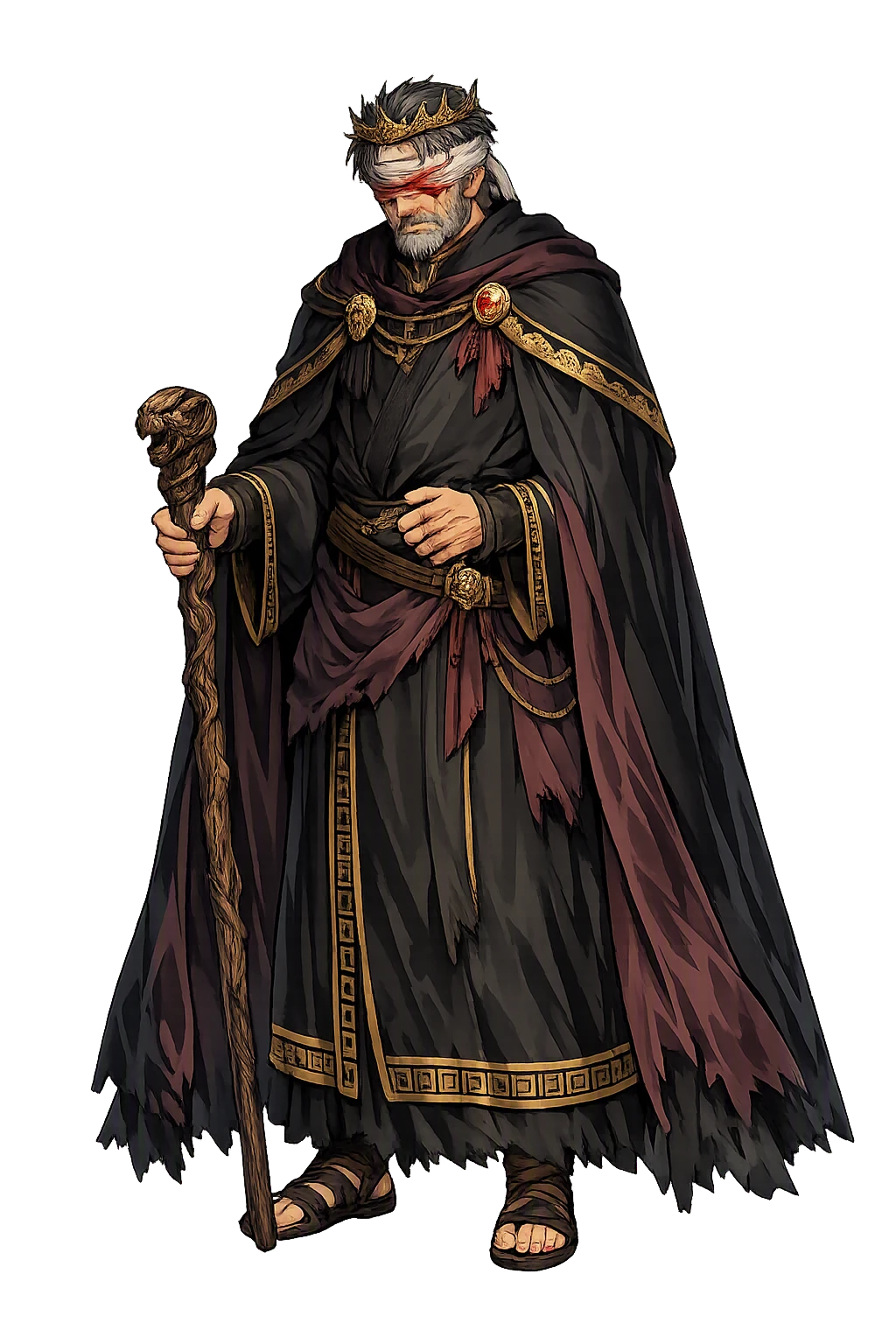
Stress-testing Oidípous: do the industry seats hold?
The stress test for Oidípous. Every seat in the atlas was attacked with the same question — is the match real, or is it poetry? — and the survivors are recorded with their evidence.
At a Glance
- Temple: Oidípous
- Pantheon: Greek
- Domain of influence: Fate, Riddles, Thebes
- Pattern seats: 6
- Sectors touched: Health & Wellbeing · Culture & Entertainment · Technology & Innovation · Society & Spirit · Commerce & Governance
- Strongest seat: Mental Health & Emotional Wellness
- Series: The Resonance Files, No. 359 of 548
The Test
Seat 1: Mental Health & Emotional Wellness
Claim: The strict transliteration of Oedipus; the tragedy that gave psychoanalysis one of its founding complexes. Exhibit: Pinned Ankles on Kithairon — Laios, king of Thebes, was warned by the Delphic oracle that the son born to him would kill his father.
Verdict: stands. Strip both to their function and the functions match.
Seat 2: Mythic Name Restoration
Claim: The strict transliteration of Oedipus, avoiding the Latinized hybrid. Exhibit: The Singer at the Gates — On his road to Thebes Oidípous met the Sphinx — ‘who plagued the Cadmeans’, as Hesiod calls her, the daughter of Typhon and Echidna (Theogony 326–329) — and she put the riddle: what creature walks on four legs at dawn, two at noon and three in the evening.
Verdict: survives scrutiny. The myth and the trade do the same work.
Seat 3: Diacritic-First Domains
Claim: The acute on Oidípous replaces the Latinized Oedipus hybrid. Exhibit: The Hour of Truth — Years later a plague fell on Thebes, and the oracle answered: drive out the killer of Laios.
Verdict: holds under load. The correspondence is functional, not decorative.
Seat 4: Global Pantheon Brands
Claim: The strict transliteration of Oedipus, a name that names an entire psychological complex. Exhibit: Pinned Ankles on Kithairon — Laios, king of Thebes, was warned by the Delphic oracle that the son born to him would kill his father.
Verdict: stands. Strip both to their function and the functions match.
Seat 5: Legal, Justice & Compliance
Claim: The tragedy turns on fate, guilt, and the discovery of truth — the law's oldest thematic triad. Exhibit: The Singer at the Gates — On his road to Thebes Oidípous met the Sphinx — ‘who plagued the Cadmeans’, as Hesiod calls her, the daughter of Typhon and Echidna (Theogony 326–329) — and she put the riddle: what creature walks on four legs at dawn, two at noon and three in the evening.
Verdict: survives scrutiny. The myth and the trade do the same work.
The Control Group
Against the seats that survived, one control: the temple's own summary of its figure — Oidípous is the subject of the most perfectly constructed tragedy in the Greek corpus. The seats do not drift far from it. That is the audit's cleanest result.
The Method, Stated Plainly
The atlas is not a horoscope. Seats are earned from the sources — argued, weighted, published — and every one of them can be challenged at the methodology page. A match that cannot survive an argument does not survive review. That is the whole trick: the patterns are claims, and claims can be tested.
For the Ones Who Work There
For a sponsor in mental health & emotional wellness, the fit here is not adjacency — it is inheritance. Your trade already tells this story every working day; the temple simply holds the original. The patron tier and the advertising terms carry the mechanics; the myths above carry the reason.
The File Continues
This is one of 548 Resonance Files — the third dispatch from every flagship temple, where the myths meet the markets. The temple's founding dispatch tells the name's story; its Restoration File tells the spelling's; the blog index holds the whole archive.
Continue the series — previous: Ògún (read it) · next: Ōkeanós (read it).
The Resonance Files are argued from the same canonical record as the pattern atlas itself: the lexicon, the lore catalog, and the cited sources. Every seat can be challenged at the methodology page — and the challenge is the point.