
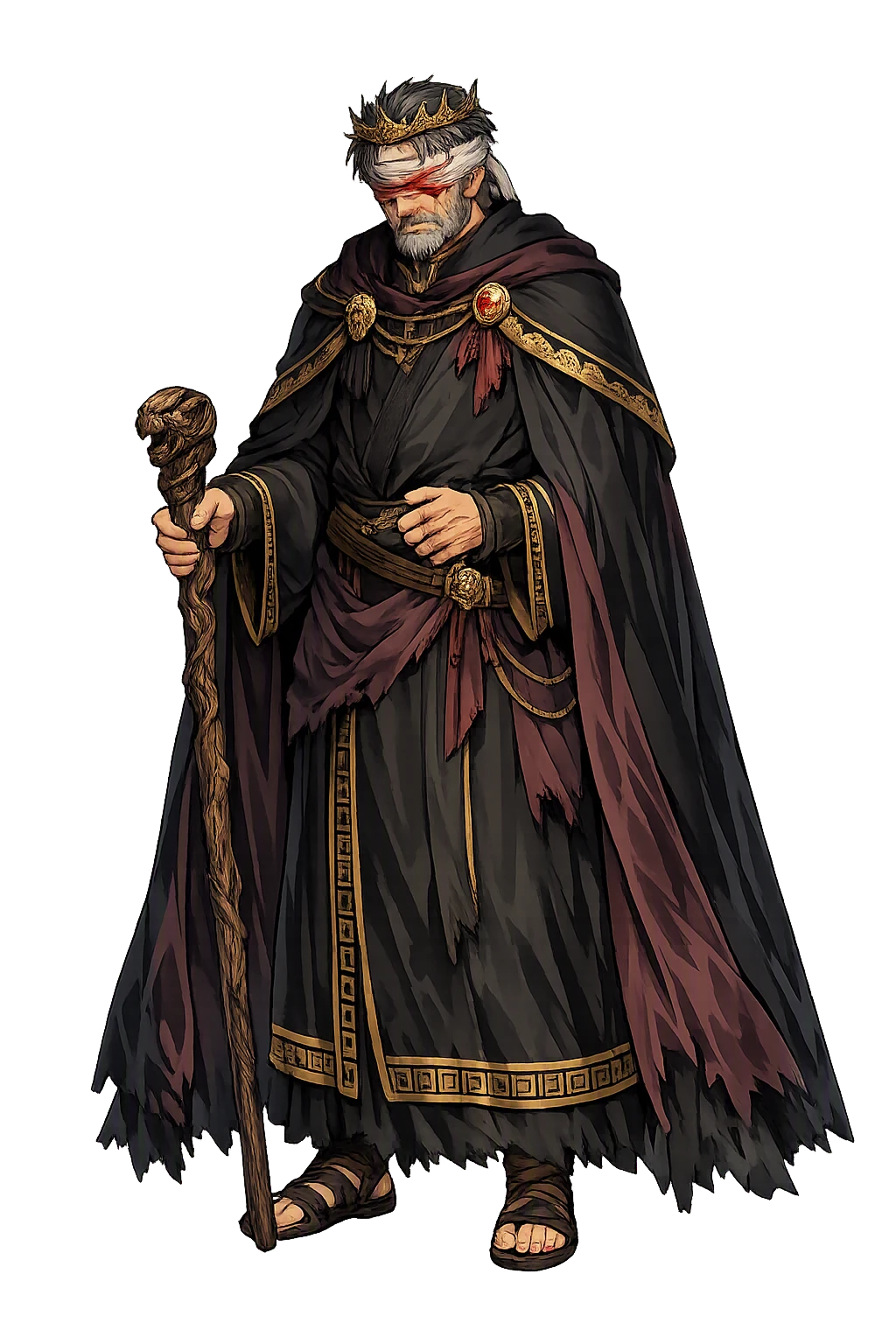
The provenance file on Oidípous
Catalogue entry — Oidípous. Every claim below carries its chain of custody.
Provenance
1. The attestation. Οἰδίπους — "Swollen-foot (from οἰδάω + πούς)". On record: Sophocles, Oidipous Tyrannos (esp. 391–402, 716–813, 1034–1046, 1146–1297), Sophocles, Oidipous at Colonus 84–110, 1518–1666, Homer, Odyssey 11.271–280, Hesiod, Theogony 326–329; Pindar, Olympian 2.35–42; Aeschylus, Seven Against Thebes.
2. The preserved evidence. i → í (Acute on iota) — absent from the ASCII form oidipous, present in the restoration, verifiable against the sources above.
3. The narrative record. Pinned Ankles on Kithairon — Laios, king of Thebes, was warned by the Delphic oracle that the son born to him would kill his father. When the child came, he ordered it exposed on Mount Kithairon with a pin driven through its ankles to fix it to the ground; a shepherd took pity and passed the baby to a Corinthian, who carried it to the childless king Polybos. The Singer at the Gates — On his road to Thebes Oidípous met the Sphinx — ‘who plagued the Cadmeans’, as Hesiod calls her, the daughter of Typhon and Echidna (Theogony 326–329) — and she put the riddle: what creature walks on four legs at dawn, two at noon and three in the evening. Citizens of Thebes had died for failing it; Oidípous answered man, who crawls, walks upright and leans on a staff in old age, and the Sphinx threw herself down from her rock.
4. The physical record. Oidipous is a Bronze Age memory wearing a Classical costume. Excavations on the Kadmeia at Thebes have uncovered a Mycenaean palace with its archive of Linear B tablets — a real Theban kingdom of the thirteenth century BC whose dynastic troubles could seed a legend of cursed kingship. The Sphinx he defeated still stands in stone: the Sphinx of the Naxians, dedicated at Delphi around 560 BC, is the very monster type, and Attic red-figure cups of the fifth century show Oidípous seated before her with the answer on his lips. No sanctuary of Oidipous has been excavated; his cult was a literary and civic one, kept at Colonus in the grove Sophocles describes and at Thebes in the tomb tradition Pausanias records.
5. The current holding. The temple at /oidipous/, classified Tier 1. What survives here cannot be shown in ASCII: a feature of the original that the fallback alphabet flattens. That is the Tier-1 test, and this name passes it without argument.
6. The documented resonances. Mental Health & Emotional Wellness, Mythic Name Restoration, Diacritic-First Domains — seats argued and weighted in the pattern atlas, read through the myths in this temple's Resonance File.
7. The primary sources. Theogony, Homeric Hymns, Works and Days — the library this file answers to, open at the Sacred Texts collection.
8. The continuing record. The hero left two cults and a vocabulary. At Colonus the grove he sanctified remained sacred ground beside the Academy; at Thebes Pausanias (9.
At a Glance
- Restored name: Oidípous
- ASCII form: oidipous
- Meaning: "Swollen-foot (from οἰδάω + πούς)"
- Domain of influence: Fate, Riddles, Thebes
- Pantheon: Greek
- Classification: Tier 1
- Original script: Οἰδίπους
- Series: The Restoration Files, No. 359 of 548
The File Continues
Read the founding dispatch for the name's full story, the Resonance File for the archetype at work — or the whole archive in one sitting.
Continue the series — previous file: Ògún (read it here) · next file: Ōkeanós (read it here).
The Restoration Files are written from the same canonical record as the temples themselves: the lexicon, the lore catalog, the pattern atlas, and the cited scholarly sources. If a file ever disagrees with its temple, the temple is right — tell us, and the file will be corrected.