
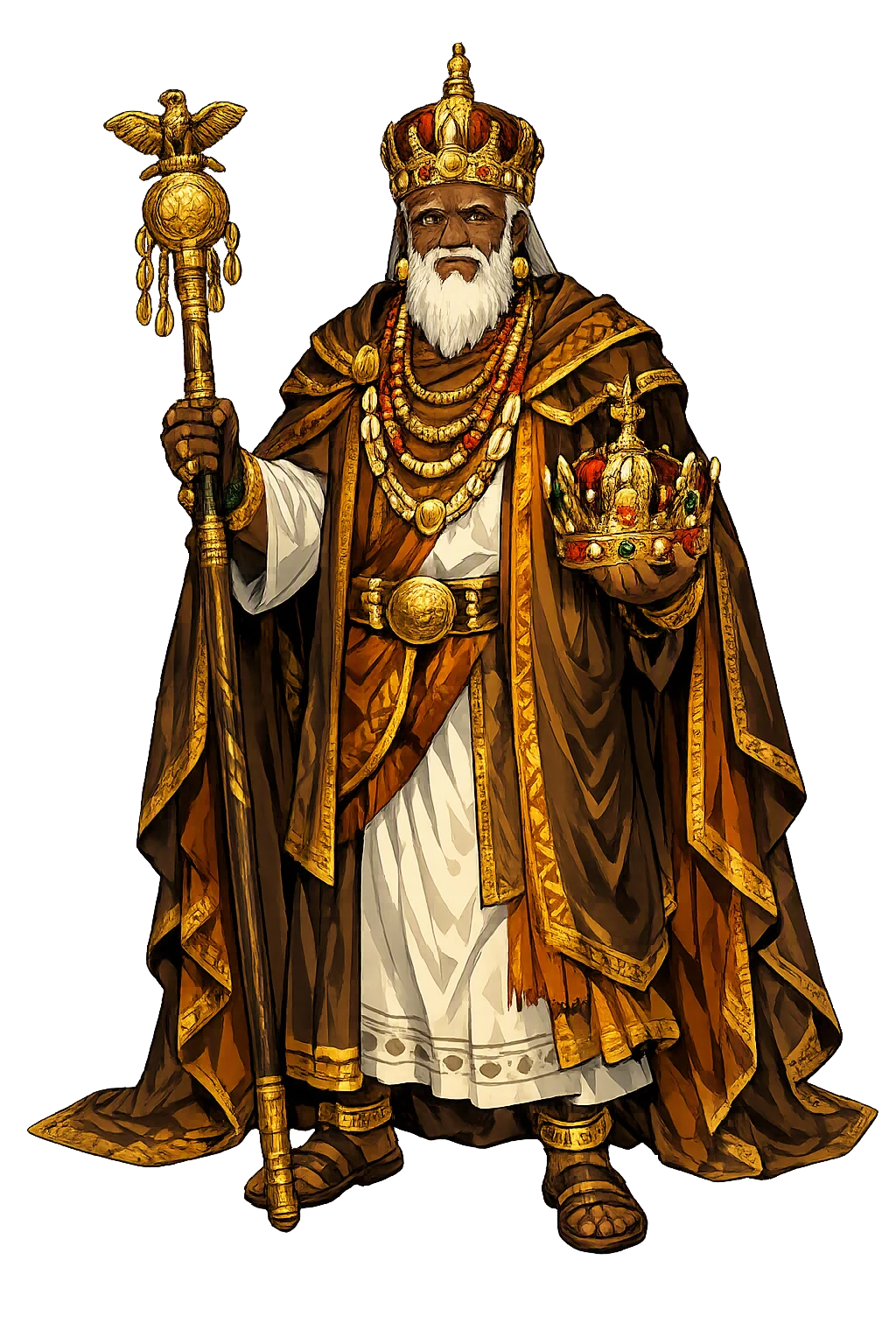
Pronouncing Odùduwà: a guide for the curious
Saying Odùduwà aloud is harder than reading it on a screen, and more rewarding. The restored spelling is a compressed pronunciation guide: every accent and macron is an instruction. This post unpacks those instructions — the reconstructed sound, the phoneme-by-phoneme record, the kindred forms in neighboring languages — and then zooms out to the full record around the name: its Yoruba (modern Latin orthography) writing, its mythology, its cult, and its modern life as a Unicode domain. Whether you arrive as a linguist, a reader of myth, or a domainer, you will leave able to say the name the way the evidence suggests it was said — and able to type it the way it was written.
At a Glance
- Restored name: Odùduwà
- ASCII form: oduduwa
- Meaning: "Creator of the earth; primordial ancestor of the Yoruba"
- Domain of influence: Progenitor, Ile-Ife, First King
- Pantheon: Yoruba
- Restoration: Preserves stress
- Original script: Òdùduwà (Yoruba (modern Latin orthography))
- Live domain: odùduwà.com
Overview
Odùduwà (oduduwa) — Progenitor, Ile-Ife, First King · Creator of the earth; primordial ancestor of the Yoruba — belongs to the Yoruba tradition, where it is catalogued under the domain "Progenitor, Ile-Ife, First King". The name means "Creator of the earth; primordial ancestor of the Yoruba".
Odùduwà belongs to the Yoruba tradition, where it is associated with progenitor, ile-ife, first king.
PuniCodex restores the name as Odùduwà and serves its temple at oduduwa.com. The restoration preserves at least one distinctive feature — a diacritic or a distinctive letter — that the ASCII form loses, and exactly one historically valid Unicode restoration exists. The plain ASCII form oduduwa survives as a modern convenience imposed by the early domain-name system; the restoration, not the fallback, is the form the project defends as philologically complete.
The Name
The name is attested in modern standard Yoruba orthography; tone marks are fully written in dictionaries and optional in everyday writing. Etymologically the name means "Creator of the earth; primordial ancestor of the Yoruba".
Yoruba Ọdùduwà, the divine ancestor who descended with a chain at Ile-Ife and founded the Yoruba city-states.
The ASCII form oduduwa survives only because the early domain-name system could not carry diacritics; it is a technological compromise, not an ancient spelling. The Unicode restoration Odùduwà recovers the stress accent of the original directly in the address bar. The restoration preserves at least one distinctive feature — a diacritic or a distinctive letter — that the ASCII form loses, and exactly one historically valid Unicode restoration exists.
The letter-by-letter transformation runs:
- o → O — Same, capitalized
- d → d — Same
- u → ù — Tone mark
- d → d — Same
- u → u — Same
- w → w — Same
- a → à — Tone mark
The canonical temple for this name is served at oduduwa.com.
Etymology & Roots
The recorded derivation reads: Yoruba Ọdùduwà, the divine ancestor who descended with a chain at Ile-Ife and founded the Yoruba city-states.
The root gloss is "progenitor."
The reconstruction is classed as attested.
The Original Script
No indigenous writing system is securely attested for individual yoruba names. The form shown is a modern scholarly transliteration.
The form Odùduwà is therefore a scholarly transliteration rather than an attested ancient spelling; it encodes the reconstructed sound of the name for modern use, and no mark in it is decorative.
Pronunciation
The reconstructed pronunciation of the name is /oduduwa/ — Yoruba Reconstruction.
Phoneme by phoneme:
- O — Initial character of the restored form Odùduwà.
- dùduwà — Remainder of the name, preserving the distinctive marks of the Yoruba tradition.
For the modern speaker, the closest approximation is: 'ODUDUWA' — pronounce the restored form with attention to the preserved diacritics and length.
Kindred and historical forms of the name:
- Yoruba — Odùduwà, the restored Unicode form of the name
Odùduwà preserves both features because the Yoruba form preserves distinctive features that ASCII loses: stress, length, or special characters.
Mythology
The stories of Odùduwà circulate within the Yoruba corpus, where the figure embodies progenitor, ile-ife, first king.
Primary Attestation (Sources)
Odùduwà is attested in the canonical Yoruba sources as a figure associated with progenitor, ile-ife, first king.
Name and Meaning (Etymology)
The name means "Creator of the earth; primordial ancestor of the Yoruba" and reflects the figure's role in the tradition. Òdùduwà is the founding ancestor of the Yoruba peoples and the first ruler of Ilé-Ifẹ̀. According to tradition, he descended from heaven with a chain and scattered soil over the primordial waters to create dry land. His descendants became the kings of Yoruba city-states, and his shrine at Ilé-Ifẹ̀ remains the spiritual capital. His reign established the royal lineages and oracular institutions that continue to legitimate Yoruba kingship today.
Seventeen from Ọ̀run (The Delegation)
In the beginning the world was water: Olódùmarè, the supreme God, ruled from Ọ̀run, the sky, while Ayé, the earth below, was soft marsh without a place to stand. The orishas petitioned to build a dry world, and Olódùmarè chose Ọbàtálá — Oríṣàńlá, the most senior among them — to lead the mission down, with Odùduwà in the company: in some tellings his younger brother, in others simply the keeper of the god's bag of materials. The delegation received what creation required — a handful of earth, a five-toed cockerel, and a chain long enough to climb from heaven to the waves. The number of the delegates shifts between tellings, sixteen or seventeen, as oral tradition allows. The story is recorded in the tellings collected by Bascom, Johnson, and Idowu from the Ifá corpus and Ifẹ̀ priests.
The myth's quiet claim is that creation in Yoruba thought is delegated: God entrusts the founding of the world to a team, and seniority alone does not finish the job. The one who climbs down will matter more than the one who was chosen to lead — and the tradition already knows it.
The Sleep of Ọbàtálá (Palm Wine)
Before the descent, Ọbàtálá grew thirsty and drank palm wine — and the wine dulled him. He staggered, fell, and slept beside the work he had been sent to do. Odùduwà took the bag from his sleeping brother, climbed down the chain to the primordial waters, scattered the handful of earth onto the waves, and set the five-toed cockerel to scratching; the fowl spread the dust outward into wide dry land, beginning at the place that became Ifẹ̀. When Ọbàtálá awoke and came down to find the creation finished by another hand, the rivalry between the two worship-lines was born. Tradition adds the ritual moral: Ọbàtálá therefore forbade his priests the palm wine that undid him.
The myth explains two lasting facts at once — the founding of Ifẹ̀ and a living taboo in Ọbàtálá's cult — and its judgement is characteristic of Yoruba narrative: creation passes not to the most senior but to the most steadfast, and the instrument of failure is never an enemy, only a pleasure taken at the wrong hour.
Where the World Began (Ilé-Ifẹ̀)
The spot where Odùduwà landed and made his camp became Ilé-Ifẹ̀ — the name is usually explained as 'the house of expansion' (ifẹ̀, breadth). Here he planted his staff and raised the first city; from here the world was peopled and the kingship of the earth was administered. Ifẹ̀ tradition points to the ground of the descent to this day, and some tellings carry the quarrel upward: Ọbàtálá lodged his claim to the work with Olódùmarè, and the settlement divided the realms between them — the earth and its rule to Odùduwà, the fashioning of human bodies to Ọbàtálá. The version is old and not the only one; the tradition keeps several and argues from all of them.
Ifẹ̀'s claim to be the place where the world began is not geography but memory: the city is a monument to the act of landing. In Yoruba religious geography every road of consequence runs back to this one settlement, and the mythology exists to say why the road is there.
Symbols & Iconography
The iconography associated with Odùduwà concentrates in a small set of recurring attributes, each a compressed statement about the name:
- Restored Name — The Unicode form Odùduwà carries the original marks of the Yoruba tradition.
- Source Script — Preserved through scholarly transliteration and canonical sources.
- Domain — Progenitor, Ile-Ife, First King
- Etymology — Creator of the earth; primordial ancestor of the Yoruba
- The chain of descent — The chain by which Odùduwà climbed down from Ọ̀run, the sky, to the primordial waters — the umbilical cord between heaven and the first city
- The five-toed cockerel — The sacred fowl whose scratching spread the scattered handful of earth into the world's dry land
- The handful of earth — The seed-soil of creation given by Olódùmarè — from a fistful of dust, a continent
- Red earth of Ifẹ̀ — Ilé-Ifẹ̀, 'the house of expansion' — the red soil where creation began and where his shrine still stands
- The Ade Aare crown — The ancient crown of Ifẹ̀, worn by the Oòni only at the Olojo festival and believed by tradition to have been Odùduwà's own
Archaeology & Evidence
The material record for Odùduwà survives in a small number of securely identified remains, catalogued below; the corpus is thin but unambiguous, and each site is tied to the name by ancient testimony.
Odùduwà is attested in the textual and iconographic record of the Yoruba tradition.
Realm & Domain
Odùduwà belongs to the Yoruba tradition, where it is associated with progenitor, ile-ife, first king.
Progenitor
The central domain of Odùduwà in the yoruba tradition.
Creator of the earth; primordial ancesto
The name signifies "Creator of the earth; primordial ancestor of the Yoruba".
Unicode Restoration
The restoration Odùduwà recovers what plain ASCII oduduwa flattens.
Original Attestation
Attested in the sources as —.
Maker of the Firm Earth
He took the materials of creation — a handful of earth, a five-toed cockerel, a chain — and made the dry land on which the world stands (Ifá corpus; oral tradition).
Ifá and Oral Attestation
Attested in the Ifá corpus and Yoruba oral tradition; Yoruba's Latin orthography is a nineteenth-century standardization, so the true attestation is tonal and performative, not alphabetic.
Across Cultures
Odùduwà appears within the Yoruba tradition and has influenced later retellings, artistic depictions, and scholarly study. The Unicode restoration preserves the name's distinctive orthography for contemporary use.
Within the Yoruba tradition, closely related names in the corpus include Aganjú, Ọbalúayé, Ẹṣù, Ọbà, Ọbàtálá, and Ọṣọọsì.
Cultural Legacy
Odùduwà continues to appear in scholarship, art, and popular reception as a significant figure of the Yoruba tradition. Restoring the name in Unicode returns the original marks that ASCII removes. Òdùduwà is venerated as the progenitor of Yoruba civilization, and his name is invoked in diasporic traditions such as Candomblé and Santería.
The Scholarly Record
The account of Odùduwà given in this edition rests on the witnesses and reference works listed below. Lexica and etymological dictionaries secure the form and meaning of the name; the literary and religious texts supply the narrative evidence.
- Ifá corpus.
- Yoruba oral tradition. Archaeological work at Ilé-Ifẹ̀ has uncovered naturalistic bronze heads associated with early Òdùduwà-period courts.
A Meditation
Odùduwà embodies progenitor, ile-ife, first king in the Yoruba imagination. The name's restoration is not merely cosmetic: it recovers the stress, length, and script that make the figure recognizable in the source tradition.
The Unicode Restoration
Odùduwà preserves stress. The ASCII fallback oduduwa still resolves everywhere, but it is the restored form that carries the name's full information. Across the 7 characters of the name, the restoration adjusts 2: 2 marks of stress (ù, à). That is the whole thesis of this temple: the marks are the message.
Character by Character
The journey from oduduwa to Odùduwà, one character at a time:
- o → O — Same, capitalized
- d → d — Same
- u → ù — Tone mark
- d → d — Same
- u → u — Same
- w → w — Same
- a → à — Tone mark
The Domain Name
The restored name is live as a working domain: odùduwà.com, which the DNS carries in punycode form as xn--odduw-vqa5o.com — an ASCII-compatible encoding that lets a non-ASCII name travel the global network without breaking older infrastructure. The visitor sees Odùduwà; the machines see the encoding. That duality is the engineering compromise on which the entire restoration rests, and it is why a name written the way its own tradition wrote it in Yoruba (modern Latin orthography) can now be typed into any browser on earth.
The Yoruba Pantheon
Odùduwà is one of 21 entries the PuniCodex lexicon catalogues under the Yoruba pantheon. The Pantheon page gathers the tradition's major figures in one place, and the Lexicon lets you filter all 983 restorations by tradition or script — the fastest way to see where this name sits among its kin.
Frequently Asked Questions
What does Odùduwà mean? The traditional gloss is "Creator of the earth; primordial ancestor of the Yoruba."
Which tradition does Odùduwà belong to? Odùduwà is catalogued in the Yoruba pantheon of the PuniCodex lexicon.
What does Odùduwà preserve that ASCII cannot show? The form itself answers: Odùduwà preserves stress — and the marks in the restored spelling are exactly that evidence.
Is Odùduwà a working domain? Yes — odùduwà.com resolves today and routes to this temple.
What is the punycode for odùduwà.com? The DNS encoding is xn--odduw-vqa5o.com; browsers perform the translation automatically, so visitors only ever see the restored name.
Can I use Odùduwà in a normal browser? Yes. The DNS resolves the punycode form automatically, and the type tool on this site converts oduduwa to Odùduwà for copying and pasting.
Where does the scholarly information come from? The entry is built from lexica, inscriptional evidence, and reviewed scholarly sources listed in the Scholarly Edition. Every claim is traceable to a canonical source.
Typing Odùduwà
You do not need a special keyboard to use this restoration. The PuniCodex Type Tool converts the ASCII form oduduwa into Odùduwà as you type, and the browser extension offers the same conversion inside any text field. Copy the restored form, paste it into the address bar, and the DNS does the rest.
Sister Temples
Other temples in the Yoruba pantheon include Ọbà, Ọbàtálá, and Ọṣọọsì — each with its own restoration story, its own scholarly record, and its own place in the lexicon.
Why This Restoration Matters
Pronunciation turns out to be the heart of the matter. The marks in Odùduwà are instructions for the voice, and a web that strips them is a web that mispronounces the past at scale. The restoration hands the instructions back: say it as the evidence suggests, type it as the tradition wrote it, and let the punycode machinery do the quiet translation in between. That is all the PuniCodex project asks of the infrastructure — and everything it asks of you, the reader, is to use the whole name.
Explore Further
This post is one doorway into the temple. The home page carries the full character breakdown and the ambient canvas; the lore page tells the myths in long form; the Scholarly Edition preserves the sources, pronunciation data, and revision history; and the patron wall supports the restoration directly. For the wider map, browse the Lexicon, explore the Pantheon, or return to the PuniCodex blog.
A Closer Look at the Marks
A restored name is a small map. In Odùduwà, the journey from the ASCII fallback oduduwa to the Unicode form can be read letter by letter, and each letter tells a story. Of the 7 characters, 5 remain unchanged; they anchor the name to its modern shape. The remaining adjustments recover marks the source tradition used to distinguish this name from every other word built from the same letters.
The o stays as it is — Same, capitalized.
The d stays as it is — Same.
The u becomes ù — Tone mark.
The d stays as it is — Same.
The u stays as it is — Same.
The w stays as it is — Same.
The a becomes à — Tone mark.
Together these changes are not decoration. They are the minimum set of marks needed to keep the name legible in its own tradition. Remove them and you still have a string of letters; you no longer have the name as it was written.
Odùduwà in Its Tradition
Odùduwà does not stand alone. It belongs to the Yoruba tradition, where it is counted among 21 names in the PuniCodex lexicon. Its sphere — Progenitor, Ile-Ife, First King — places it beside other figures who govern similar aspects of experience. The restored spelling is therefore not only a philological decision; it is a way of keeping the name in the company of its kin. When the address bar shows Odùduwà, it marks the boundary between a generic search term and a named entry in a living catalog of myth. That catalog is the point of the project. Every restored name is a vote for specificity: the web should know the difference between a figure and a keyword, between a tradition and a trend. Odùduwà is one such vote.
Related Names
Sources
The full scholarly apparatus — every citation, revision, and review — lives in the Scholarly Edition. Key references for this post:
- Ifá corpus.
- Bascom, Ifa Divination: Communication Between Gods and Men in West Africa.
- Yoruba oral tradition.
- Ifá corpus.
- Yoruba oral tradition.
- Lexicon authorities for this entry: Ifá corpus, Yoruba oral tradition.