
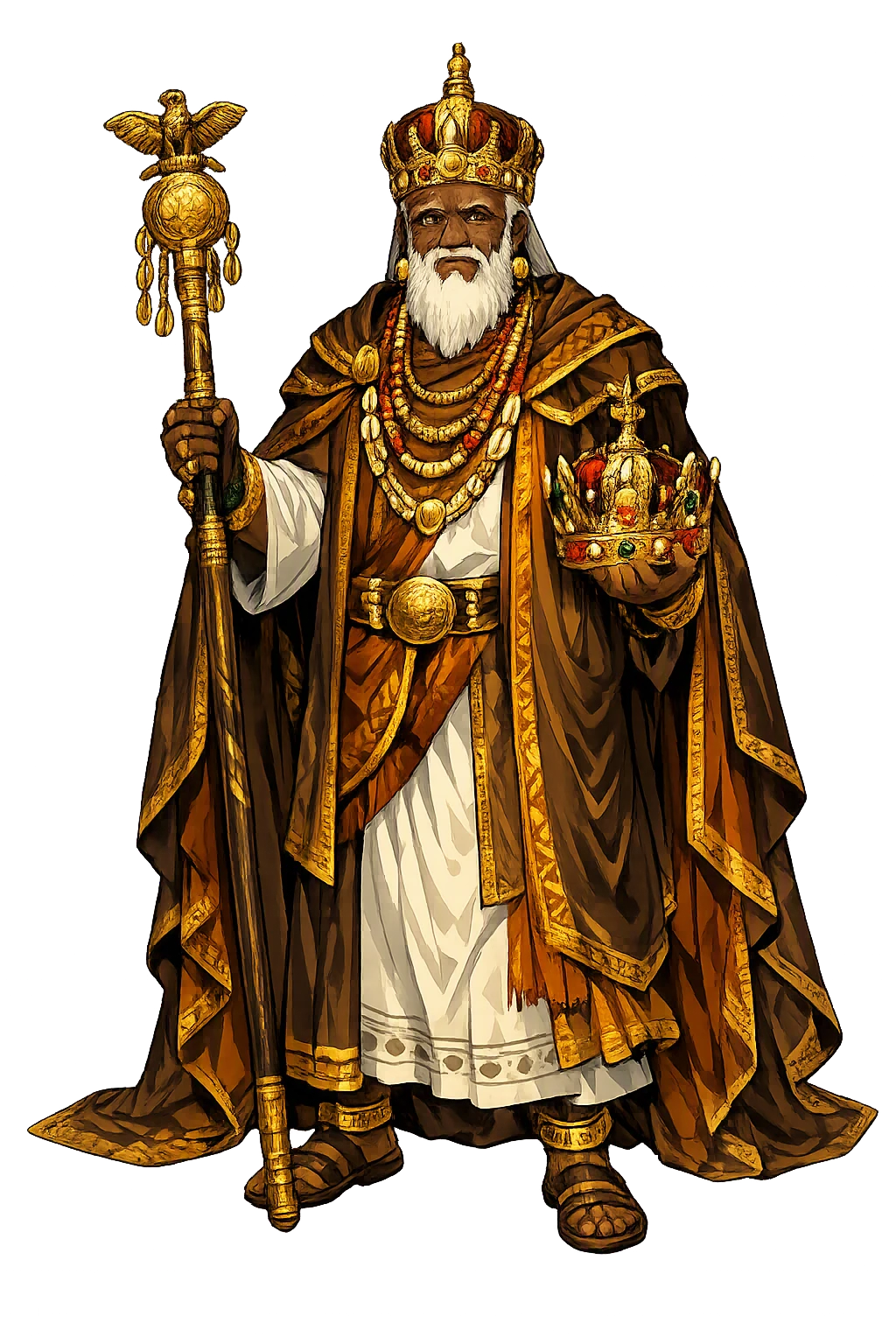
How Odùduwà was rebuilt, mark by mark
From the restoration bench — the working notes on Odùduwà, kept because the process is the proof.
What We Found
The attestation runs through the tradition's own sources: Òdùduwà. Meaning: "Creator of the earth; primordial ancestor of the Yoruba".
The figure behind the name: Odùduwà's story is the Yoruba Genesis: the descent from heaven, the making of dry land, the founding of Ilé-Ifẹ̀, and the fathering of dynasties.
What the Name Carried In
Seventeen from Ọ̀run. In the beginning the world was water: Olódùmarè, the supreme God, ruled from Ọ̀run, the sky, while Ayé, the earth below, was soft marsh without a place to stand. The orishas petitioned to build a dry world, and Olódùmarè chose Ọbàtálá — Oríṣàńlá, the most senior among them — to lead the mission down, with Odùduwà in the company: in some tellings his younger brother, in others simply the keeper of the god's bag of materials.
The Sleep of Ọbàtálá. Before the descent, Ọbàtálá grew thirsty and drank palm wine — and the wine dulled him. He staggered, fell, and slept beside the work he had been sent to do.
A spelling that has to carry stories like these is not a label. It is equipment.
Where It Stood Before Us
The material record of the myth is the city itself. Excavations at Ilé-Ifẹ̀ — beginning with Frobenius's notorious 1910 visit and continuing through the work of Willett, Eyo, and Fabunmi — uncovered the celebrated Ifẹ̀ heads: naturalistic terracotta portrait heads and copper-alloy castings of the twelfth to fifteenth centuries CE, among them the bronze heads found in 1938 in the Wunmonije compound, interpreted in tradition as the shrine images of past Oònis. The iron-crusted Opa Ọ̀rànmíyàn, a monolith over five metres tall, still stands at Ifẹ̀ as the monumental staff of Odùduwà's youngest son, and the sacred sites of the city — Odùduwà's shrine, the Olojo ground, the groves — keep the founding geography walkable. Ifẹ̀'s red earth, the stuff of the creation story, is underfoot everywhere the myth names. The bench inherits all of it — the web temple is the newest site, not the first.
What We Kept
The evidence, mark by mark — 2 features the keyboard form oduduwa cannot hold:
- u → ù — Tone mark. Kept.
- a → à — Tone mark. Kept.
What We Rejected
oduduwa as the primary form. It survives as the convenience it is; it does not get to lead. The hierarchy is full restoration first, and this name can afford to stand at the top of it.
What We Set Down
Odùduwà — What survives here cannot be shown in ASCII: a feature of the original that the fallback alphabet flattens. That is the Tier-1 test, and this name passes it without argument.
For the voice: 'oh-doo-DOO-wah' — four even syllables; the grave-marked syllables ù and à are low in pitch, sung below the others, not stressed harder.
The temple stands at /oduduwa/ — the notes above are public in its Scholarly Edition, sources and all.
At a Glance
- Restored name: Odùduwà
- ASCII form: oduduwa
- Meaning: "Creator of the earth; primordial ancestor of the Yoruba"
- Domain of influence: Progenitor, Ile-Ife, First King
- Pantheon: Yoruba
- Classification: Tier 1
- Original script: Òdùduwà
- Series: The Restoration Files, No. 355 of 548
The File Continues
The temple's founding dispatch tells the name's story; its Resonance File reads the myths into the industries; the blog index holds the whole archive.
Continue the series — previous file: Óðinn (read it here) · next file: Odysseús (read it here).
The Restoration Files are written from the same canonical record as the temples themselves: the lexicon, the lore catalog, the pattern atlas, and the cited scholarly sources. If a file ever disagrees with its temple, the temple is right — tell us, and the file will be corrected.