The Living Myth
Progenitor, Ile-Ife, First King · Creator of the earth; primordial ancestor of the Yoruba
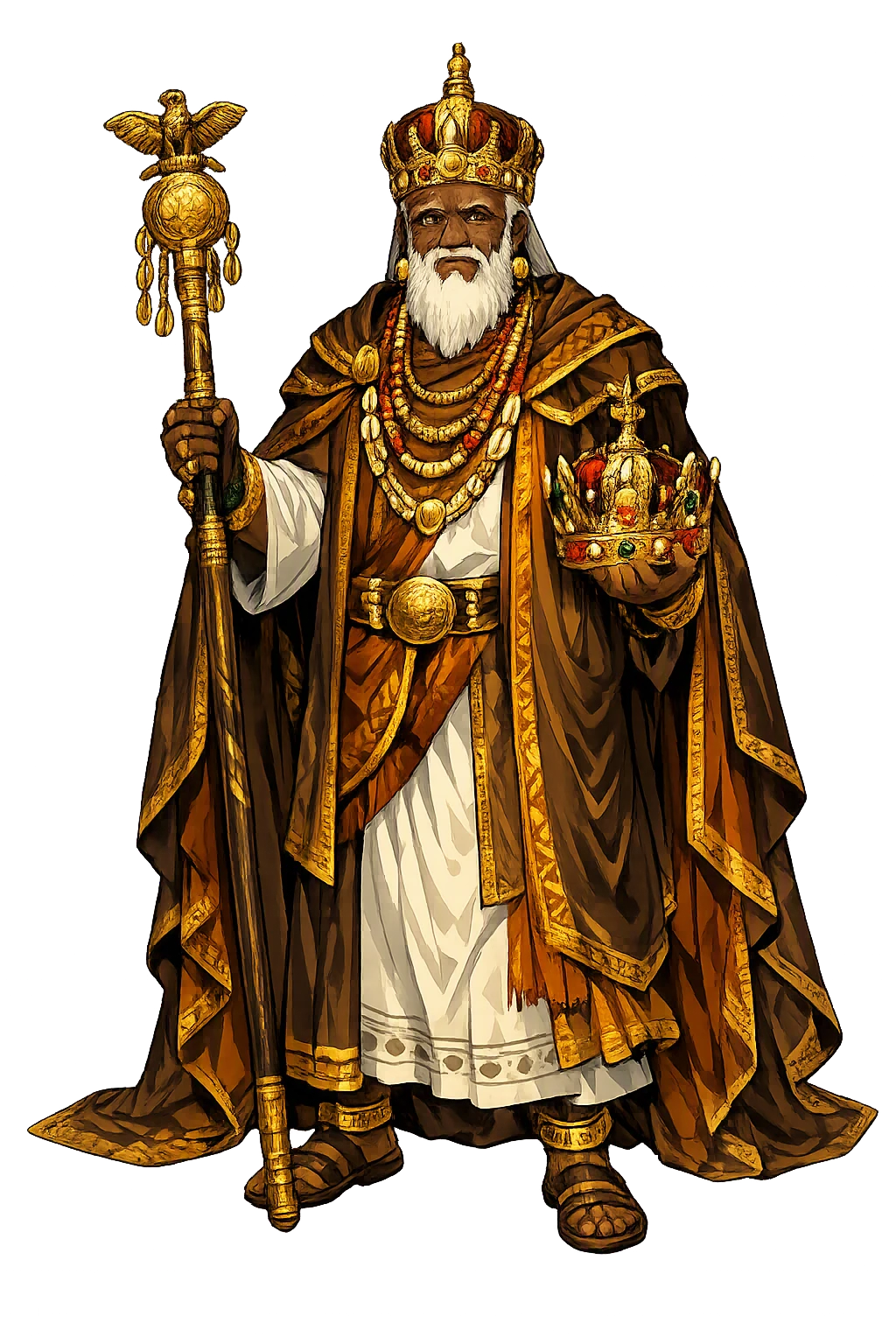
Stories of Odùduwà
Odùduwà's story is the Yoruba Genesis: the descent from heaven, the making of dry land, the founding of Ilé-Ifẹ̀, and the fathering of dynasties. It lives in the Ifá corpus and in oral tradition rather than any fixed book, and the tellings disagree with one another — the tradition itself treats the variants as paths to the same city.
In the beginning the world was water: Olódùmarè, the supreme God, ruled from Ọ̀run, the sky, while Ayé, the earth below, was soft marsh without a place to stand. The orishas petitioned to build a dry world, and Olódùmarè chose Ọbàtálá — Oríṣàńlá, the most senior among them — to lead the mission down, with Odùduwà in the company: in some tellings his younger brother, in others simply the keeper of the god's bag of materials. The delegation received what creation required — a handful of earth, a five-toed cockerel, and a chain long enough to climb from heaven to the waves. The number of the delegates shifts between tellings, sixteen or seventeen, as oral tradition allows. The story is recorded in the tellings collected by Bascom, Johnson, and Idowu from the Ifá corpus and Ifẹ̀ priests.
The myth's quiet claim is that creation in Yoruba thought is delegated: God entrusts the founding of the world to a team, and seniority alone does not finish the job. The one who climbs down will matter more than the one who was chosen to lead — and the tradition already knows it.
Before the descent, Ọbàtálá grew thirsty and drank palm wine — and the wine dulled him. He staggered, fell, and slept beside the work he had been sent to do. Odùduwà took the bag from his sleeping brother, climbed down the chain to the primordial waters, scattered the handful of earth onto the waves, and set the five-toed cockerel to scratching; the fowl spread the dust outward into wide dry land, beginning at the place that became Ifẹ̀. When Ọbàtálá awoke and came down to find the creation finished by another hand, the rivalry between the two worship-lines was born. Tradition adds the ritual moral: Ọbàtálá therefore forbade his priests the palm wine that undid him.
The myth explains two lasting facts at once — the founding of Ifẹ̀ and a living taboo in Ọbàtálá's cult — and its judgement is characteristic of Yoruba narrative: creation passes not to the most senior but to the most steadfast, and the instrument of failure is never an enemy, only a pleasure taken at the wrong hour.
The spot where Odùduwà landed and made his camp became Ilé-Ifẹ̀ — the name is usually explained as 'the house of expansion' (ifẹ̀, breadth). Here he planted his staff and raised the first city; from here the world was peopled and the kingship of the earth was administered. Ifẹ̀ tradition points to the ground of the descent to this day, and some tellings carry the quarrel upward: Ọbàtálá lodged his claim to the work with Olódùmarè, and the settlement divided the realms between them — the earth and its rule to Odùduwà, the fashioning of human bodies to Ọbàtálá. The version is old and not the only one; the tradition keeps several and argues from all of them.
Ifẹ̀'s claim to be the place where the world began is not geography but memory: the city is a monument to the act of landing. In Yoruba religious geography every road of consequence runs back to this one settlement, and the mythology exists to say why the road is there.
From Ifẹ̀, kingship radiated outward. Ifẹ̀ tradition names seven sons of Odùduwà who went out from the city to become kings of the Yoruba towns, the royal lines of the entire people descending from this single household; the youngest, Ọ̀rànmíyàn, was the heir who stayed at home longest and set out last of all. He went north and founded Ọ̀yọ́, whose Aláàfin — 'owner of the palace' — ruled the greatest of the Yoruba kingdoms. And Benin's own court tradition tells that when Benin needed a king, an embassy walked the forest road to Ifẹ̀ and was given Ọ̀rànmíyàn, whose son became the first Ọba of Benin — making Odùduwà, through his son, an ancestor of the Benin dynasty too.
The two traditions differ in detail, and modern historians debate how much of the migration narrative is memory and how much charter-myth; what no account disputes is the direction of the claim. Every dynasty wants its road to lead back to Ifẹ̀. The myth is a map of Yoruba political order, with all paths drawn to one father.
At Ifẹ̀, Odùduwà is not only remembered; he is worshipped. His shrine stands in the sacred city, and at the Olojo festival — the feast of 'the owner of the day' — the Oòni, held to be his direct descendant, withdraws and then emerges wearing the Ade Aare, the ancient crown that tradition holds to have come down from heaven with Odùduwà himself. On this one occasion in the year the king is seen crowned, and Ifẹ̀ fills with pilgrims, chiefs, and the priests of a hundred lineages. The rite ties the city's foundation story to its living calendar: creation is not past tense at Ifẹ̀ but an annual appointment.
Each Olojo is the descent from Ọ̀run restaged in cloth, bead, and procession — the myth worn rather than told. That is the deepest sense in which Odùduwà is progenitor: the crown, the city, and the festival are one continuous inheritance, and the living king is its current syllable.
Progenitor, Ile-Ife, First King
Odùduwà is the founder: the heaven-sent ancestor who made the earth firm, founded Ilé-Ifẹ̀, and fathered the dynasties of the Yoruba world. Every Yoruba king claims descent from him, and the Oòni of Ifẹ̀, his living heir, is the acknowledged spiritual head of the tradition.
The primordial ancestor of Yoruba kingship — Ifẹ̀ tradition names his sons and grandsons as the founders of the Yoruba towns and their dynasties.
He took the materials of creation — a handful of earth, a five-toed cockerel, a chain — and made the dry land on which the world stands (Ifá corpus; oral tradition).
The restoration Odùduwà recovers the low tones that plain ASCII oduduwa flattens — in Yoruba, pitch is meaning.
Attested in the Ifá corpus and Yoruba oral tradition; Yoruba's Latin orthography is a nineteenth-century standardization, so the true attestation is tonal and performative, not alphabetic.
From the original script to the living URL
Òdùduwà
The name in its original Yoruba form. Odùduwà (Òdùduwà) is attested in the source tradition — “Creator of the earth; primordial ancestor of the Yoruba”. Its original diacritics and script distinctions carry the full phonetic and orthographic weight of the source tradition.
oduduwa
Reduced to plain oduduwa, the name loses everything that made it specific: original diacritics and script distinctions. What remains is an ASCII string that machines can parse but that no longer speaks with its original voice.
Odùduwà
The Unicode restoration recovers what ASCII flattened. Odùduwà restores original diacritics and script distinctions, returning the name to its original written dignity. The domain encodes to Punycode, but the browser displays the truth.
Odùduwà.com → xn--odduw-vqa5o.com
The non-ASCII characters in Odùduwà are encoded while the ASCII remains visible. To the DNS, it is Punycode. To humanity, it is Odùduwà.
Owned, ideal, and ASCII forms of Odùduwà
Odùduwà
Restores Òdùduwà. The live temple domain — odùduwà.com.
oduduwa
Flattens Òdùduwà. The plain ASCII fallback — what DNS and legacy systems see.
How Odùduwà was spoken
How Odùduwà travels from ancient script to the modern URL
Yoruba theonym of the primordial ancestor orisha Òdùduwà, founder of Ile-Ife and progenitor of Yoruba kingship.
Progenitor, kingship, Ile-Ife, sacred authority; the ancestor of the Yoruba royal dynasties.
The lore you have read is the living myth. Extended Lore opens the scholarly vault beneath it: the cult and its material remains, a history of the image, the name after antiquity, a meditation on what the name still means, and the full scholarly apparatus — etymology, orthography, sources.
Enter Extended Lore