
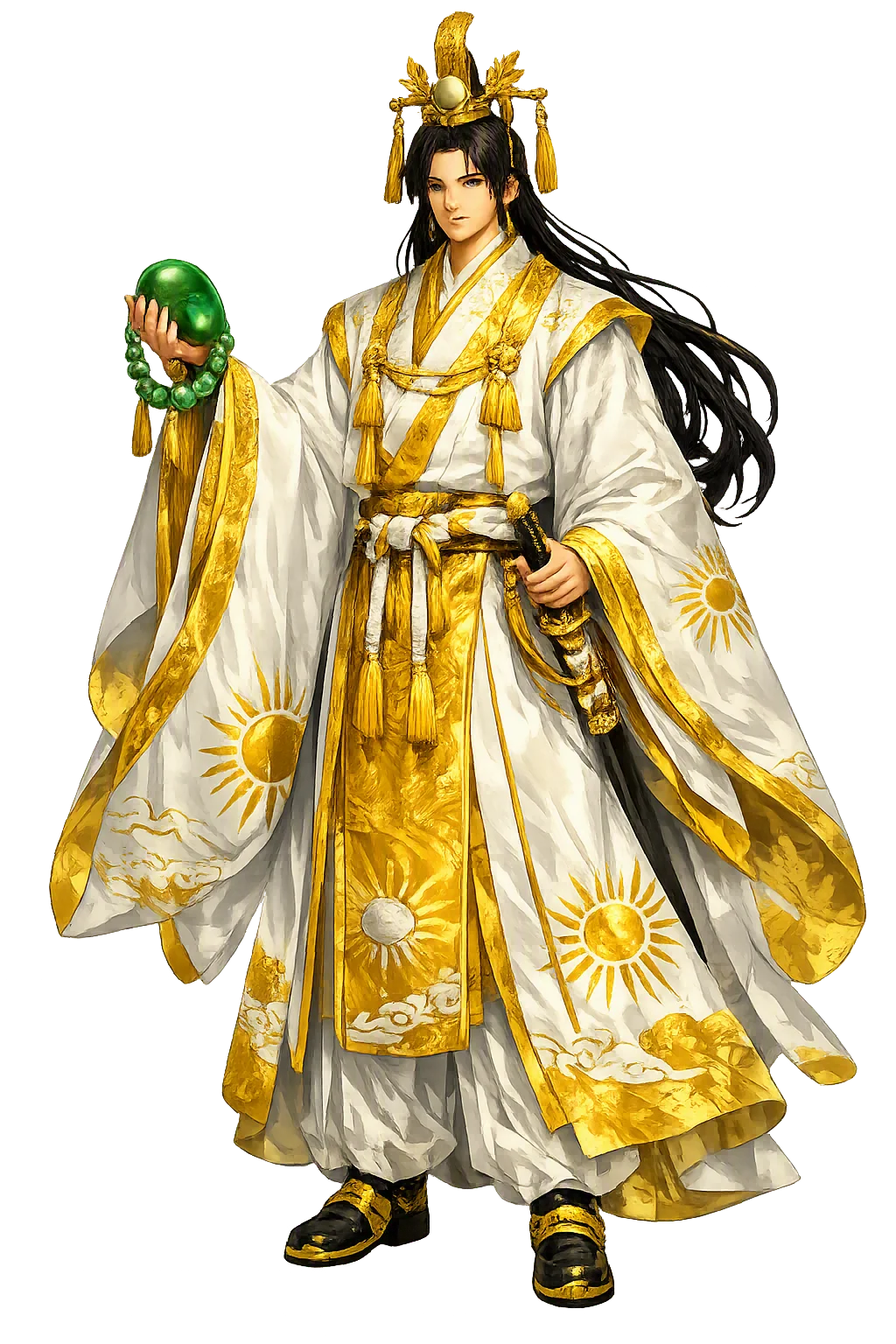
Ninigi walks into a agriculture, food & harvest firm
Walk into any agriculture, food & harvest outfit and watch for ten minutes. You will see a very old act performed with newer props. The act has a name. It is Ninigi.
Before the Office, the Story
The Descent from Heaven. When Amaterasu resolved that the land of reed plains should be governed from heaven, she chose not her son but her grandson. She gave Ninigi the Three Sacred Regalia — the mirror Yata, the sword Kusanagi that Susanoo had won from the eight-forked serpent, and the curved jewel Yasakani — and sent him down, escorted by the deities Ame-no-koyane and Futodama, from the Floating Bridge of Heaven to Takachiho in Kyūshū. The Kojiki (Book I) frames the descent as a transfer of title: heaven holds sovereignty, and the earth must receive it.
Ōkuninushi's Withdrawal. The earth, however, was occupied. Its master, the great kami Ōkuninushi, had built and governed the land — some say he had won it by ordeal and war — and heaven's envoy could not simply take it. The Kojiki (Book I) tells how Ninigi pressed the matter through negotiation rather than battle, with pressure from the celestial host.
At a Glance
- Temple: Ninigi
- Pantheon: Japanese
- Domain of influence: Rice, Descendant of Amaterasu
- Pattern seats: 3
- Sectors touched: Energy & Natural World · Commerce & Governance · Home & Lifestyle
- Strongest seat: Agriculture, Food & Harvest
- Series: The Resonance Files, No. 341 of 548
The Reveal, Seat by Seat
Agriculture, Food & Harvest
The august rice spirit who descended to rule; the imperial line carries the grain mandate. The match is not poetic license. Strip the trade to its function and the function is the myth.
Leadership, Governance & Public Administration
The grandson of Amaterasu sent to rule; the mandate from heaven made flesh. Nobody in that trade worships at this temple. They just keep its hours.
Food & Hospitality
Now read the why-line with the office in mind: The rice spirit; every bowl of sake begins with his grain. The people doing this work did not borrow the archetype. They re-derived it — the way Ninigi was always going to be re-derived wherever rice, descendant of amaterasu matters.
Not the First Rebrand
Ninigi was never a popularly worshipped god, and that absence is itself revealing. His role was absorbed into two institutions: the imperial house, which descends from him, and State Shinto, which taught his descent as the founding act of the Japanese nation. The office is only the latest translation.
The Method, Stated Plainly
None of this is numerology. A seat exists only where the match can be argued from the deity’s documented domains and deeds — weighted, published, and falsifiable. The derivation, the weights, and the challenge process are public on the methodology page. If a seat in this file reads wrong, the atlas itself tells you how to prove it — and the correction becomes part of the record.
For the Ones Who Work There
For a sponsor in agriculture, food & harvest, the fit here is not adjacency — it is inheritance. Your trade already tells this story every working day; the temple simply holds the original. The patron tier and the advertising terms carry the mechanics; the myths above carry the reason.
The File Continues
This is one of 548 Resonance Files — the third dispatch from every flagship temple, where the myths meet the markets. The temple's founding dispatch tells the name's story; its Restoration File tells the spelling's; the blog index holds the whole archive.
Continue the series — previous: Nikkō (read it) · next: Ninlil (read it).
The Resonance Files are argued from the same canonical record as the pattern atlas itself: the lexicon, the lore catalog, and the cited sources. Every seat can be challenged at the methodology page — and the challenge is the point.