
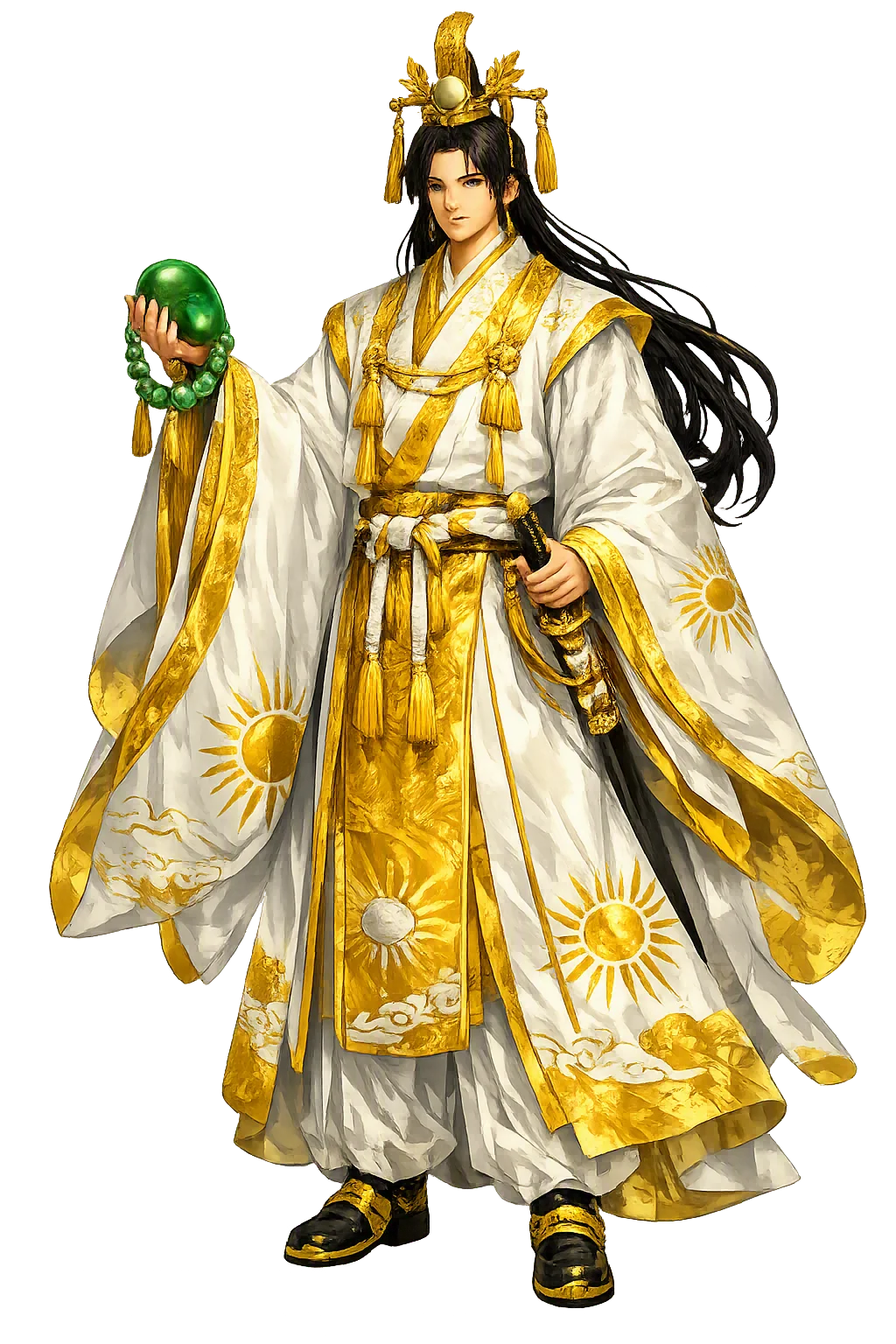
Ninigi: the stories first, then the spelling
The marks in Ninigi make the most sense standing next to the myths they have to carry. So the myths come first.
The Stories That Carry the Name
The Descent from Heaven. When Amaterasu resolved that the land of reed plains should be governed from heaven, she chose not her son but her grandson. She gave Ninigi the Three Sacred Regalia — the mirror Yata, the sword Kusanagi that Susanoo had won from the eight-forked serpent, and the curved jewel Yasakani — and sent him down, escorted by the deities Ame-no-koyane and Futodama, from the Floating Bridge of Heaven to Takachiho in Kyūshū. The Kojiki (Book I) frames the descent as a transfer of title: heaven holds sovereignty, and the earth must receive it.
Ōkuninushi's Withdrawal. The earth, however, was occupied. Its master, the great kami Ōkuninushi, had built and governed the land — some say he had won it by ordeal and war — and heaven's envoy could not simply take it. The Kojiki (Book I) tells how Ninigi pressed the matter through negotiation rather than battle, with pressure from the celestial host.
The Ordeal of Fire. Standing one day at Cape Kasasa, Ninigi saw a woman more beautiful than any other and asked her name. She was Konohanasakuya-hime, daughter of the mountain-god Ōyamatsumi; she consented, and that same night conceived. Ninigi doubted her when the pregnancy showed at once — whose child could be born in a day?
And Here Is What the Spelling Preserves
Against those stories, the attestation: 邇邇芸命, on the evidence Kojiki, Book I (descent, Ōkuninushi's withdrawal, the ordeal of fire) and Nihon Shoki, Books I–III (parallel and variant accounts) set down. The name means "The august rice spirit".
At a Glance
- Restored name: Ninigi
- ASCII form: ninigi
- Meaning: "The august rice spirit"
- Domain of influence: Rice, Descendant of Amaterasu
- Pantheon: Japanese
- Classification: Tier 2
- Original script: 邇邇芸命
- Series: The Restoration Files, No. 341 of 548
The Name Travels
Ninigi was never a popularly worshipped god, and that absence is itself revealing. His role was absorbed into two institutions: the imperial house, which descends from him, and State Shinto, which taught his descent as the founding act of the Japanese nation.
The Address It Earned
The temple of Ninigi stands at /ninigi/ — lore, scholars, patterns — because a name carrying this much story deserves more than a parking page. The restoration keeps one feature the ASCII form drops. One is enough to matter, and the label says so plainly: Tier-2.
The Sources Are Open
The myths above are retold from the temple's record; the primary voices are in the Sacred Texts: Kojiki and Nihon Shoki. Nothing in this file outranks them.
The File Continues
Read the founding dispatch for the name's full story, the Resonance File for the archetype at work — or the whole archive in one sitting.
Continue the series — previous file: Nikkō (read it here) · next file: Ninlil (read it here).
The Restoration Files are written from the same canonical record as the temples themselves: the lexicon, the lore catalog, the pattern atlas, and the cited scholarly sources. If a file ever disagrees with its temple, the temple is right — tell us, and the file will be corrected.