
The hidden history behind Ninigi
Behind the plain ASCII spelling ninigi stands a much longer record. Ninigi reaches through manuscripts, inscriptions, oral transmission, and scholarly convention long before it reaches a keyboard. No lost marks are being invented here. Instead, this post traces why the tradition's sources support this exact form, how the name sounds, what its myths preserve, and how the digital temple keeps that evidence open for review.
At a Glance
- Canonical name: Ninigi
- ASCII form: ninigi
- Meaning: "The heavenly grandchild (the name's etymology is debated)"
- Domain of influence: Heavenly Descent, Imperial Ancestor
- Pantheon: Japanese
- Restoration: ASCII-equivalent form
- Original script: 邇邇芸命 (Japanese characters)
Overview
Ninigi (ninigi) — Rice, Descendant of Amaterasu · The august rice spirit — belongs to the Japanese tradition, where it is catalogued under the domain "Heavenly Descent, Imperial Ancestor". The name means "The heavenly grandchild (the name's etymology is debated)".
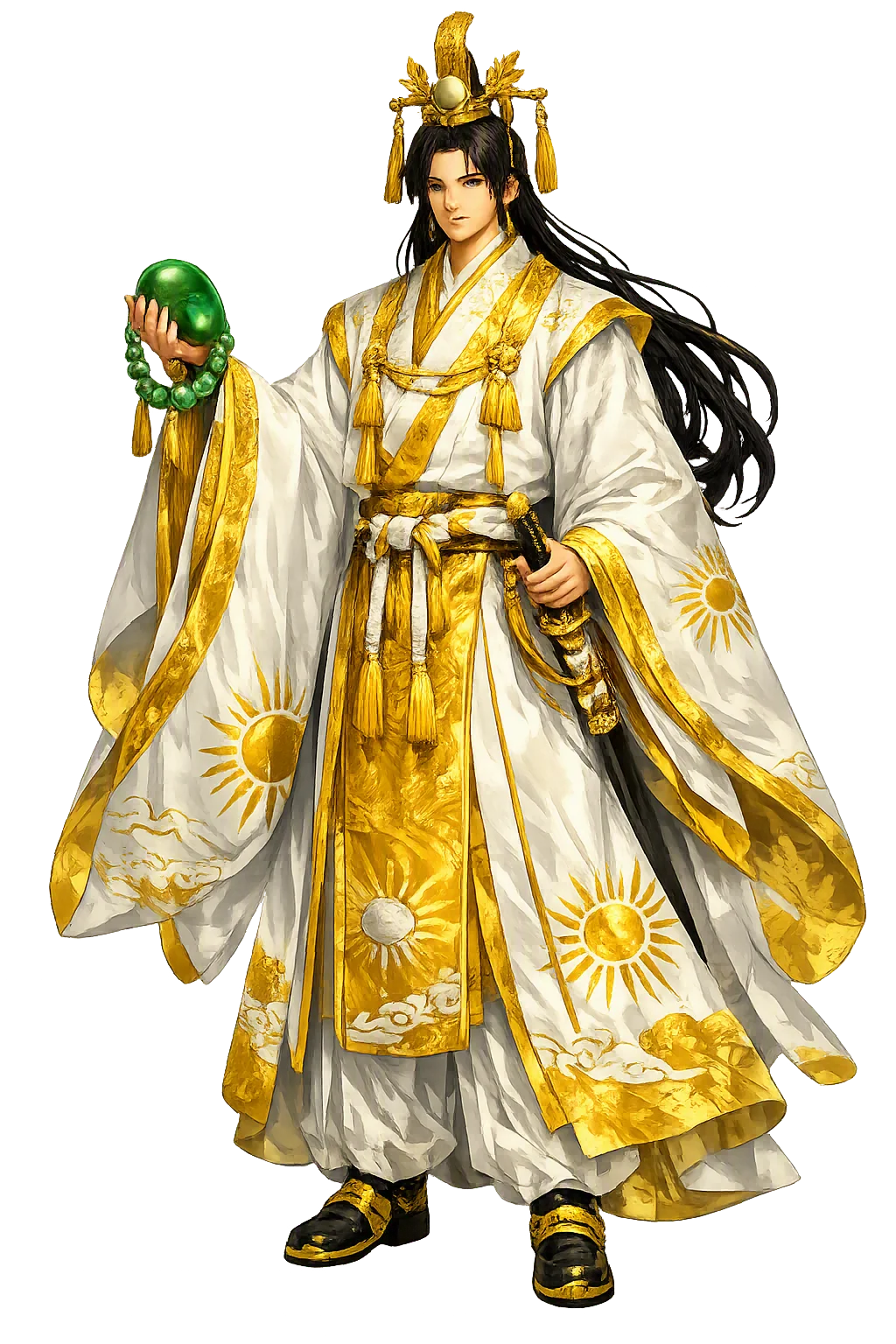
Ninigi is the grandson of Amaterasu, sent from heaven to rule the terrestrial world and establish the imperial line. He descended to Takachiho in Kyūshū bearing the Three Sacred Regalia — the mirror, the sword, and the jewel — and his great-grandson became Emperor Jimmu, the legendary first emperor of Japan.
PuniCodex records the canonical scholarly spelling Ninigi and serves its temple at its temple. The displayed form is ASCII-equivalent — a description computed from the displayed form itself. The plain ASCII form ninigi contains the same letters: no recovered diacritics or special encoding is claimed. The work here is consistent citation, capitalization, provenance, and cultural context.
The Name
The name is attested in Japanese characters as 邇邇芸命. Etymologically it means "The heavenly grandchild (the name's etymology is debated)".
The canonical spelling Ninigi matches the conventional scholarly romanization. The plain ASCII form ninigi contains the same letters, so no lost diacritics or encoding transition is claimed. The editorial work is to fix one reviewed reference spelling, preserve capitalization and provenance, and keep the original evidence visible. The displayed form is ASCII-equivalent — a description computed from the displayed form itself.
The letter-by-letter transformation runs:
- n → N — Same, capitalized
- i → i — Same
- n → n — Same
- i → i — Same
- g → g — Same
- i → i — Same
The Original Script
The name is written in Japanese characters as 邇邇芸命. That attested script remains the primary evidence for the conventional romanization Ninigi. The canonical Latin spelling does not pretend to recover marks it never contained: it fixes one reviewed reference form while leaving the original script visible for comparison.
The Kojiki writes 邇邇芸命 (Ninigi-no-mikoto): 邇邇 is a reduplication of 邇 (ni), and the whole compound is phonetic scaffolding around the name Ni-ni-gi, with the honorific 命 mikoto. The Nihon Shoki writes the fuller 瓊瓊杵尊, substituting 'jewel' characters that gesture at the imperial regalia he carried down from heaven. The meaning of the name has been debated since the medieval commentaries without resolution. What the writing preserves beyond dispute is the descent itself — the regalia, the grandson, the mandate.
Pronunciation
The reconstructed pronunciation of the name is /ni.ni.ɡi/ — Modern Standard Japanese (Hepburn).
Phoneme by phoneme:
- Ni- — Alveolar nasal [n] plus close front [i]
- -ni- — Alveolar nasal [n] plus close front [i]
- -gi — Voiced velar stop [ɡ] plus close front [i]; from 邇邇芸, whose final character associates him with rice and skill
For the modern speaker, the closest approximation is: 'NEE-nee-gee' — light, even syllables; the 'g' is hard.
Kindred and historical forms of the name:
- Japanese — 邇邇芸命 (Ninigi-no-mikoto), 'The August Grandchild of the Rice' (Kojiki, Book I)
- Grandmother — Amaterasu, the sun goddess who sent him down (Kojiki, Book I)
- Descendant — Great-grandfather of Emperor Jimmu (Nihon Shoki, Books I–III)
Ninigi keeps its restoration plain: plain Hepburn with no distinctive feature for the ASCII form to lose. He is the heavenly grandson sent to rule the terrestrial world.
Mythology
Ninigi's mythology is the bridge between the heavenly realm of Amaterasu and the earthly rule of the emperors: four scenes — the descent, the negotiated surrender of the land, the ordeal by fire that proved his wife's fidelity, and the genealogy that produced Jimmu — suffice to carry three regalia and a nation from the Floating Bridge of Heaven to Kashihara.
The Descent from Heaven (Kojiki I)
When Amaterasu resolved that the land of reed plains should be governed from heaven, she chose not her son but her grandson. She gave Ninigi the Three Sacred Regalia — the mirror Yata, the sword Kusanagi that Susanoo had won from the eight-forked serpent, and the curved jewel Yasakani — and sent him down, escorted by the deities Ame-no-koyane and Futodama, from the Floating Bridge of Heaven to Takachiho in Kyūshū. The Kojiki (Book I) frames the descent as a transfer of title: heaven holds sovereignty, and the earth must receive it. One detail sharpens the stakes. As Ninigi left, Amaterasu told him the mirror was to be worshipped as her own spirit — the warrant of his rule was simultaneously her presence. A thousand generations of imperial ideology condensed into a single instruction: the emperor rules because he carries what Ninigi carried. The myth means that legitimacy, in the Japanese telling, is a thing handed down, not taken.
Ōkuninushi's Withdrawal (Kojiki I)
The earth, however, was occupied. Its master, the great kami Ōkuninushi, had built and governed the land — some say he had won it by ordeal and war — and heaven's envoy could not simply take it. The Kojiki (Book I) tells how Ninigi pressed the matter through negotiation rather than battle, with pressure from the celestial host. Ōkuninushi consulted his sons; his wise son Kotoshironushi, recognising heaven's claim, withdrew of his own accord and is still honored at Mount Miwa. His father then set his price: a great sanctuary built for him at Kizuki in Izumo — the origin of the shrine now called Izumo Ōyashiro — and the keeping of the land's hidden, numinous affairs. In one stroke the myth explains two of Japan's greatest shrines and establishes a template of Japanese statecraft: conquest by diplomacy, and the defeated party honored, not erased. The Nihon Shoki gives variant versions, but the pattern holds. The myth's deepest meaning may be that sovereignty is best taken by leaving the former holder something greater than his loss.
The Ordeal of Fire (Kojiki I)
Standing one day at Cape Kasasa, Ninigi saw a woman more beautiful than any other and asked her name. She was Konohanasakuya-hime, daughter of the mountain-god Ōyamatsumi; she consented, and that same night conceived. Ninigi doubted her when the pregnancy showed at once — whose child could be born in a day? The princess answered with fire. She entered a parturition hut, sealed it, and set it alight, vowing that if the children were truly Ninigi's they would be unharmed. In the midst of the flames she delivered three sons: Hoderi, the luck of the sea; Hoori, the luck of the mountains; and Hosuseri. Mother and infants survived, and Ninigi's suspicion was answered with living proof. The episode is one of the most vivid ordeal-births in world mythology, and it quietly elevates the bride: it is her fidelity, tested by fire, that founds the dynasty. The myth means that legitimacy flows not from the doubting husband but through the mother whose truth outlasts the flames.
From Ninigi to Jimmu (Nihon Shoki)
The Nihon Shoki (Books I–III) completes the genealogy. Hoori, the mountain-lucky son, married Toyotama-hime, daughter of the sea-god, and their son Ugayafukiaezu wed his aunt Tamayori-hime; of that union was born Kamuyamato-Iwarebiko, who marched east from Hyūga, fought through the Kumaso, and acceded at Kashihara — Emperor Jimmu, the legendary first emperor. Ninigi is thus Jimmu's great-grandfather, and every imperial genealogy in Japanese history has run through him. The same chapters preserve the succession stories the official line passed over: in one Nihon Shoki variant, Ninigi's elder brother Ame-no-hohi was sent to the earth first and never returned, and Ninigi's descent was the second attempt. The sources are candid that more than one heir was considered. The myth's function is transparent and, for over a millennium, was effectively constitutional: it makes the emperor a descendant of Amaterasu in the fourth generation. It means that the state located its origin not in a conquest but in a birth — a genealogy, not a battlefield.
Symbols & Iconography
The iconography associated with Ninigi concentrates in a small set of recurring attributes, each a compressed statement about the name:
- Three Sacred Regalia — The mirror, sword, and jewel that legitimize imperial rule
- Rice — The agricultural foundation of his name and authority
- Takachiho — The Kyūshū peak where he descended from heaven
- Heavenly robe — The divine garments that accompanied his descent
Archaeology & Evidence
No artifact can be tied to Ninigi himself, but the geography of his myth is mapped in standing shrines. Takachiho in Miyazaki Prefecture keeps the sites of the descent — the Ama-no-Iwato ('Cave of Heaven') shrine and the sheer gorge where, by tradition, he first set foot on earth. Izumo Ōyashiro in Shimane, rebuilt in its monumental ancient form, marks the sanctuary Ōkuninushi demanded as the price of withdrawing; excavations in 2000 uncovered pillar bases suggesting an ancient structure of unprecedented height. Kashihara Jingū in Nara stands at the foot of Unebi-yama, the traditional accession site of Jimmu, Ninigi's great-grandson. The regalia he carried are kept at Ise (the mirror), Atsuta (the sword), and the palace (the jewel) — none ever displayed or archaeologically examined. Ninigi's material record is thus a landscape of shrines rather than a museum of objects.
Realm & Domain
Ninigi is the grandson of Amaterasu, sent from heaven to rule the terrestrial world and establish the imperial line. He descended to Takachiho in Kyūshū bearing the Three Sacred Regalia — the mirror, the sword, and the jewel — and his great-grandson became Emperor Jimmu, the legendary first emperor of Japan.
Bearer of the Regalia
He carried the mirror Yata, the sword Kusanagi, and the jewel Yasakani from heaven to earth — the warrant of every later throne.
Heavenly Descent
Amaterasu sent him to rule the land of reed plains — the tenson kōrin, the founding descent of Japanese sovereignty.
Imperial Ancestor
His line produced Hoori, Ugayafukiaezu, and Jimmu — four generations from heaven to Kashihara.
Rice Spirit
His name's final character, 芸, ties him to rice and skill — agricultural sovereignty in a single syllable.
Across Cultures
Ninigi was never a popularly worshipped god, and that absence is itself revealing. His role was absorbed into two institutions: the imperial house, which descends from him, and State Shinto, which taught his descent as the founding act of the Japanese nation. In the Meiji period the tenson kōrin became civic doctrine, and Jimmu's traditional accession date anchored the national holiday Kigensetsu. After 1945 the emperor's divinity was renounced, and Ninigi settled back into mythology — taught in schools, visited at Takachiho, but rarely prayed to. Buddhism, meanwhile, largely ignored him: he is one of the few major kami without a Buddhist avatar (honji). His syncretic afterlife is thus mostly political memory — the story a state told about where its authority came from.
Kindred figures in the PuniCodex cross-tradition index include Amaterasu (solar grandmother and divine grandson), Anāhitā (earth / mother / fertility), Auðhumla (earth / mother / fertility), Ọbalúayé (earth / mother / fertility), Bꜣstt (earth / mother / fertility), and Cernunnos (earth / mother / fertility).
Cultural Legacy
Ninigi's legacy is carried by objects and places rather than temples. The Three Sacred Regalia he bore — mirror, sword, jewel — remain the symbols of imperial legitimacy, presented at each accession though never publicly displayed. Takachiho in Miyazaki Prefecture, his traditional landing place, draws pilgrims and visitors to the Ama-no-Iwato shrine and the gorge of the descent; Kashihara Jingū in Nara marks where his great-grandson Jimmu is said to have acceded. The Kojiki (712) and Nihon Shoki (720) preserve his story as the hinge between gods and emperors. In a Japan that no longer claims divine descent, Ninigi endures as the mythological explanation of why the islands were long thought to belong to one unbroken line.
The Scholarly Record
The account of Ninigi given in this edition rests on the witnesses and reference works listed below. Lexica and etymological dictionaries secure the form and meaning of the name; the literary and religious texts supply the narrative evidence.
- Kojiki, Book I (descent, Ōkuninushi's withdrawal, the ordeal of fire).
- Nihon Shoki, Books I–III (parallel and variant accounts).
- Philippi, Kojiki (translation).
- Aston, Nihongi (translation).
A Meditation
Ninigi is the moment when heaven touches earth. He carries divine authority not as force but as gift — the mirror that sees truly, the sword that cuts cleanly, the jewel that holds abundance — and his story asks what it means to receive power and pass it on. He is, notably, a mediocre protagonist: he doubts his wife, wins no battles, performs no miracles. The tradition seems uninterested in his character because his function is transmission, not heroism. He is a conduit, and the myth honors the conduit more than the current.
That is a quietly radical theology of legitimacy. Authority is not earned in the descent but entrusted before it, and its proof is not the bearer's virtue but the unbroken line that follows him. Every institution that inherits rather than conquers its mandate — every regency, every relay, every succession — retells Ninigi's descent without knowing it.
The Canonical Spelling
Ninigi is the canonical spelling used by this temple. The plain ASCII form ninigi contains the same letters, so there are no lost diacritics to recover and no special encoding transition to explain. What the temple preserves is the reviewed reference form: capitalization, conventional romanization, original evidence, and a stable place to inspect them. The value here is not added decoration; it is fidelity to the attested record.
Character by Character
The canonical form Ninigi and the plain ASCII form ninigi share the same letters. The character list therefore documents continuity rather than recovery: every character is carried forward deliberately, with capitalization serving as the proper-noun convention. No additional mark is inserted merely to make the restoration appear more elaborate.
The Japanese Pantheon
Ninigi is one of 45 entries the PuniCodex lexicon catalogues under the Japanese pantheon. The Pantheon page gathers the tradition's major figures in one place, and the Lexicon lets you filter all 983 restorations by tradition or script — the fastest way to see where this name sits among its kin.
Frequently Asked Questions
What does Ninigi mean? The traditional gloss is "The heavenly grandchild (the name's etymology is debated)."
Which tradition does Ninigi belong to? Ninigi is catalogued in the Japanese pantheon of the PuniCodex lexicon.
Does this name need recovered diacritics? No. Ninigi is already an ASCII-form canonical spelling. The scholarly work is to preserve the attested convention and its evidence, not to add marks.
Can I use Ninigi in a normal browser? Yes. The spelling works directly in an ordinary browser, and the type tool can confirm and copy the canonical form.
Where does the scholarly information come from? The entry is built from lexica, inscriptional evidence, and reviewed scholarly sources listed in the Scholarly Edition.
Typing Ninigi
You do not need a special keyboard to use this name. Ninigi already uses ordinary Latin letters. The PuniCodex Type Tool lets you confirm the canonical spelling and copy it cleanly, while the original-script notes in the temple show the evidence behind the romanization.
Sister Temples
Other temples in the Japanese pantheon include Izanami, Kannon, and Kumano — each with its own restoration story, its own scholarly record, and its own place in the lexicon.
Why This Record Matters
The story of Ninigi did not end in antiquity; it changed medium. Names survive because each generation finds a new carrier for them — clay, papyrus, print, and now the digital temple. The carrier is honest when the spelling that resolves is the spelling the evidence supports. Ninigi and ninigi contain the same letters; what the project adds is not ornament but provenance, review, and a permanent home for the record.
Explore Further
This post is one doorway into the temple. The home page carries the full character breakdown and the ambient canvas; the lore page tells the myths in long form; the Scholarly Edition preserves the sources, pronunciation data, and revision history; and the patron wall supports the restoration directly. For the wider map, browse the Lexicon, explore the Pantheon, or return to the PuniCodex blog.
Related Names
Sources
The full scholarly apparatus — every citation, revision, and review — lives in the Scholarly Edition. Key references for this post:
- Kojiki, Book I (descent, Ōkuninushi's withdrawal, the ordeal of fire).
- Nihon Shoki, Books I–III (parallel and variant accounts).
- Philippi, Kojiki (translation).
- Aston, Nihongi (translation).
- Lexicon authorities for this entry: Kojiki, Nihon Shoki.