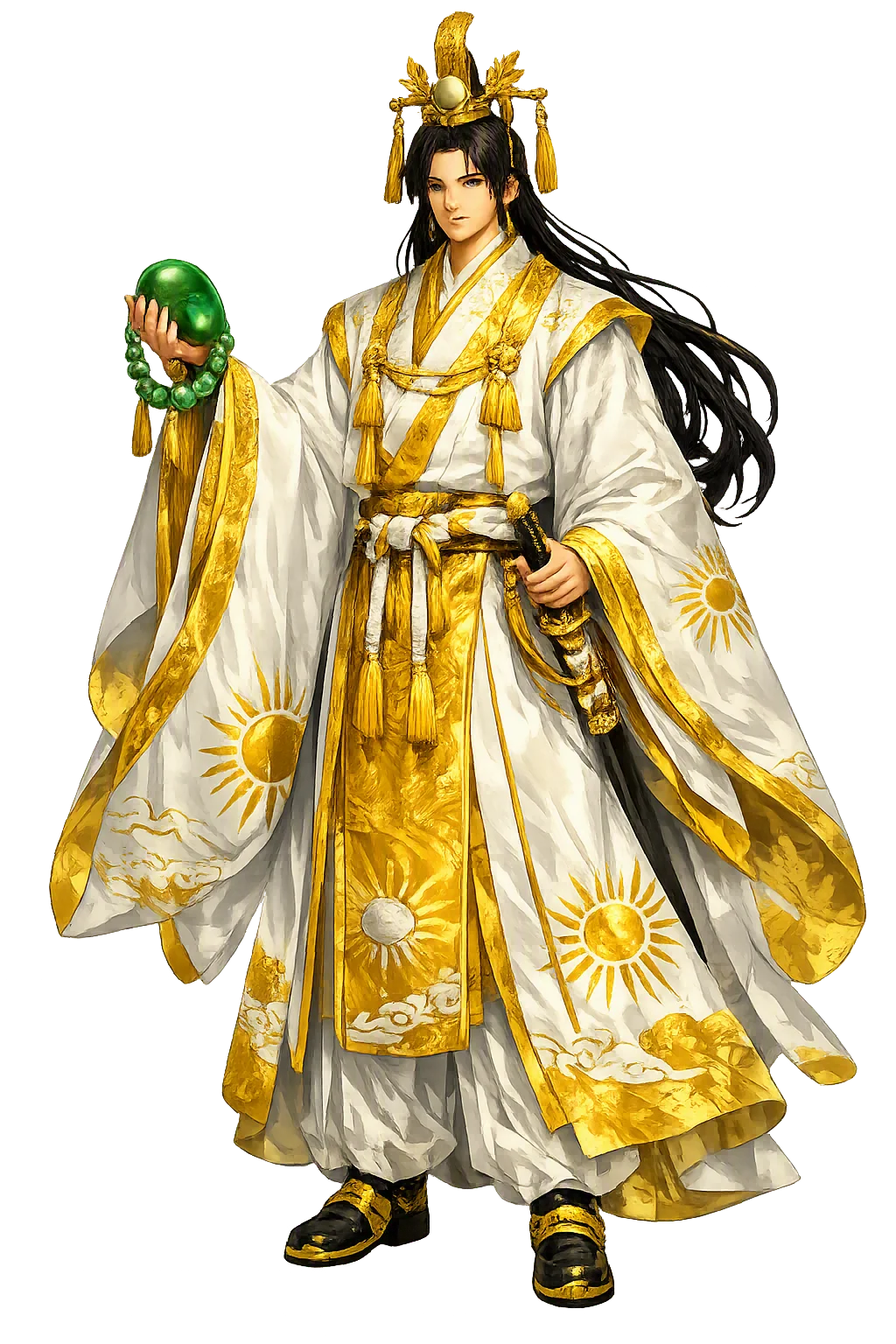
Stories of Ninigi
Ninigi's mythology is the bridge between the heavenly realm of Amaterasu and the earthly rule of the emperors: four scenes — the descent, the negotiated surrender of the land, the ordeal by fire that proved his wife's fidelity, and the genealogy that produced Jimmu — suffice to carry three regalia and a nation from the Floating Bridge of Heaven to Kashihara.
When Amaterasu resolved that the land of reed plains should be governed from heaven, she chose not her son but her grandson. She gave Ninigi the Three Sacred Regalia — the mirror Yata, the sword Kusanagi that Susanoo had won from the eight-forked serpent, and the curved jewel Yasakani — and sent him down, escorted by the deities Ame-no-koyane and Futodama, from the Floating Bridge of Heaven to Takachiho in Kyūshū. The Kojiki (Book I) frames the descent as a transfer of title: heaven holds sovereignty, and the earth must receive it. One detail sharpens the stakes. As Ninigi left, Amaterasu told him the mirror was to be worshipped as her own spirit — the warrant of his rule was simultaneously her presence. A thousand generations of imperial ideology condensed into a single instruction: the emperor rules because he carries what Ninigi carried. The myth means that legitimacy, in the Japanese telling, is a thing handed down, not taken.
The earth, however, was occupied. Its master, the great kami Ōkuninushi, had built and governed the land — some say he had won it by ordeal and war — and heaven's envoy could not simply take it. The Kojiki (Book I) tells how Ninigi pressed the matter through negotiation rather than battle, with pressure from the celestial host. Ōkuninushi consulted his sons; his wise son Kotoshironushi, recognising heaven's claim, withdrew of his own accord and is still honored at Mount Miwa. His father then set his price: a great sanctuary built for him at Kizuki in Izumo — the origin of the shrine now called Izumo Ōyashiro — and the keeping of the land's hidden, numinous affairs. In one stroke the myth explains two of Japan's greatest shrines and establishes a template of Japanese statecraft: conquest by diplomacy, and the defeated party honored, not erased. The Nihon Shoki gives variant versions, but the pattern holds. The myth's deepest meaning may be that sovereignty is best taken by leaving the former holder something greater than his loss.
Standing one day at Cape Kasasa, Ninigi saw a woman more beautiful than any other and asked her name. She was Konohanasakuya-hime, daughter of the mountain-god Ōyamatsumi; she consented, and that same night conceived. Ninigi doubted her when the pregnancy showed at once — whose child could be born in a day? The princess answered with fire. She entered a parturition hut, sealed it, and set it alight, vowing that if the children were truly Ninigi's they would be unharmed. In the midst of the flames she delivered three sons: Hoderi, the luck of the sea; Hoori, the luck of the mountains; and Hosuseri. Mother and infants survived, and Ninigi's suspicion was answered with living proof. The episode is one of the most vivid ordeal-births in world mythology, and it quietly elevates the bride: it is her fidelity, tested by fire, that founds the dynasty. The myth means that legitimacy flows not from the doubting husband but through the mother whose truth outlasts the flames.
The Nihon Shoki (Books I–III) completes the genealogy. Hoori, the mountain-lucky son, married Toyotama-hime, daughter of the sea-god, and their son Ugayafukiaezu wed his aunt Tamayori-hime; of that union was born Kamuyamato-Iwarebiko, who marched east from Hyūga, fought through the Kumaso, and acceded at Kashihara — Emperor Jimmu, the legendary first emperor. Ninigi is thus Jimmu's great-grandfather, and every imperial genealogy in Japanese history has run through him. The same chapters preserve the succession stories the official line passed over: in one Nihon Shoki variant, Ninigi's elder brother Ame-no-hohi was sent to the earth first and never returned, and Ninigi's descent was the second attempt. The sources are candid that more than one heir was considered. The myth's function is transparent and, for over a millennium, was effectively constitutional: it makes the emperor a descendant of Amaterasu in the fourth generation. It means that the state located its origin not in a conquest but in a birth — a genealogy, not a battlefield.
Heavenly Grandson and Bearer of the Regalia
Ninigi is the grandson of Amaterasu, sent from heaven to rule the terrestrial world and establish the imperial line. He descended to Takachiho in Kyūshū bearing the Three Sacred Regalia — the mirror, the sword, and the jewel — and his great-grandson became Emperor Jimmu, the legendary first emperor of Japan.
He carried the mirror Yata, the sword Kusanagi, and the jewel Yasakani from heaven to earth — the warrant of every later throne.
Amaterasu sent him to rule the land of reed plains — the tenson kōrin, the founding descent of Japanese sovereignty.
His line produced Hoori, Ugayafukiaezu, and Jimmu — four generations from heaven to Kashihara.
His name's final character, 芸, ties him to rice and skill — agricultural sovereignty in a single syllable.
From the original script to the living URL
邇邇芸命
The name in its original Japanese form. Ninigi (邇邇芸命) is attested in the source tradition — “The august rice spirit”. Its original diacritics and script distinctions carry the full phonetic and orthographic weight of the source tradition.
ninigi
The plain ninigi form is identical to the Unicode restoration. Because this name is already written in Latin letters, no diacritics, stress, or script information were lost — only capitalization differs.
Ninigi
The Unicode restoration does not need to recover lost marks for Ninigi. Its value is canonical spelling and consistent cataloguing, not the reconstruction of erased orthography. The domain is readable as-is to both DNS and humanity.
Ninigi.com
This restoration is written entirely in ASCII letters — no Punycode encoding stands between Ninigi and the DNS. The domain reads identically to machines and to human eyes.
Owned, ideal, and ASCII forms of Ninigi
Ninigi
Restores 邇邇芸命. The full Unicode restoration. ninigi.com is not in the PuniCodex collection — it is watched for release; if it drops, this temple upgrades to an owned flagship.
How Ninigi was spoken
How Ninigi is preserved in writing
A bespoke provenance study for Ninigi is being prepared by the PUNICODEX scholarly team.
Contribute scholarly provenance →The lore you have read is the living myth. Extended Lore opens the scholarly vault beneath it: the cult and its material remains, a history of the image, the name after antiquity, a meditation on what the name still means, and the full scholarly apparatus — etymology, orthography, sources.
Enter Extended Lore