
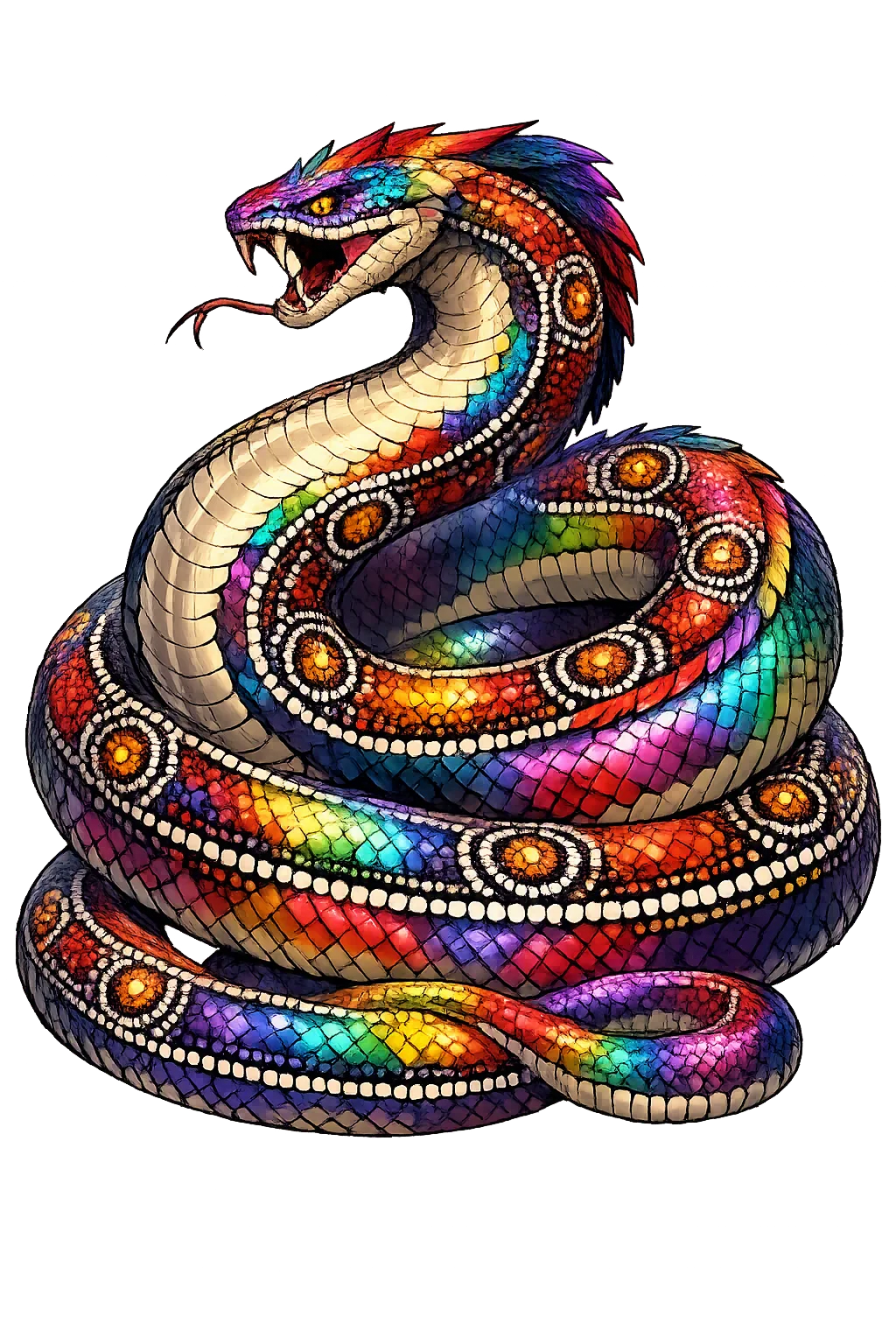
The canonical register: Ngalyod
Evidence dossier 335 — Ngalyod. Every exhibit catalogued, every ruling stated with its grounds.
At a Glance
- Canonical form: Ngalyod
- Original script: —
- Pantheon: Aboriginal
- Convention: the tradition’s own scholarly transliteration standard
- False forms on record: 0
- Contested forms: none attested
- Series: The Canonical Register, No. 335 of 548
The Evidence
Exhibit 1 — the attestation. The tradition's record preserves this name in its romanized scholarly form: Ngalyod — no older script survives to transcribe, so the canonical content is the exactness of the spelling itself.
Exhibit 2 — the flattened form. The plain form ngalyod differs from the canonical Ngalyod only by convention of display — case, not content. It is acceptable everywhere: in legacy systems, in plain-text citation, in the DNS itself. What is not acceptable is what follows in the register: respellings that change the letters, not just their case.
Exhibit 3 — the physical record. The primary material witnesses to Ngalyod are the rock-art galleries of western Arnhem Land — the Kakadu escarpment sites such as Ubirr and Nourlangie, the plateau country, and the Kuninjku heartland around Maningrida, Mumeka, and the Mann and Liverpool Rivers — where Rainbow Serpent figures appear in both naturalistic and x-ray styles across millennia of painting, some of the oldest continuously maintained sacred art in the world. Excavated occupation deposits, stone tool scatters, and fish-trap complexes document the long-term human use of the waterholes and wetlands associated with the serpent; dating of mud-wasp nests over painted figures has pushed the antiquity of some Arnhem Land art well past ten thousand years. These places remain under the custodianship of their traditional-owner clans; access and reproduction of designs are regulated by Indigenous cultural authority, and the 'archive' of Ngalyod is alive in a way no museum can replicate.
Exhibit 4 — the continuing record. Ngalyod survives most visibly in the x-ray rock art of western Arnhem Land, where the serpent is painted with internal organs, ribs, and backbone showing — a visual convention that identifies the figure as both animal and ancestor. These galleries, some thousands of years old, are now part of a living heritage managed by traditional owners in partnership with archaeologists and park authorities.
The Convention's Own History
Every tradition in this register has its own scholarly transliteration standard, built by its own specialists over decades or centuries, and the register follows each on its own terms: the tradition’s own standard. The principle that unifies them is the one the whole project stands on: a name is evidence, and evidence is not negotiable — not for keyboards, not for convenience, not for anyone.
The Protocol's Position
Can the canonical form live in the address bar? Almost always, yes. IDNA 2008 admits every mark this register defends — the DNS stores them as `xn--` punycode and modern browsers render them natively. The real frictions are practical, not legal: some registrars stock only part of the IDN space, so a theoretically valid name can be temporarily unbuyable; and stacked combinations (an acute riding a macron) remain awkward to type on mobile keyboards even where the protocol accepts them.
The project's answer is a ranked ladder, not a compromise: the full restoration first, then attested fallbacks in descending order of completeness. The ladder's lowest rung, plain ASCII, is a vehicle for legacy systems — sanctioned, but never presented as the scholarly form.
The Verdict
Case closed on Ngalyod: canonical, cited, and defended. The keyboard form ngalyod is the same name in another register of display — always acceptable. The register's files remain open: if a source surfaces that changes any line of this entry, the entry changes. Until then, the temple at /ngalyod/ holds the canonical form.
The docket for this ruling: no false forms on the docket; no contested forms attested; the attestation rests on 6 cited sources — Berndt, Ronald M. and Catherine H. Berndt, The Speaking Land: Myth and Story in Aboriginal Australia, Penguin, 1989, Berndt, Ronald M., Kunwinjku (Gunwinggu) religious texts and field recordings, AIATSIS, AIATSIS (Australian Institute of Aboriginal and Torres Strait Islander Studies), subject guides and language resources.
The Register Continues
The register holds 548 entries like this one — each temple with its own ruling. Read the temple's founding dispatch for the story, its Restoration File for the philology, its Resonance File for the industries, or the whole archive end to end.
Continue the register — previous entry: Nézhā (read it) · next entry: Nḫt (read it).
The Canonical Register is written from the same canonical record as the lexicon itself. If a false form is missing from this page, it is because the evidence does not support calling it false — or because we have not seen it yet. Show us, with a citation, and the register will answer.