
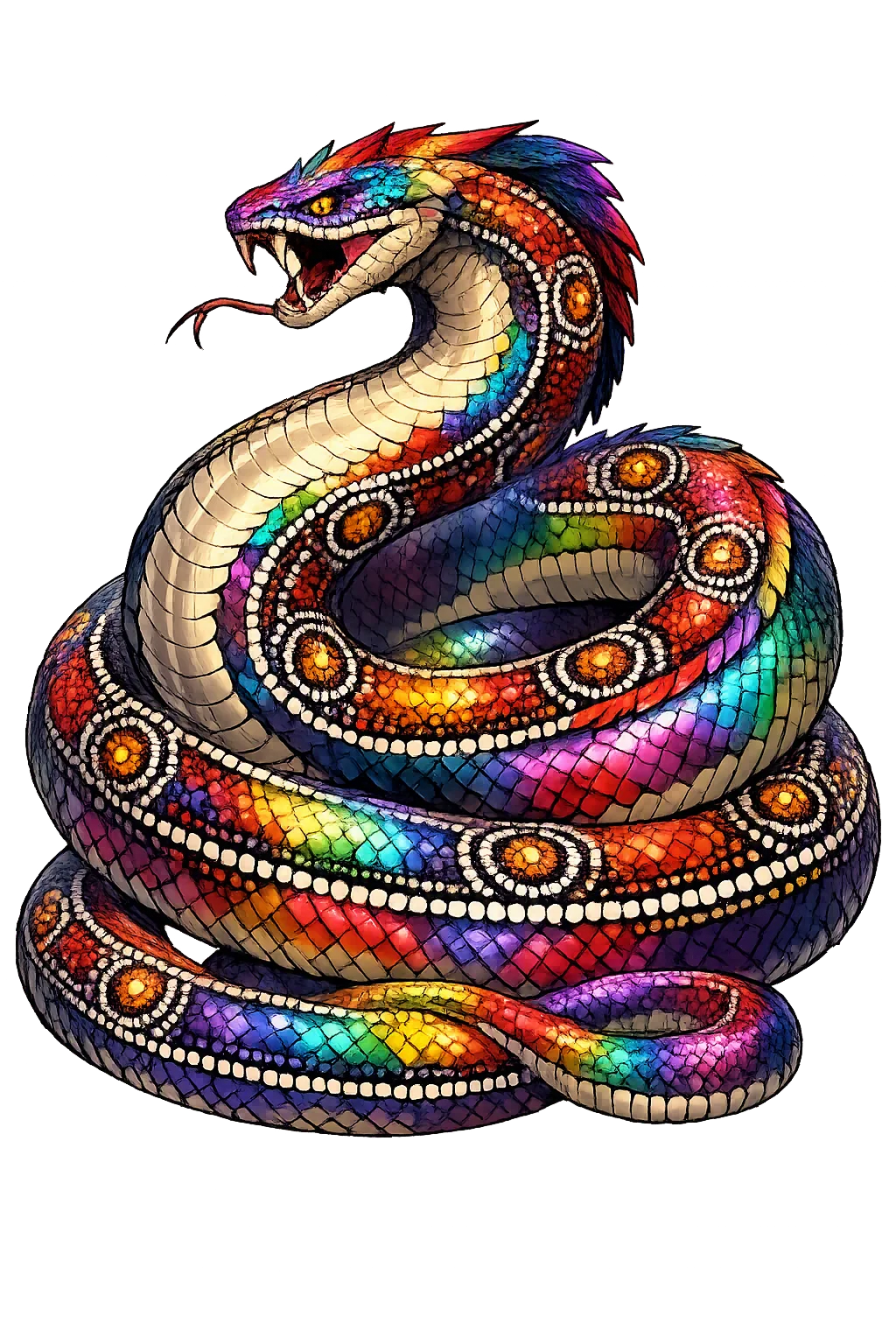
How Ngalyod got its name back
The ASCII form ngalyod is missing something subtle but important. Ngalyod restores the capitalisation that marks it as a proper name — a name, not a common noun. That single restored letter changes how the name is read, cited, and understood. This post explains, with the full scholarly record behind it, what the restoration preserves: the Kunwinjku language evidence, the reconstructed sound, the myths the name carries, and the classification logic that separates Tier 1 restorations from Tier 2. By the end, the capital N in Ngalyod will look less like an ornament and more like what it is — recovered scholarly convention, pinned back in its proper place.
At a Glance
- Restored name: Ngalyod
- ASCII form: ngalyod
- Meaning: "The rainbow"; the Rainbow Serpent of western Arnhem Land
- Domain of influence: Rainbow Serpent, water, law, monsoon
- Pantheon: Aboriginal Australian (Kunwinjku / Kuninjku)
- Classification: Tier 2
- Original script: Scholarly transliteration of an oral tradition
Overview
Ngalyod (ngalyod) — Rainbow Serpent — belongs to the Aboriginal Australian tradition of western Arnhem Land. The name means "the rainbow".
Ngalyod is the great Rainbow Serpent: creator of rivers and waterholes, guardian of the wet season, and law-giver who established the social and ceremonial order of Kunwinjku country. In the wet she arcs across the sky as the rainbow; in the dry she sleeps beneath the earth in the permanent waters.
PuniCodex restores the name as Ngalyod. The plain ASCII form ngalyod is a DNS compromise: the early domain-name system could not carry the capitalised proper-name form or any Indigenous-script representation, so the lower-case string became the practical fallback. The Unicode restoration capitalises the initial N as the standard scholarly citation form for a proper name. Because no diacritic or distinctive special letter is added, the name is placed in Tier 2: the philological content is identical to the ASCII form, but the capitalisation marks the name as a name.
The Name
The name is attested in the oral traditions of the Kunwinjku and closely related Kuninjku peoples of western Arnhem Land as Ngalyod, meaning "the rainbow" and, by extension, the Rainbow Serpent with whom the rainbow is identified.
No Indigenous writing system was used for Kunwinjku before European contact. The form Ngalyod is therefore a modern scholarly transliteration. The initial capital is not decorative: it signals that the word is a proper name, the standard convention when citing Aboriginal sacred figures in English-language scholarship. The ASCII form ngalyod erases that signal and treats the name as a common noun.
For a domainless ASCII name, the plain ASCII form is simply a technological compromise imposed by the DNS root zone. It is not a preferred spelling and carries no scholarly authority. The Unicode restoration Ngalyod is the citation form used in mythographic, linguistic, and art-historical discussion.
Pronunciation
The reconstructed pronunciation is /ˈŋa.ljɔd/ — Kunwinjku / Kuninjku.
For the modern English speaker, the closest approximation is: 'NGAL-yod' — start with the 'ng' sound of English 'sing' followed by 'al', then a light 'yod'. Avoid adding an initial vowel before the ng; the sound ŋ is the very first phoneme of the name.
Kindred and related forms of the figure include Yurlungur in Yolŋu country, Wagyl in Noongar country, and Julunggul in some north-eastern traditions. These are related Rainbow Serpent figures, but each belongs to a specific country, language, and ceremonial complex; they are not simply alternate spellings of Ngalyod.
Ngalyod is Tier 2 because the ASCII form ngalyod already encodes the same phonemic sequence; the restoration adds only the capitalisation that marks a proper name. The distinctive velar nasal /ŋ/ is represented by the digraph ng, which is available in ASCII, so no distinctive non-ASCII letter is required for phonemic recovery.
Mythology and Domains
Ngalyod governs the domain of water, law, and seasonal renewal in Kunwinjku country. Her mythic acts created the rivers, waterholes, and wetlands of western Arnhem Land and established the moiety system, marriage rules, and ceremonial obligations that still structure social life.
Four domains are especially prominent:
- The Rainbow — Ngalyod's visible body, the sign of her movement between waterholes during the wet season.
- Waterhole Guardian — In the dry season she rests in the deep, permanent waters; their protection is a sacred duty.
- Law Giver — She divided the people into moieties and set the rules of kinship, ceremony, and land tenure.
- Creator of Abundance — She created the fish, waterlilies, and other foods that sustain the wetlands economy.
The central myths explain the shape of the country and the obligations of the people who live in it. In the Dreaming she travelled across a flat land, raising ridges and excavating waterholes with her body. She established the two moieties and the marriage rules that bind clans. A widely recorded narrative tells of a boy who mocked or wounded the serpent; Ngalyod swallowed him and carried him underground through the water system, releasing him transformed or far from home. The story teaches that waterholes and sacred sites must be approached with restraint.
Why Tier 2?
PuniCodex classifies restorations by whether they recover a distinctive feature that plain ASCII loses. For Greek names, that feature is usually a stress mark or a length mark. For names in scripts such as Japanese or Chinese, the original characters themselves are distinctive but cannot be represented in the Latin alphabet at all.
For Ngalyod, the only difference between the ASCII form ngalyod and the restored form Ngalyod is the capitalisation of the initial N. Capitalisation is not a phonemic feature, but it is a scholarly convention that marks the word as a proper name. Because the convention is real and the ASCII form erases it, the restoration has value; but because no diacritic or special letter is involved, the name remains Tier 2.
Cultural Legacy
Ngalyod survives most visibly in the rock-art galleries of western Arnhem Land, painted in both naturalistic and x-ray styles across thousands of years of artistic tradition. Sites such as Ubirr and Nourlangie are now managed as living heritage by their traditional owners, and the serpent remains a central figure in contemporary Kunwinjku bark painting and ceremony.
More broadly, the Rainbow Serpent has become a national symbol of Indigenous Australian ecological knowledge and spiritual connection to country. That wider fame carries a risk: the specific clan-owned meanings of Ngalyod can be absorbed into a generic 'Aboriginal' icon. Restoring the Kunwinjku name is therefore an act of precision, resisting the flattening that comes with over-generalisation.
Conclusion
The restoration of Ngalyod is small in letter-count but significant in principle. It insists that a Kunwinjku sacred name should appear in the address bar as a name, not as an anonymous string. It acknowledges that the ASCII form is a technological compromise, not a scholarly spelling. And it reminds us that the Dreaming is not a single generic story but a tapestry of specific languages, countries, and clans — each with its own names, including this one.
The Meaning Behind the Name
The name Ngalyod encodes more than a simple label. In the Aboriginal tradition that holds it, the name carries the history of the country, the authority of ancestral law, and the obligations of the living custodians. The plain ASCII form ngalyod is a modern technological convenience: it allows the name to travel through the domain-name system and other digital infrastructure, but it cannot represent the full cultural weight that the name carries in ceremony and song.
PuniCodex restores the name as Ngalyod because the capitalized scholarly form is the standard way to cite a proper noun from an oral tradition. This restoration is not a cosmetic change. It marks the name as belonging to a living culture and asserts that digital infrastructure should be able to honor such names rather than flatten them into lowercase ASCII strings.
Mythology and Worldview
The stories of Ngalyod are not entertainment or simple explanations of natural phenomena. They are title deeds to country, instructions for ceremony, and maps of moral responsibility. In the accounts recorded by anthropologists and preserved by custodians, Ngalyod appears as a figure whose actions shaped the land and established the patterns that human beings must follow.
These stories are held under traditional protocols. Some details are appropriate for public discussion, while others are restricted to initiated members of the community or to specific kin groups. The public scholarly record therefore gives only the outer layer of a much deeper body of knowledge. Even so, it is enough to show that Ngalyod is not a static mythological curiosity but a living presence in Aboriginal law and identity.
Cultural Significance Today
In contemporary Australia, Ngalyod continues to appear in Aboriginal art, dance, environmental management, and public ceremony. Indigenous artists depict the figure in bark paintings, rock-art renewals, and digital media, always in ways that respect the custodial protocols of the communities that hold the name. Welcome-to-country ceremonies, language-revival programs, and land-care initiatives all draw on the authority of ancestral figures such as Ngalyod.
At the same time, the name reminds us that the digital world was built on assumptions that privilege ASCII text. Domain names, file systems, search engines, and social-media handles all tend to treat lowercase English letters as the default. Restoring Ngalyod as a flagship temple is a small but concrete step toward challenging that default and making space for Indigenous names in the digital realm.
Why This Restoration Matters
PuniCodex classifies Ngalyod as a Tier 2 restoration. This means that the ASCII form ngalyod already represents the same phonemic and orthographic sequence as the restored form; no diacritic or special letter is required to recover the scholarly spelling. The restoration therefore focuses on the proper-noun convention: the capitalized form Ngalyod is the respectful citation form, while ngalyod remains a practical compromise for digital systems that cannot yet honor Indigenous typographic conventions.
Even without a registered Unicode domain, Ngalyod deserves a flagship temple. The domain-name market may make the exact string unavailable, but the name itself remains a vital part of human heritage. By building a temple around it, PuniCodex preserves the scholarly form, explains its significance, and keeps watch for the day when the digital infrastructure of names can fully include the world's oral traditions.
A Note on Sources and Respect
The scholarly record on Ngalyod draws on nineteenth- and twentieth-century ethnography, more recent anthropological fieldwork, and the guidance of Aboriginal custodians and institutions such as AIATSIS. Early colonial accounts must be read critically: they often imposed European religious categories on Aboriginal beliefs and ignored the protocols that govern the transmission of sacred knowledge. Contemporary presentations of Ngalyod therefore prioritize Indigenous authorship and custodial authority.
Readers who wish to learn more should seek out resources produced by the Aboriginal nations that hold the name, as well as scholarly works that cite Indigenous collaborators. The PuniCodex temple is offered as a starting point for that journey, not as the final word on a living tradition.
Related Names
The Aboriginal traditions of Australia hold many figures whose stories overlap or contrast with Ngalyod. Sky beings, ancestral creators, and totemic ancestors appear in different regional forms, and the same figure may be known by more than one name or spelling across language groups. Ngalyod belongs to a network of names that includes Baiame, the Kamilaroi sky father; Bunjil, the Kulin eaglehawk creator; Ngalyod, the rainbow serpent of the north; and Yurlungur, the great copper python of Yolŋu country. Each name encodes a specific relationship to country, law, and custodial responsibility, and none is interchangeable with another.
For researchers and readers, the important distinction is between the capitalized scholarly citation form Ngalyod and the lowercase ASCII form ngalyod. The capitalized form marks the name as a proper noun and situates it within the scholarly and custodial discourse of Aboriginal studies. The lowercase form is a technological artifact, useful for domain names and search queries but carrying none of the cultural weight of the citation form.
Sources
The account of Ngalyod given here rests on ethnographic and anthropological sources spanning more than a century, together with the guidance of Aboriginal custodians and institutions such as AIATSIS. Early colonial accounts must be read critically, because they often imposed European religious categories on Aboriginal beliefs and ignored the protocols that govern sacred knowledge. Contemporary presentations of Ngalyod therefore prioritize Indigenous authorship and custodial authority.
Readers who wish to learn more should seek out resources produced by the Aboriginal nations that hold the name, as well as scholarly works that cite Indigenous collaborators. The PuniCodex temple is offered as a starting point for that journey, not as the final word on a living tradition. It preserves the scholarly form Ngalyod, explains its significance, and keeps watch for the day when digital infrastructure can fully include the worlds oral traditions.
Ngalyod also invites reflection on the broader project of digital decolonization. The internet was built on protocols that assumed ASCII text as the universal default, and that assumption continues to shape who can be represented online and on what terms. Restoring Ngalyod as a flagship temple is one small step toward challenging that default and making space for Indigenous names, languages, and forms of knowledge in the digital realm. The name is not a relic; it is a living part of Aboriginal law and identity, and its presence in a scholarly catalog of Unicode restorations is a reminder that digital infrastructure can and should evolve to honor the full diversity of human naming.
Ngalyod also invites reflection on the broader project of digital decolonization. The internet was built on protocols that assumed ASCII text as the universal default, and that assumption continues to shape who can be represented online and on what terms. Restoring Ngalyod as a flagship temple is one small step toward challenging that default and making space for Indigenous names, languages, and forms of knowledge in the digital realm. The name is not a relic; it is a living part of Aboriginal law and identity, and its presence in a scholarly catalog of Unicode restorations is a reminder that digital infrastructure can and should evolve to honor the full diversity of human naming.
Ngalyod also invites reflection on the broader project of digital decolonization. The internet was built on protocols that assumed ASCII text as the universal default, and that assumption continues to shape who can be represented online and on what terms. Restoring Ngalyod as a flagship temple is one small step toward challenging that default and making space for Indigenous names, languages, and forms of knowledge in the digital realm. The name is not a relic; it is a living part of Aboriginal law and identity, and its presence in a scholarly catalog of Unicode restorations is a reminder that digital infrastructure can and should evolve to honor the full diversity of human naming.