PuniCodex

Extended Lore

Ngalyod

Etymology · Phonology · Orthography · Cultural Legacy · Primary Sources

Tier 2 Ngalyod
Ngalyod — Rainbow Serpent
01

Quick Facts

Essential information about Ngalyod, Rainbow Serpent

Scholarly TransliterationNgalyod
Unicode RestorationNgalyod
Reconstructed Pronunciation/ˈŋa.ljɔd/
PantheonAboriginal
DomainRainbow Serpent
MeaningThe rainbow
ClassificationTier 2
Primary DomainNgalyod
Sacred SymbolsRainbow, Waterhole, Stone spear-points, Lightning
02

Etymology & Word Family

From original script to Unicode restoration

Scholarly Transliteration Ngalyod Ngalyod — "The rainbow"
Unicode Restoration Ngalyod Restored stress, length, and script
Modern ASCII ngalyod Plain-ASCII fallback

The restoration capitalizes the initial N as a proper name, but the ASCII form *ngalyod* is otherwise identical. Because the distinctive phoneme ŋ is not representable in the basic ASCII set and because the name preserves no further diacritic or special letter, PuniCodex places the restored form **Ngalyod** in Tier 2: the capitalization signals scholarly citation form, while the underlying phonemic content remains the same. The plain ASCII form is a DNS compromise, not a misspelling.

03

Unicode Character Breakdown

Character-by-character philological analysis

CharacterUnicodeNameBlockPhonetic Role
NU+004ELatin Capital Letter NBasic LatinSame, capitalized
gU+0067Latin Small Letter GBasic LatinSame
aU+0061Latin Small Letter ABasic LatinSame
lU+006CLatin Small Letter LBasic LatinSame
yU+0079Latin Small Letter YBasic LatinSame
oU+006FLatin Small Letter OBasic LatinSame
dU+0064Latin Small Letter DBasic LatinSame

The Tier 2 classification reflects how much of the original phonology this restoration preserves — stress and vowel length for Greek names, distinctive letters and diacritics for every other tradition.

04

Cultural Significance

From ancient cult to modern Unicode

Ancient Domain

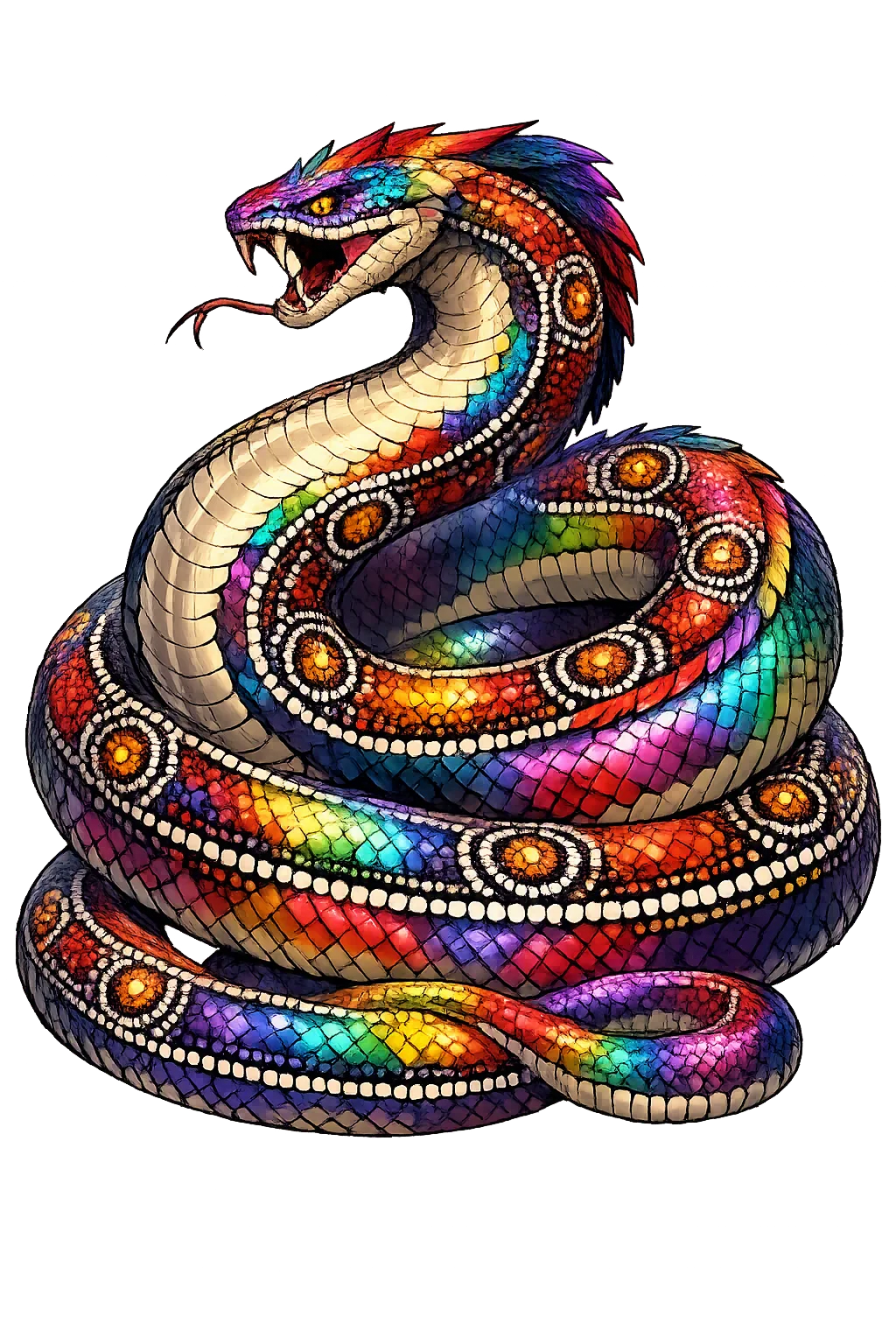
Ngalyod is the great Rainbow Serpent of the Kunwinjku-speaking peoples of western Arnhem Land. In the wet season she — or he, for gender shifts with country and ceremony — arcs across the sky as the rainbow; in the dry she sleeps beneath the earth in waterholes, springs, and rocky escarpments. She is not merely a weather spirit: she is a creator being who carved out the rivers, stocked them with fish and waterlilies, and laid down the law that still governs the relationship between people, country, and kin.

Ngalyod in Later Traditions

The Rainbow Serpent is one of the most widely distributed figures in Aboriginal Australia, yet it is not a single deity under many names. Each language group knows a distinct serpent with its own country, kinship, and ceremonies: Yurlungur in Yolŋu country, Wagyl in Noongar country, Julunggul among some north-eastern groups, and Ngalyod among the Kunwinjku. Anthropologists and art historians have long debated whether these figures share a common origin or whether the rainbow-serpent concept is a convergence of regional powers onto a similar natural sign. What is clear is that Ngalyod must be understood on Kunwinjku terms first, before any wider comparison is attempted.

Modern Legacy

Ngalyod survives most visibly in the x-ray rock art of western Arnhem Land, where the serpent is painted with internal organs, ribs, and backbone showing — a visual convention that identifies the figure as both animal and ancestor. These galleries, some thousands of years old, are now part of a living heritage managed by traditional owners in partnership with archaeologists and park authorities. In contemporary Australia the Rainbow Serpent has also become a national symbol of Indigenous ecological knowledge, appearing in public art, children's books, and environmental education. That wider fame brings a risk: the specific clan-owned meanings of Ngalyod can be flattened into a generic 'Aboriginal' icon. The restoration of the Kunwinjku name is a small act of precision against that flattening.

Unicode Restoration as Cultural Act

Restoring Ngalyod in a domain name is more than orthographic accuracy. It is a statement that the internet should recognize the full range of human writing — not only the ASCII keyboard.

05

Frequently Asked Questions

Common questions about Ngalyod, Rainbow Serpent, and Unicode restoration

01How do you pronounce Ngalyod?

In reconstructed pronunciation, Ngalyod is /ˈŋa.ljɔd/ — approximately 'NGAL-yod' — start with the 'ng' of 'sing' followed by 'al', then a light 'yod' rhyming roughly with 'yod' in Hebrew scholarship..

02What does Ngalyod mean?

Ngalyod means The rainbow in the aboriginal tradition.

03What are the symbols of Ngalyod?

Ngalyod is associated with Rainbow (The serpent's visible body arching across the sky after rain), Waterhole (The resting place and dwelling of Ngalyod in the dry season), Stone spear-points (Sacred objects sometimes identified as the serpent's teeth or gifts), Lightning (The flash that accompanies the serpent's movement and the breaking of wet-season storms).

04Why restore Ngalyod in Unicode?

Plain ASCII ngalyod strips the stress, length, and script that make the name specific. Unicode restoration returns the name to its original written dignity.

05What is the most important myth about Ngalyod?

In the Dreaming, Ngalyod travelled across a flat and featureless land. Where she raised her body, ridges and escarpments rose; where she lay down, waterholes and rivers formed. Her tracks are the deep channels that still carry floodwater in the wet. Every permanent waterhole is remembered as a place where the serpent paused, and each is owned and cared for by the clan whose ancestors witnessed her passage.

06

Scholarly Sources

The philological foundations of this restoration

Every claim on this page is grounded in established scholarship. The orthographic restorations follow disciplinary convention. The etymological chain follows the best available reference works. This is not invention — it is resurrection through scholarship.

Lexicography & Philology

  • AIATSIS
  • Berndt

Primary Texts

  • Primary sources in the aboriginal tradition for Ngalyod.

Archaeology & Art History

  • Material evidence — iconography, inscriptions, and temple archaeology — for Ngalyod and related cults.
  • The primary material witnesses to Ngalyod are the rock-art galleries of western Arnhem Land, notably at sites such as Ubirr, Nourlangie, and the Arnhem Land plateau, where Rainbow Serpent figures appear in both naturalistic and x-ray styles across millennia of painting. Excavated occupation deposits, stone tool scatters, and fish-trap complexes document the long-term human use of the waterholes and wetlands associated with the serpent. These places remain under the custodianship of their traditional-owner clans; access and reproduction of designs are regulated by Indigenous cultural authority.

Religious Studies

  • Berndt, Ronald M. and Catherine H. Berndt, The Speaking Land: Myth and Story in Aboriginal Australia, Penguin, 1989
  • Berndt, Ronald M., Kunwinjku (Gunwinggu) religious texts and field recordings, AIATSIS
  • AIATSIS (Australian Institute of Aboriginal and Torres Strait Islander Studies), subject guides and language resources
  • Taylor, Luke, 'Seeing the Inside: Bark Painting in Western Arnhem Land', Clarendon Press, 1996
  • Chaloupka, George, 'Journey in Time: The World's Longest Continuing Art Tradition', Reed Books, 1993
Return

The Surface Awaits

You have traced the name from its earliest attestation to its Unicode restoration. Now return to the myth. The story is where the name lives.

Back to Lore
Ngalyod mascot