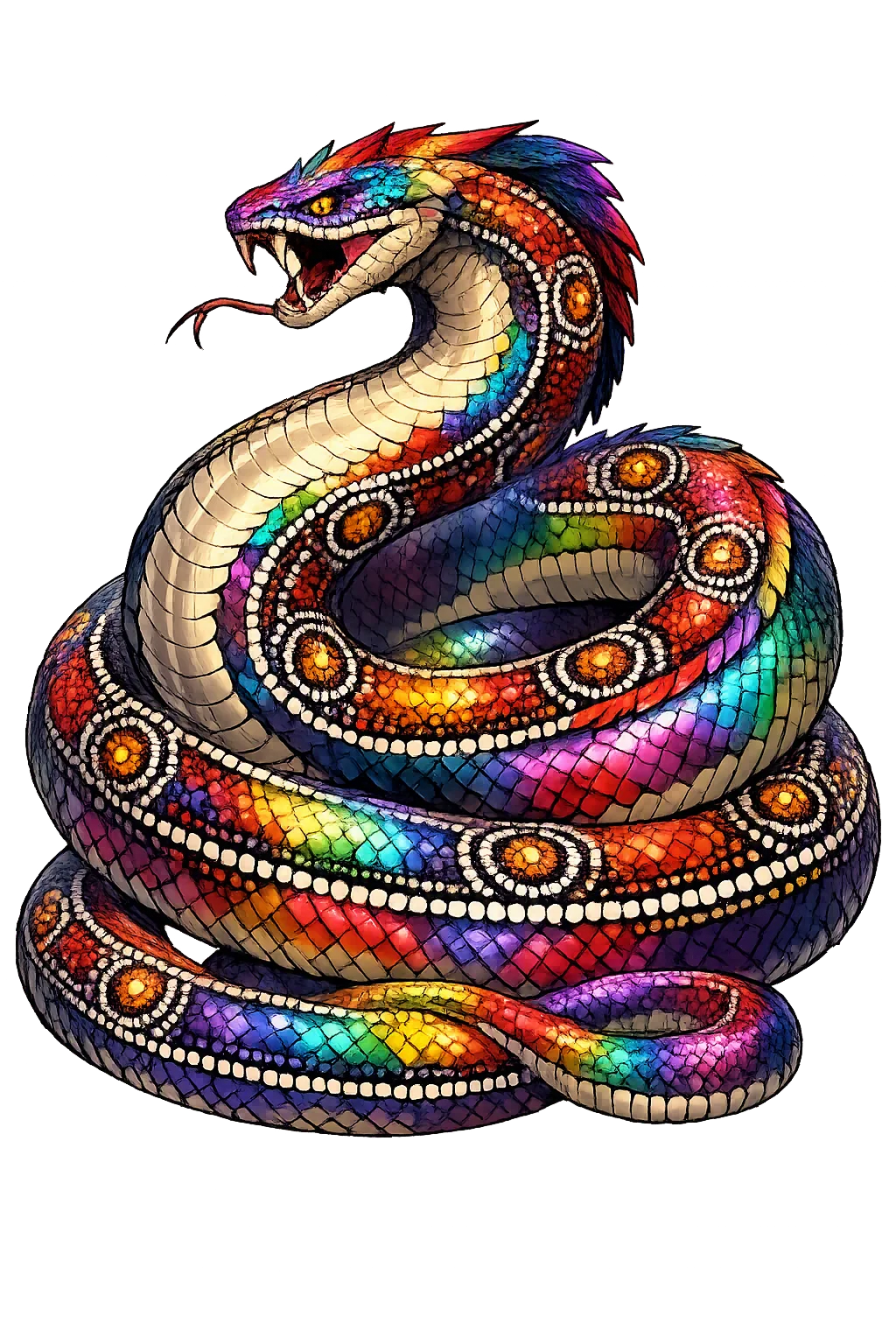
Stories of Ngalyod
Ngalyod's stories are told in rock art galleries, song cycles, and ceremonial narratives across western Arnhem Land. The serpent is not a single fixed character but a continuum of powers: creator, law-giver, healer, and avenger. The myths explain why certain waterholes never dry, why the wet season returns, and why human beings must respect the boundaries between clans and countries.
In the Dreaming, Ngalyod travelled across a flat and featureless land. Where she raised her body, ridges and escarpments rose; where she lay down, waterholes and rivers formed. Her tracks are the deep channels that still carry floodwater in the wet; her resting places are the spring-fed waterholes that never run dry, and every one of them is remembered as a place where the serpent paused. Each such waterhole is owned and cared for by the clan whose ancestors witnessed her passage, and the right to paint the serpent's story or sing its country belongs to that clan alone. The creation is thus also a map of title: the landscape is the deed, and the myth is the conveyance. To tell where Ngalyod travelled is to say, precisely, who owns which water.
Ngalyod divided the people into the two great moieties — Dhuwa and Yirritja in the regional terminology — the two halves of society whose rules of marriage, ceremony, and land ownership still structure Kunwinjku social life. Every person, place, species, and ancestral being belongs to one moiety or the other; a Dhuwa person marries a Yirritja person, and the serpent's body itself is apportioned between them in the stories. The serpent's law is not written down; it is sung, painted, and enacted in ceremony, and the moiety system it founded is less a rule-book than a grammar — a way of knowing, from any single thing, what it may be joined to. To break it is to disturb the balance of country and to invite illness, accident, or the withdrawal of the waters.
When the first storms build over the Arnhem Land plateau, elders say that Ngalyod is moving from one waterhole to another. The rainbow is her body seen between earth and sky; the thunder is her voice; and the first floodwaters running down the escarpment are the proof that she has taken up residence in the pools for another year. The arrival of the wet season is therefore not only a meteorological event but a ceremonial one, requiring the songs and restrictions that announce the serpent's presence — and the dry season's shrinking billabongs are read the same way, as the serpent settling down. The myth is a complete weather lore: it predicts, explains, and prescribes the behaviour owed to the sky's most beautiful and most dangerous visitor.
A widely recorded story tells of a boy who mocked or wounded Ngalyod — laughing at the rainbow arched over a forbidden waterhole, in some versions spearing into the pool where the serpent lay. In retaliation the serpent rose from the water, swallowed him, and carried him underground through the water system itself, through channels no living person has walked, releasing him far from his own country — or, in the versions told around particular landmarks, transforming him into a rock or stone country that marks the boundary of the serpent's domain. The details shift from teller to teller and from country to country, as they should: the story is attached to real waterholes, and each clan tells it of its own place. What does not shift is the teaching. Elders cite the tale when instructing children at the pools: approach with restraint, take only what you need, never mock what you do not understand. The serpent's anger is not arbitrary temper; it is the boundary of the sacred, patrolled.
Water, Law, Monsoon, and the Dreaming
Ngalyod is the great Rainbow Serpent of the Kunwinjku-speaking peoples of western Arnhem Land. In the wet season she — or he, for gender shifts with country and ceremony — arcs across the sky as the rainbow; in the dry she sleeps beneath the earth in waterholes, springs, and rocky escarpments. She is not merely a weather spirit: she is a creator being who carved out the rivers, stocked them with fish and waterlilies, and laid down the law that still governs the relationship between people, country, and kin.
Ngalyod is the rainbow itself, the visible sign of the serpent moving between waterholes and bringing the rains that renew the land.
In the dry season Ngalyod rests in permanent waterholes; to disturb or pollute those places is to risk the serpent's anger.
The Rainbow Serpent established moiety, marriage rules, and the ceremonial obligations that bind clans to country.
Ngalyod created the fish, waterlilies, and other foods of the wetlands; her body shaped the country people still live from.
From the original script to the living URL
Ngalyod
The name survives in scholarly transliteration. Ngalyod is the standard Aboriginal romanisation, documented in academic sources — “The rainbow”. Because the spelling uses only Latin letters, the form is the same in both ASCII and Unicode.
No indigenous writing system is securely attested for individual aboriginal names. The form shown is a modern scholarly transliteration.
ngalyod
The plain ngalyod form is identical to the Unicode restoration. Because this name is already written in Latin letters, no diacritics, stress, or script information were lost — only capitalization differs.
Ngalyod
The Unicode restoration does not need to recover lost marks for Ngalyod. Its value is canonical spelling and consistent cataloguing, not the reconstruction of erased orthography. The domain is readable as-is to both DNS and humanity.
Ngalyod.com
This restoration is written entirely in ASCII letters — no Punycode encoding stands between Ngalyod and the DNS. The domain reads identically to machines and to human eyes.
Owned, ideal, and ASCII forms of Ngalyod
Ngalyod
The full Unicode restoration. ngalyod.com is not in the PuniCodex collection — it is watched for release; if it drops, this temple upgrades to an owned flagship.
How Ngalyod was spoken
How Ngalyod is preserved in writing
No indigenous writing system is securely attested for individual aboriginal names. The form shown is a modern scholarly transliteration.
Contribute scholarly provenance →The lore you have read is the living myth. Extended Lore opens the scholarly vault beneath it: the cult and its material remains, a history of the image, the name after antiquity, a meditation on what the name still means, and the full scholarly apparatus — etymology, orthography, sources.
Enter Extended Lore