
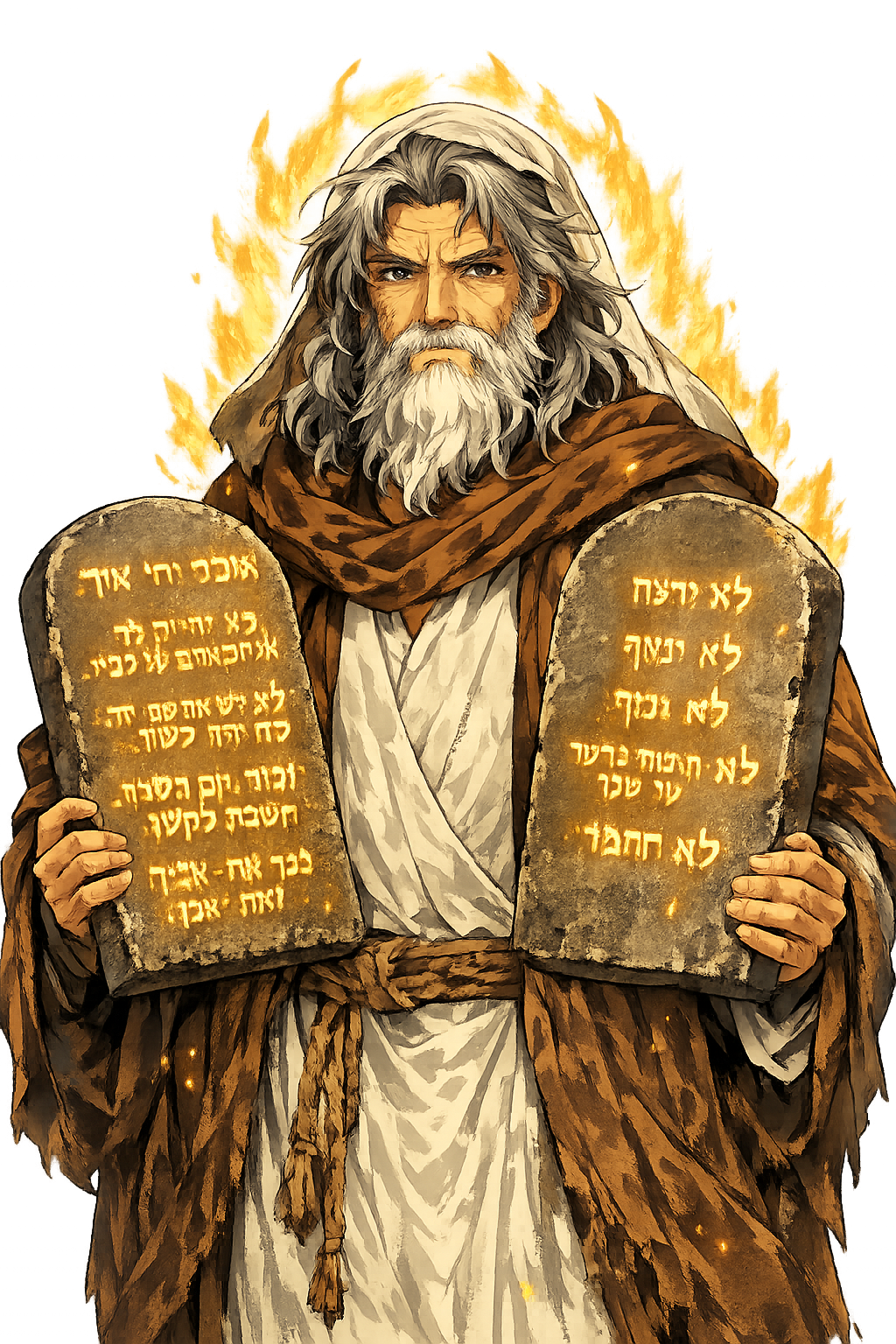
How Mōšeh was rebuilt, mark by mark
From the restoration bench — the working notes on Mōšeh, kept because the process is the proof.
What We Found
The attestation runs through the tradition's own sources: מֹשֶׁה. Meaning: "Hebrew prophet and lawgiver".
The figure behind the name: Moses’ story is not a single hero’s quest but a forty-year negotiation between a people and their god, with one reluctant man standing in the gap.
What the Name Carried In
The Child in the Basket. Born under Pharaoh’s edict of death — the Hebrew boys cast into the Nile — the infant is hidden by his mother in a papyrus basket daubed with bitumen, among the reeds where Pharaoh’s daughter comes to bathe. The child is discovered, adopted, and nursed, the Bible notes with quiet irony, by his own mother; and he is named Mōšeh, “because,” the princess says, “I drew him out of the water” (Exodus 2:10) — a pun on Hebrew māšâ, “to draw out.
The Reluctant Prophet. At Horeb, “the mountain of God,” Moses the fugitive shepherd turns aside to look at a bush that burns without being consumed, and from it a voice commissions him: go back to Egypt, and bring out my people. Moses objects five times (Exodus 3–4): Who am I?
A spelling that has to carry stories like these is not a label. It is equipment.
Where It Stood Before Us
No archaeological find names Moses directly, and the historicity of the Exodus remains debated. The Merneptah Stele (c. 1208 BCE) is the earliest extra-biblical reference to a people called Israel in Canaan. Excavations at Tel el-Dab'a (ancient Avaris) in the eastern Nile Delta reveal a large Semitic settlement during the Second Intermediate Period, though its connection to the Exodus narrative is contested. Proto-Sinaitic inscriptions from Serabit el-Khadim suggest early alphabetic writing in the Sinai mining region, a context compatible with later tradition. The search for Mount Sinai continues at several candidates, including Jebel Musa in the southern Sinai Peninsula and Jebel al-Lawz in northwest Arabia, but no consensus exists. The bench inherits all of it — the web temple is the newest site, not the first.
What We Kept
The evidence, mark by mark — 1 feature the keyboard form moses cannot hold:
- o → ō — Macron: long vowel. Kept.
What We Rejected
moses as the primary form. It survives as the convenience it is; it does not get to lead. The hierarchy is full restoration first, and this name can afford to stand at the top of it.
What We Set Down
Mōšeh — What survives here cannot be shown in ASCII: a feature of the original that the fallback alphabet flattens. That is the Tier-1 test, and this name passes it without argument.
For the voice: 'moh-SHEH' — the first vowel is long and steady like 'mow'; the second syllable is short and crisp, ending in a soft breath.
The temple stands at /moses/ — the notes above are public in its Scholarly Edition, sources and all.
At a Glance
- Restored name: Mōšeh
- ASCII form: moses
- Meaning: "Hebrew prophet and lawgiver"
- Domain of influence: Prophet, Lawgiver
- Pantheon: Canaanite
- Classification: Tier 1
- Original script: מֹשֶׁה
- Series: The Restoration Files, No. 321 of 546
The File Continues
The temple's founding dispatch tells the name's story; its Resonance File reads the myths into the industries; the blog index holds the whole archive.
Continue the series — previous file: Morana (read it here) · next file: Mūt (read it here).
The Restoration Files are written from the same canonical record as the temples themselves: the lexicon, the lore catalog, the pattern atlas, and the cited scholarly sources. If a file ever disagrees with its temple, the temple is right — tell us, and the file will be corrected.