
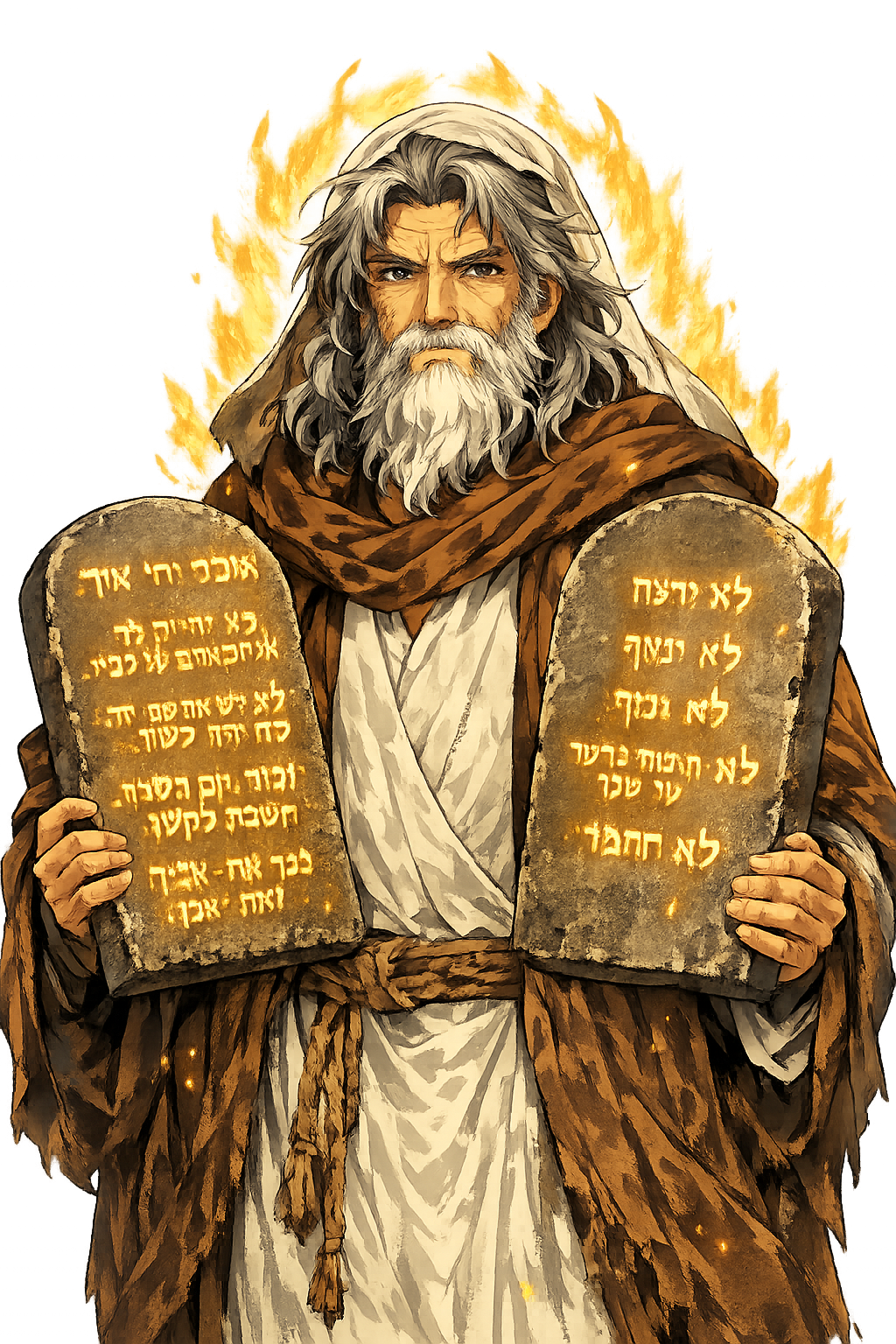
The appointments Mōšeh made — and who is keeping them
One myth is a story. A cycle of myths is a specification. Read Mōšeh's cycle in order and the industries fall out of it one by one.
At a Glance
- Temple: Mōšeh
- Pantheon: Canaanite
- Domain of influence: Prophet, Lawgiver
- Pattern seats: 4
- Sectors touched: Society & Spirit · Commerce & Governance · Culture & Entertainment
- Strongest seat: Faith & Spiritual Organizations
- Series: The Resonance Files, No. 321 of 546
The Cycle, Read Forward
Faith & Spiritual Organizations — through The Child in the Basket
Born under Pharaoh’s edict of death — the Hebrew boys cast into the Nile — the infant is hidden by his mother in a papyrus basket daubed with bitumen, among the reeds where Pharaoh’s daughter comes to bathe. The child is discovered, adopted, and nursed, the Bible notes with quiet irony, by his own mother; and he is named Mōšeh, “because,” the princess says, “I drew him out of the water” (Exodus 2:10) — a pun on Hebrew māšâ, “to draw out.
The atlas states the seat in one line: The prophet and lawgiver of the Exodus; the covenant he carried down the mountain still anchors three living faiths. The story above is the long version of the same sentence. The trade thinks it is optimizing a process. It is re-enacting a charter.
Leadership, Governance & Public Administration — through The Reluctant Prophet
At Horeb, “the mountain of God,” Moses the fugitive shepherd turns aside to look at a bush that burns without being consumed, and from it a voice commissions him: go back to Egypt, and bring out my people. Moses objects five times (Exodus 3–4): Who am I?
The atlas states the seat in one line: The liberator who led a nation out of bondage; forty years of statecraft without a crown. The story above is the long version of the same sentence. That is the cycle working: story becomes duty, duty becomes trade.
Legal, Justice & Compliance — through Plagues and Sea
Before Pharaoh, Moses and Aaron announce ten blows that fall on Egypt’s land, gods, and economy in escalating order: the Nile to blood, frogs, gnats, flies, pestilence on the livestock, boils, hail, locusts, darkness, and finally the death of the firstborn (Exodus 7–14). The plagues read as a staged dismantling of Egypt — its water, its fertility gods, its sun — while Pharaoh’s hardening heart demonstrates, chapter by chapter, what it costs a ruler to mistake stubbornness for strength.
The atlas states the seat in one line: The lawgiver; the tablets still anchor jurisprudence. The story above is the long version of the same sentence. Industries do not invent their archetypes; they inherit them and call them best practice.
Writing, Publishing & Media — through Sinai and the Broken Tablets
At Mount Sinai, three months after the sea, the people encamp before the mountain wrapped in cloud, thunder, and trumpet-blast; Moses alone is summoned into the smoke. He speaks with God “face to face, as one speaks to a friend” (Exodus 33:11) — an intimacy granted to no other prophet — and receives the stone tablets of the covenant, carved by the finger of God.
The atlas states the seat in one line: The traditional author of the Torah; the five books behind Western publishing’s longest-running title. The story above is the long version of the same sentence. The trade thinks it is optimizing a process. It is re-enacting a charter.
The Theme That Runs the Cycle
Moses’ story is not a single hero’s quest but a forty-year negotiation between a people and their god, with one reluctant man standing in the gap. Every episode tests whether liberation can become responsibility — and whether a stammering mediator can hold both sides to a covenant neither fully keeps.
The Method, Stated Plainly
The atlas is not a horoscope. Seats are earned from the sources — argued, weighted, published — and every one of them can be challenged at the methodology page. A match that cannot survive an argument does not survive review. That is the whole trick: the patterns are claims, and claims can be tested.
For the Ones Who Work There
If you work in faith & spiritual organizations, leadership, governance & public administration, or any trade this temple holds a seat in, this is the honest version of what a placement means: your industry beside the story it has been re-telling all along — on the temple floor itself, before an audience that came specifically to read it. The patron tier and the advertising terms describe the mechanics; the resonance above describes the fit.
The File Continues
One of 546 Resonance Files — the series where the pantheon goes to work. Read the founding dispatch for the name, the Restoration File for the spelling, or the whole archive end to end.
Continue the series — previous: Morana (read it) · next: Mūt (read it).
The Resonance Files are argued from the same canonical record as the pattern atlas itself: the lexicon, the lore catalog, and the cited sources. Every seat can be challenged at the methodology page — and the challenge is the point.