
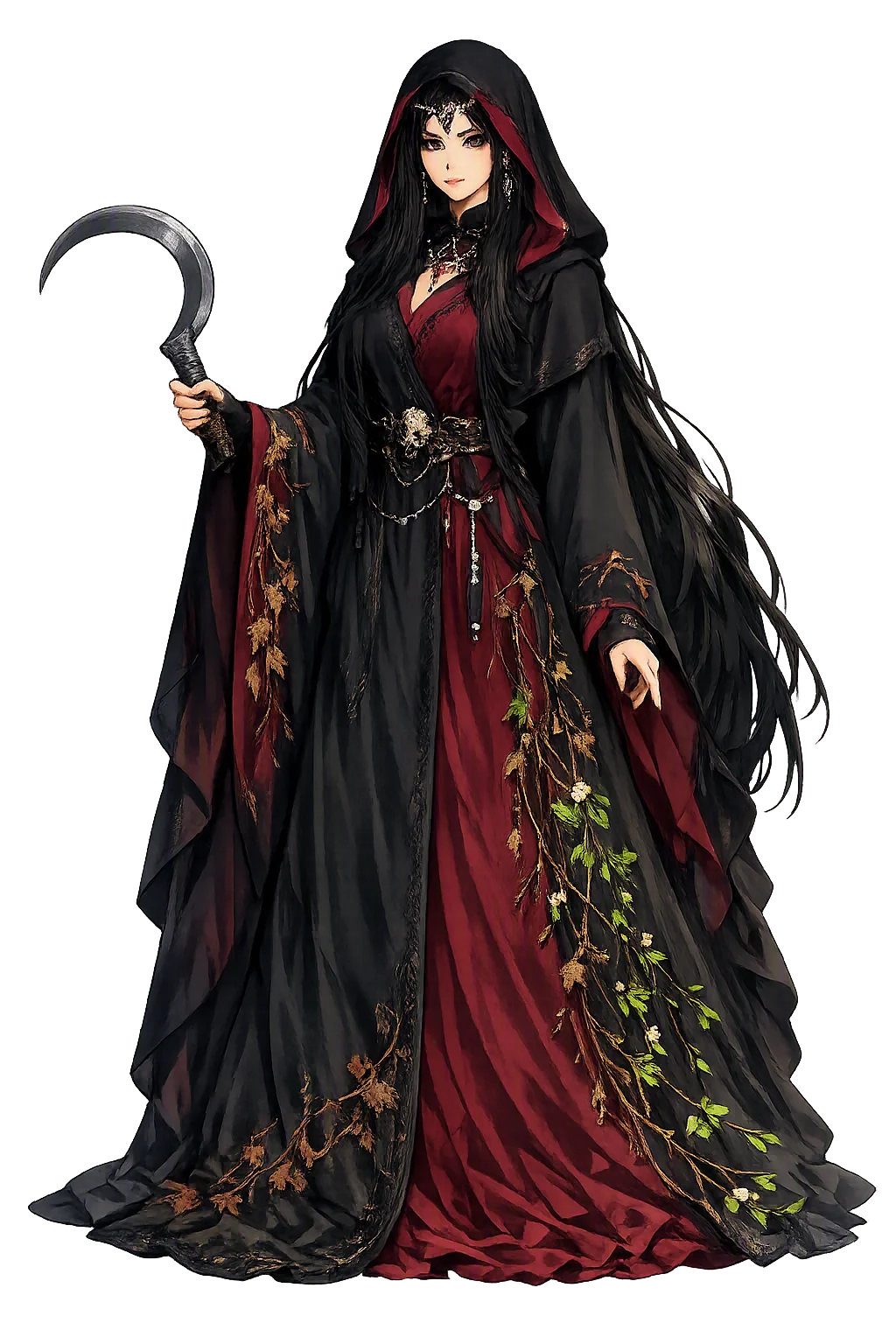
Morana: the stories first, then the spelling
You cannot weigh an accent without knowing what it carries. Here is what Morana has been carrying.
The Stories That Carry the Name
A Goddess between the Lines. Morana reaches us obliquely, through the margins of other people's books. Her earliest written trace is a fifteenth-century Latin–Polish school glossary, the so-called Medulla Grammatice, where the Latin word mors — 'death' — is glossed with the Polish morana; schoolboys were being taught the goddess's name as the plain word for dying. Sixteenth-century writers then describe the rite itself: Marcin Siennik complains of peasants who fashion a straw woman at winter's end and drown or burn her in the name of Marzanna, and Maciej Stryjkowski's chronicle records the custom in the villages of Mazovia.
The Drowning of Marzanna. On the fourth Sunday of Lent — or on the spring equinox in the older reckoning — the village takes a figure of straw and rags dressed as a woman and carries it in procession to the riverbank: Morana's Polish ritual self, Marzanna. The girls who carry her sing farewells to winter; then the effigy is doused with water, drowned, and often burned where it lies. Her Moravian and Slovak cousins carry the Morena doll out on 30 April and throw it into the stream while the children cry that Morena should carry winter out of the village with her.
The Bride of Winter and the God of Spring. Modern scholarship has tried to give Morana the love-story the medieval sources never recorded. The Indo-Europeanists Vyacheslav Ivanov and Vladimir Toporov reconstructed a full seasonal cycle: Morana, winter's queen, is wooed and wed in spring by the vegetative god Jarilo; he abandons or dies with the autumn, she murders him in revenge, and the world freezes in her grief until the returning sun avenges him in spring. The reconstruction rests on comparative folklore and seasonal rite rather than on any surviving Slavic epic, and specialists debate its every stage — but it has been embraced by Slavic Rodnovery communities, for whom the wedding, betrayal, and killing of Morana and Jarilo form the turning myth of the liturgical year.
And Here Is What the Spelling Preserves
At a Glance
- Restored name: Morana
- ASCII form: morana
- Meaning: "Death"
- Domain of influence: Winter, Death
- Pantheon: Slavic
- Classification: Tier 2
- Original script: —
- Series: The Restoration Files, No. 322 of 548
The Name Travels
Living between Catholic Poland and Orthodox Russia, Morana was reinterpreted by every regime that met her. The medieval Church read the drowned effigy as a Lenten allegory of sin drowned in baptismal water and tolerated the rite once it was moved onto the fourth Sunday of Lent; Reformation-era moralists simply condemned it.
The Address It Earned
The temple of Morana stands at /morana/ — lore, scholars, patterns — because a name carrying this much story deserves more than a parking page. Tier-2 here means one preserved truth — not less important, just singular. The temple shows it and names it.
The File Continues
Read the founding dispatch for the name's full story, the Resonance File for the archetype at work — or the whole archive in one sitting.
Continue the series — previous file: Monókerōs (read it here) · next file: Mōšeh (read it here).
The Restoration Files are written from the same canonical record as the temples themselves: the lexicon, the lore catalog, the pattern atlas, and the cited scholarly sources. If a file ever disagrees with its temple, the temple is right — tell us, and the file will be corrected.