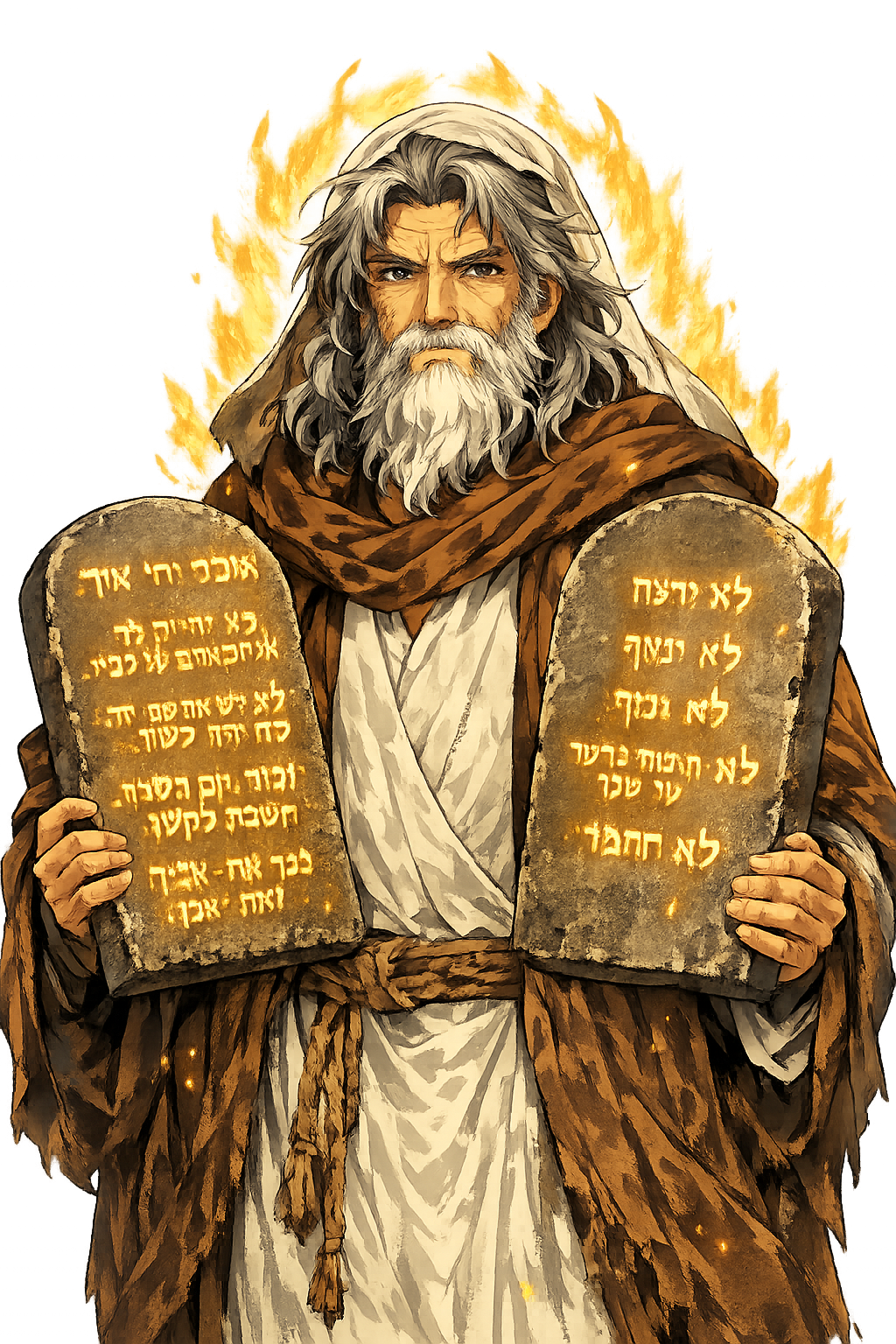
Stories of Mōšeh
Moses’ story is not a single hero’s quest but a forty-year negotiation between a people and their god, with one reluctant man standing in the gap. Every episode tests whether liberation can become responsibility — and whether a stammering mediator can hold both sides to a covenant neither fully keeps.
Born under Pharaoh’s edict of death — the Hebrew boys cast into the Nile — the infant is hidden by his mother in a papyrus basket daubed with bitumen, among the reeds where Pharaoh’s daughter comes to bathe. The child is discovered, adopted, and nursed, the Bible notes with quiet irony, by his own mother; and he is named Mōšeh, “because,” the princess says, “I drew him out of the water” (Exodus 2:10) — a pun on Hebrew māšâ, “to draw out.” Egyptologists have long heard a second pun beneath the first: -mose, “born of (a god),” is one of the most common name-elements of the New Kingdom, borne by rulers such as Thutmose and Ramesses. The double etymology is the whole story in miniature: a child of Hebrew slaves named in Egyptian, drawn from the river that was meant to kill him, and raised in the very palace whose order condemned him. His career will be built from such reversals — the weak instrument confounding the strong.
At Horeb, “the mountain of God,” Moses the fugitive shepherd turns aside to look at a bush that burns without being consumed, and from it a voice commissions him: go back to Egypt, and bring out my people. Moses objects five times (Exodus 3–4): Who am I? What is your name? What if they do not believe me? I am slow of speech. Please send someone else. Each objection is answered — the name given is “I am who I am”; the staff that becomes a serpent, the hand turned leprous and clean, and water become blood are given as signs; Aaron is appointed spokesman. The scene establishes the biblical type of the unwilling prophet: God’s chosen instrument is chosen precisely in his inadequacy, so that the power on display will not be mistaken for his own. It also fixes the book’s theology of the name — a deity who refuses a handle, yet binds himself to a promise, and to a man who asked him not to send him.
Before Pharaoh, Moses and Aaron announce ten blows that fall on Egypt’s land, gods, and economy in escalating order: the Nile to blood, frogs, gnats, flies, pestilence on the livestock, boils, hail, locusts, darkness, and finally the death of the firstborn (Exodus 7–14). The plagues read as a staged dismantling of Egypt — its water, its fertility gods, its sun — while Pharaoh’s hardening heart demonstrates, chapter by chapter, what it costs a ruler to mistake stubbornness for strength. The climax comes at the Sea of Reeds: with the Egyptian chariots behind and the water ahead, Moses stretches out his staff, “and the waters were divided,” the people crossing on dry ground between walls of sea; when the pursuers follow, the waters return. The event becomes Israel’s founding memory — rehearsed in the Psalms, the prophets, and every Passover seder since: a people defined not by conquest but by having been brought through an impossibility, and commanded to remember it as if they themselves had crossed.
At Mount Sinai, three months after the sea, the people encamp before the mountain wrapped in cloud, thunder, and trumpet-blast; Moses alone is summoned into the smoke. He speaks with God “face to face, as one speaks to a friend” (Exodus 33:11) — an intimacy granted to no other prophet — and receives the stone tablets of the covenant, carved by the finger of God. But while he lingers forty days on the height, the people below melt their gold into a calf; descending, Moses sees the revelry and shatters the tablets at the foot of the mountain, grinds the idol to powder, and makes Israel drink it. Then — the Bible’s most startling portrait of a mediator — he climbs back up and argues God out of annihilating the nation: “Why should the Egyptians say it was with evil intent that you brought them out?” A second set of tablets is cut, and the covenant survives — but only because its mediator was willing to stand, bodily, in the gap between a holy God and an unfaithful people.
The wilderness decades test everything Sinai established. At the border of Canaan the spies’ report panics the people; Moses intercedes again, and that generation is sentenced to die in the desert — Moses among them, for a reason stated twice and never softened: at Meribah, at Kadesh, he struck the rock in anger when God had told him to speak to it (Numbers 20). “Because you did not trust in me enough to honour me as holy,” he is told, “you will not bring this assembly into the land” (Numbers 20:12). The man who argued kings and God out of verdicts cannot argue his way past this one. From Mount Nebo, at a hundred and twenty years, he is shown the whole land — Gilead to the western sea — and dies there alone, buried by God in a grave no one has found (Deuteronomy 34). The Torah’s verdict is that no prophet like him ever rose again — and its last portrait is of a leader whose exclusion becomes his deepest instruction: the promise outlives the man who carries it.
Prophet, Liberator, Lawgiver
Mōšeh is the prophet who stammers before Pharaoh and then speaks the world into law. Born into slavery, raised in a palace, exiled to the wilderness, he becomes the hinge on which Israel turns from a people of laborers into a people of covenant — arguing with kings, with clouds, and with God himself at every turn.
On Horeb, a bush burns without being consumed and a voice names itself 'I am who I am'; Moses hides his face and accepts a commission he does not want (Exodus 3).
His shepherd's staff becomes a serpent, splits the sea, and strikes the rock — the tool of a man who turns ordinary matter into divine sign.
At Sinai he ascends into cloud and fire to receive the law — twice, after shattering the first tablets in rage at the golden calf (Exodus 19–24; 32).
When Israel rebels or the covenant breaks, Moses stands in the gap, pleading with YHWH to remember mercy rather than justice (Exodus 32; Numbers 14).
From the original script to the living URL
מֹשֶׁה
The name in its original Canaanite form. Mōšeh (מֹשֶׁה) is attested in the source tradition — “Hebrew prophet and lawgiver”. Its macron-length vowels carry the full phonetic and orthographic weight of the source tradition.
moses
Reduced to plain moses, the name loses everything that made it specific: macron-length vowels. What remains is an ASCII string that machines can parse but that no longer speaks with its original voice.
Mōšeh
The Unicode restoration recovers what ASCII flattened. Mōšeh restores macron-length vowels, returning the name to its original written dignity. The domain encodes to Punycode, but the browser displays the truth.
Mōšeh.com → xn--meh-qxa4h.com
The non-ASCII characters in Mōšeh are encoded while the ASCII remains visible. To the DNS, it is Punycode. To humanity, it is Mōšeh.
Owned, ideal, and ASCII forms of Mōšeh
Mōšeh
Restores מֹשֶׁה. The live temple domain — mōšeh.com.
moses
Flattens מֹשֶׁה. The plain ASCII fallback — what DNS and legacy systems see.
How Mōšeh was spoken
How Mōšeh travels from ancient script to the modern URL
Hebrew Mōšeh; the etymology is uncertain; the biblical explanation links it with māšâ “to draw out" (from the water).
Prophet, Lawgiver
The Unicode restoration Mōšeh uses registrable Latin diacritics; the Ugaritic form is not registrable in .com.
The lore you have read is the living myth. Extended Lore opens the scholarly vault beneath it: the cult and its material remains, a history of the image, the name after antiquity, a meditation on what the name still means, and the full scholarly apparatus — etymology, orthography, sources.
Enter Extended Lore