PuniCodex

Extended Lore

摩利支天 Marishiten

Etymology · Orthography · Cult · Iconography · Reception · Sources

Tier 2 Marishiten
Marishiten — War, Invisibility, Sun
01

Quick Facts

Essential information about Marishiten, War, Invisibility, Sun

Original Script摩利支天
Unicode RestorationMarishiten
Reconstructed Pronunciation/ma.ɾi.ɕi.teɴ/
PantheonJapanese
DomainWar, Invisibility, Sun
MeaningMarici in Japanese
ClassificationTier 2
Primary DomainMarishiten
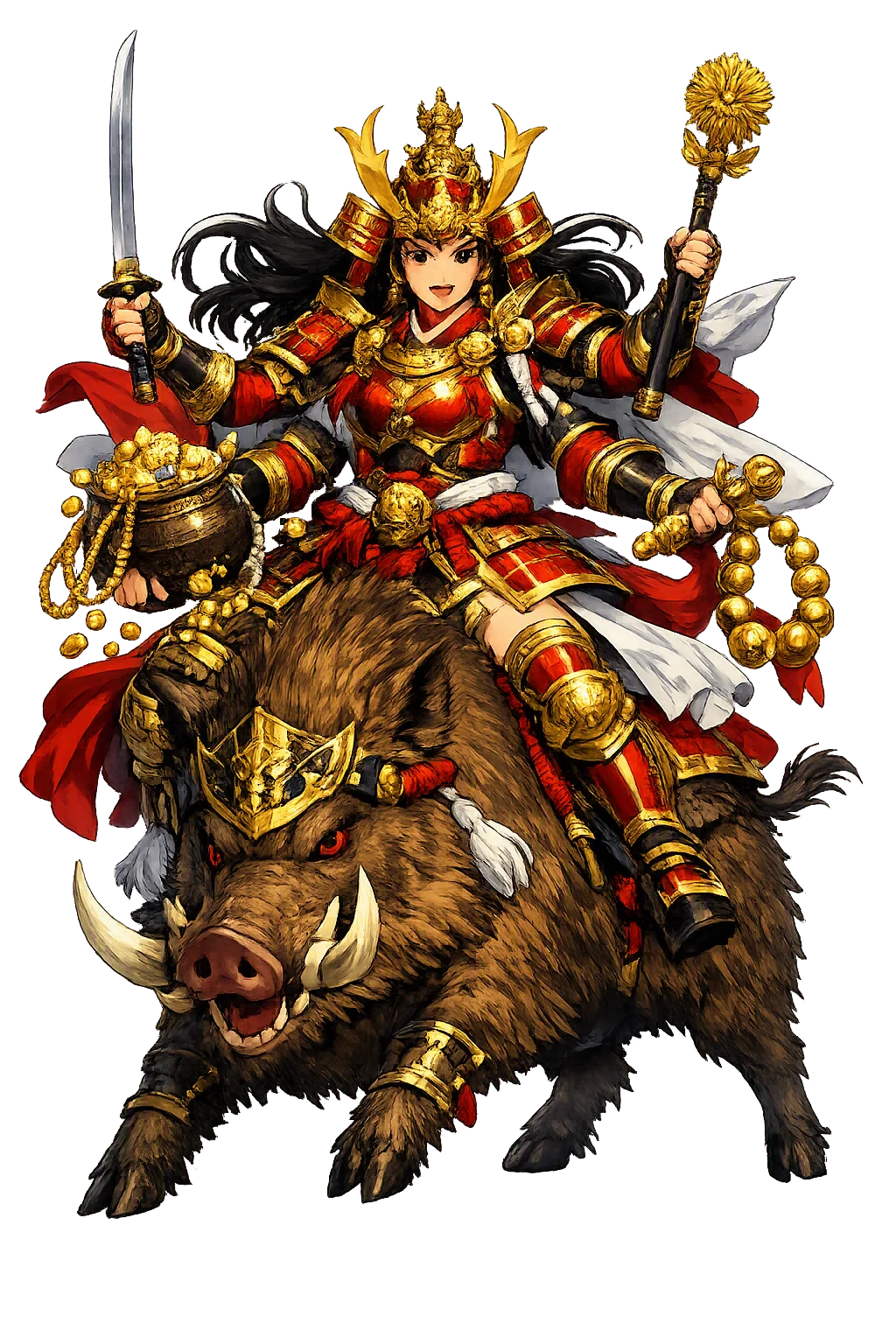
Sacred SymbolsBoar, Sun chariot, Weapons, Multiple arms
02

Etymology & Word Family

From original script to Unicode restoration

Original Script 摩利支天 Marishiten — "Marici in Japanese"
Unicode Restoration Marishiten Canonical scholarly spelling — ASCII-identical
Modern ASCII marishiten Plain-ASCII fallback

The name Marishiten reaches the modern world through scholarly transliteration of the japanese tradition. Because the conventional spelling uses only Latin letters, its Unicode and ASCII forms coincide — the tradition it carries is in the name itself, not in diacritics.

03

Unicode Character Breakdown

Character-by-character philological analysis

CharacterUnicodeNameBlockPhonetic Role
MU+004DLatin Capital Letter MBasic LatinSame, capitalized
aU+0061Latin Small Letter ABasic LatinSame
rU+0072Latin Small Letter RBasic LatinSame
iU+0069Latin Small Letter IBasic LatinSame
sU+0073Latin Small Letter SBasic LatinSame
hU+0068Latin Small Letter HBasic LatinSame
iU+0069Latin Small Letter IBasic LatinSame
tU+0074Latin Small Letter TBasic LatinSame
eU+0065Latin Small Letter EBasic LatinSame
nU+006ELatin Small Letter NBasic LatinSame

The Tier 2 classification here reflects fidelity to the attested tradition, not recovered diacritics: every character of Marishiten already survives in ASCII. What the restoration preserves is the canonical spelling itself — the form scholarship standardised.

04

Cult & Worship

How the sacred was kept — rites, sanctuaries, remains

The Cult

Marishiten's cult flourished within Japanese esoteric Buddhism, where warrior-aristocrats and later samurai households commissioned rites for invisibility, victory, and escape from battlefield harm. The Besson zakki (twelfth century) codifies her mudrās, mantras, and mandala placements, and her liturgies were transmitted in Shingon and Tendai lineages. Shugendō mountain ascetics adopted her as a solar protectress, weaving her into fire-walking and peak-entry rituals. Individual devotees wore amulets and copied her dhāraṇī; in the early modern period, military manuals and martial-ryū scrolls preserved her invocations alongside swordsmanship lore. No mass pilgrimage circuit formed around her, but her protective cult remained strong in temple treasuries and warrior households.

In the Earth

Marishiten's material record is the record of Japanese esoteric Buddhism. Multi-armed, boar-riding images in bronze, dry lacquer, and wood, and scroll paintings of her chariot, survive from the Heian period onward, prescribed by the iconographic manual Besson zakki (twelfth century) and preserved in temple treasuries of the Shingon and Tendai schools and in national collections; de Visser's Ancient Buddhism in Japan (1935) catalogues early examples and their cult settings. Edo-period confraternity paraphernalia — votive plaques, small gilt images, and Marishiten-kō registers — document her townspeople's following. No excavated sanctuary is exclusively hers; her archaeology is dispersed, like her devotees, across the altars of esoteric temples.

05

Iconography

How Marishiten was imaged across the ages

The Image

Marishiten is instantly recognizable in Japanese iconography: a multi-armed goddess riding a seven-headed boar, often holding solar discs, swords, bows, and arrows. The Besson zakki preserves the standard form, while painted mandala scrolls and wooden/lacquer sculptures in Shingon temple treasuries show regional and periodic variations. She shares visual DNA with the Indian Mārīcī and the Chinese Molizhitian, yet the boar vehicle and armor-clad ferocity became distinctively Japanese. Edo-period woodblock prints and martial manuals reproduced simplified versions of this image, ensuring that the boar-riding solar warrior survived as a martial emblem long after esoteric temple patronage declined.

06

Reception & Transformation

The name after its own age — transmission, translation, survival

Afterlives

Marishiten traveled from Indian Mārīcī to Chinese Molizhitian before lodging in Japanese esoteric Buddhism, a transmission carried by imported sūtras, iconographic manuals, and immigrant ritual specialists. In Japan she was first an imperial and aristocratic protectress, then a samurai deity, and finally a figure absorbed into Shugendō and folk practice. Her warrior associations kept her alive in Edo-period fencing schools and castle-cult manuals even as court Buddhism faded. Modern scholarship, above all de Visser's Ancient Buddhism in Japan and Miyake Hitoshi's work on Shugendō, reconstructed her ritual history. Today she survives primarily as a subject of art-historical and martial-arts research, her fierce iconography celebrated in museum exhibitions of esoteric Buddhist painting.

Identifications Across Traditions

Marishiten is a Buddhist figure assembled from several older identities. Her name and dawn office are Sanskrit, kin to the Vedic dawn goddess Uṣas; her chariot and solar imagery carry Taoist and Chinese star-lore, for the esoteric texts link her to the circumpolar stars that never set — the only lights that share her gift of never being caught. In Japan she overlaps with the Shinto sun kami: the deva of dawn bends easily toward Amaterasu, and some medieval commentators read her as the Buddhist face of the rising sun. Her boar vehicle ties her to the agricultural calendar and the zodiac year of the boar, and her warrior cult merged with Shugendō mountain asceticism, where protective spells are working tools. She is thus a layered deity — Indian ray, Chinese star, Japanese war-patron — and her history shows esoteric Buddhism operating exactly as designed: absorbing local powers and re-issuing them under a dhāraṇī.

Modern Legacy

Marishiten's cult is quieter than her reputation but it has never vanished. Esoteric temples of the Tendai and Shingon schools still keep her images among the tenbu protectors, and traditional martial arts — kyūdō above all, and some lines of swordsmanship — preserve her name in their ritual vocabulary and founding legends. In the Edo period her confraternities reached deep into townspeople's culture, and she was affectionately known as Marishiten-sama, the grandmother-like guardian of those who work by stealth. Modern Japan meets her mostly as a character: a solar warrior goddess in games, manga, and anime, where her multi-armed, boar-riding silhouette is instantly readable. For the historian of religion she remains the cleanest case study of a protective deity migrating from Indian liturgy to Chinese iconography to Japanese warrior culture — a ray of light that became a sword.

07

The Meditation

What Marishiten means — beyond the dictionary

Marishiten teaches that protection can take the form of light. To be invisible to harm is not to hide in darkness but to move in the dawn — seen by the divine, unseen by danger. She is the goddess of those who must face conflict with clarity: the soldier before the battle, the traveler before the pass, the accused before the judge.

Her deeper lesson concerns timing. The ray of light that precedes the sun cannot be opposed, because it announces what is already unstoppable; the warrior who moves with that timing shares its inevitability. In an age that worships visibility — the feed, the profile, the brand — Marishiten stands for the older excellence of being unperceived until the moment of action. Her temple honours the value of moving first, quietly, in the first light.

08

Frequently Asked Questions

Common questions about Marishiten, War, Invisibility, Sun, and Unicode restoration

01How do you pronounce Marishiten?

In reconstructed pronunciation, Marishiten is /ma.ɾi.ɕi.teɴ/ — approximately 'MAH-ree-shee-ten' — the 'r' is a light tap, and the final 'n' is soft.

02What does Marishiten mean?

Marishiten means Marici in Japanese in the japanese tradition.

03What are the symbols of Marishiten?

Marishiten is associated with Boar (Her vehicle and a symbol of courage and prosperity), Sun chariot (Her association with dawn and solar victory), Weapons (The bow, arrow, sword, and spear of the warrior goddess), Multiple arms (Her ability to act in many directions at once).

04Why restore Marishiten in Unicode?

Marishiten is written entirely in ASCII letters, so its restoration is about canonical fidelity rather than recovered diacritics: the temple fixes the name in its scholarly standard spelling, attested in the source tradition, instead of leaving it to drift.

05What is the most important myth about Marishiten?

“Mārīcī, the Ray Before the Sun” — the Buddhist origin story that anchors the mythology of Marishiten, told in full on the lore page.

09

Scholarly Sources

The philological foundations of this restoration

Every claim on this page is grounded in established scholarship. The orthographic restorations follow disciplinary convention. The etymological chain follows the best available reference works. This is not invention — it is resurrection through scholarship.

◈

Lexicography & Philology

  • Japanese Buddhism
  • Buddhist texts
◎

Primary Texts

◉

Archaeology & Art History

  • Material evidence — iconography, inscriptions, and temple archaeology — for Marishiten and related cults.
✦

Religious Studies

  • Taishō Shinshū Daizōkyō nos. 1254–1257 — the Mārīcī sūtras and dhāraṇī translations
  • Besson zakki (12th c. iconographic compendium) — the multi-armed, boar-riding form
  • de Visser, Ancient Buddhism in Japan, 2 vols (Brill, 1935) — early Japanese Marishiten images and cult
  • Miyake Hitoshi, Shugendō: Essays on the Structure of Japanese Folk Religion (University of Michigan, 1993)
  • Monier-Williams, A Sanskrit-English Dictionary, s.v. mārīcī
  • Bocking, A Popular Dictionary of Shinto
Return

The Surface Awaits

You have traced the name from its earliest attestation to its Unicode restoration. Now return to the myth. The story is where the name lives.

Back to Lore
Marishiten mascot